
The vegetable garden notebook / Vegetable garden calendar
The vegetable garden in October: planting garlic and preparing the beds
In October, decide the fate of each bed: keep crops in place, plant a suitable crop, or cover the freed soil. Variety and soil condition take precedence over the date.
Adapt this guidance to your garden’s climate and conditions.
This guide uses French examples and seasonal references. Adjust them to your garden’s climate and local conditions.
Three priorities this month
- Choose the location for garlic
Choose an autumn variety and a sunny site with well-drained soil.
- Prepare the protection your crops need
Check the needs of existing crops and keep shelters accessible for ventilation.
- Cover freed beds
Weed before applying healthy plant materials to the surface, on unfrozen soil.
Decide bed by bed
Start with crops at risk: if frost is approaching, bringing storage squashes under cover takes priority over sowing a new row. Then check whether the soil is workable; sowing and planting only come after these two decisions. The SNHF on Hortiquid advises harvesting squashes before frost.
Next, make a simple assessment: crops still present, freed spaces, planned location for garlic, and areas where water remains after rain. Consult local forecasts before choosing the day’s tasks.
If the soil is waterlogged, stay on the paths and postpone preparation. The RHS recommends not walking on waterlogged soil until it becomes workable to avoid compacting it further.
| Observed situation | Task to consider | Prerequisite condition |
|---|---|---|
| A space is available for garlic. | Plant an autumn variety. | Identify the variety and choose a sunny location with no standing water. |
| You are considering broad beans. | Check if an autumn sowing is suitable. | Be in a warm area of the Midi or South-West and verify the variety’s instructions. |
| Crops remain in place. | Prepare any protection they may need. | Check their sensitivity to the forecasted cold and the shelter’s ventilation possibilities. |
| A bed is freed with no new crop planned. | Cover the surface. | Weed and choose healthy materials; wait if the soil is frozen. |
Planting and covering conditions are detailed below. Use the table to plan your tasks; you do not need to complete every item during the month.
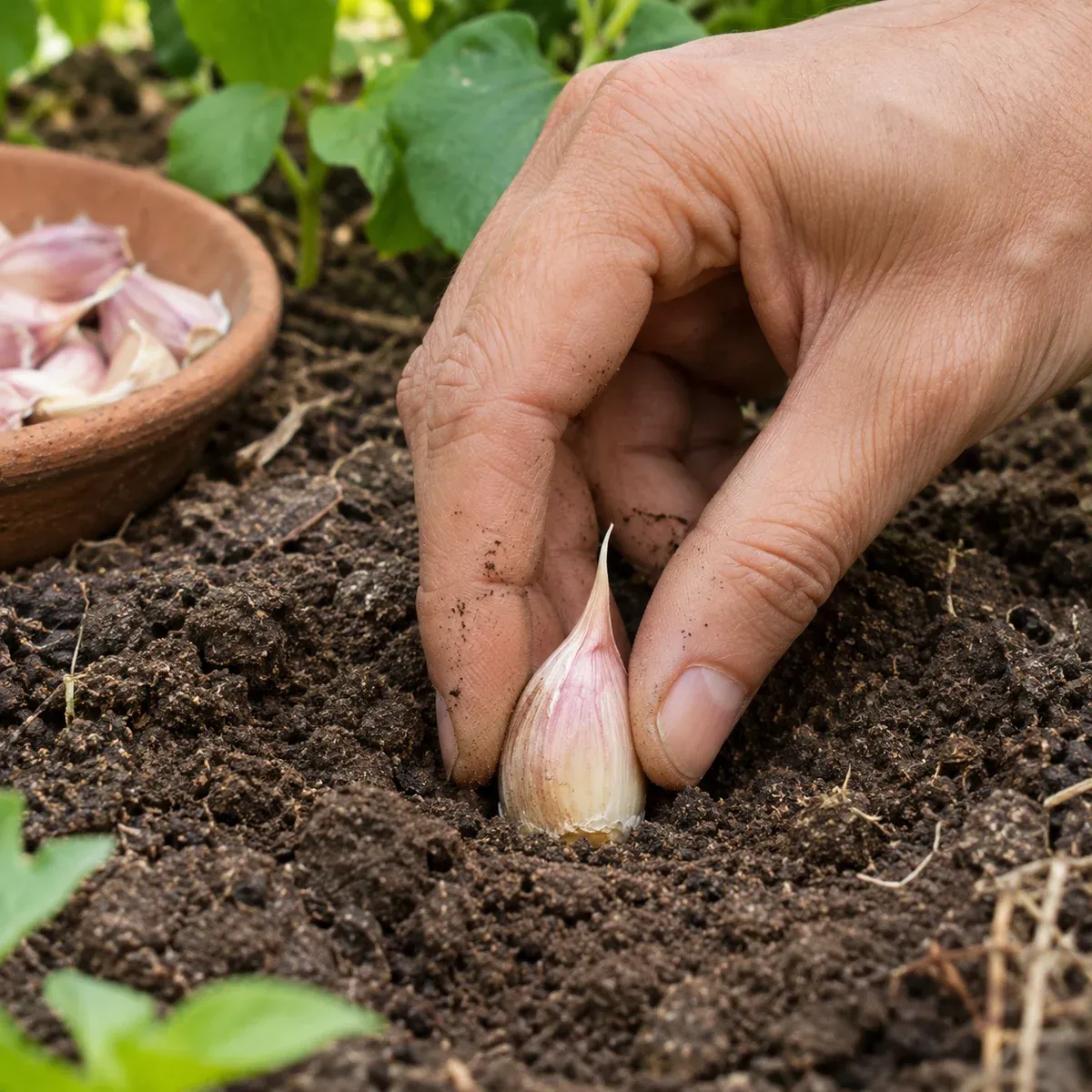
Plant autumn garlic if the soil is suitable
October falls within the period indicated by the SNHF for autumn white and purple garlic. However, verify the name and instructions for your variety before separating the cloves. Colour alone is not decisive: the PROSEMAIL and SEMAE leaflet distinguishes spring-planting pink garlic and pink varieties described as “alternatif”, which can also be planted in autumn or winter.
Choose a sunny spot and soil that does not retain water for long. The SNHF excludes heavy or poorly drained soils that remain damp in winter. If the intended location is waterlogged, postpone planting and reconsider the bed choice.
When the variety and soil are suitable, follow the steps in our garlic planting guide. Keep the label and note the date and location: you will be able to precisely identify what you planted.
Continue sowing only where suitable guidance supports it
Broad beans offer a well-defined possibility. The SNHF advises sowing from October in the warm regions of the Midi and South-West, and in early spring elsewhere. This guidance does not apply to all of France or all gardens in these regions.
Before sowing, verify that your variety is indicated for autumn and that your garden’s conditions match this timeframe. If in doubt, ask the supplier for guidance suited to your area. A packet whose period does not match your situation can wait: October does not require restarting a crop.
For other vegetables, start again with the variety, cultivation method, and local instructions instead of automatically extending the previous month’s sowings. Once you have confirmed this choice, the sowing guide helps you prepare the equipment and plan the care needed.
Harvest storage squashes before frost
If pumpkins or potimarron squash still occupy a bed, examine the fruits before freeing it. The SNHF’s response on Hortiquid considers a hardened skin and stem, along with fully developed colour, to assess maturity. Yellowing foliage is a supplementary indicator, not a harvest date in itself.
Allow ripening as long as the weather permits, but harvest before frosts. If possible, harvest in dry conditions, cut the stem without snapping the stalk off at the fruit, and handle the squash gently to avoid knocks. These precautions apply to squashes intended for storage; they do not describe harvesting young courgettes.
Prepare protection for crops kept in place
Identify the crops you wish to keep in place, then check their sensitivity to the forecasted cold. Prepare suitable protection when necessary, with easy access to observe leaves and harvest.
Fleece does not guarantee frost-free conditions. The RHS specifies that its effectiveness depends, among other factors, on its thickness and that, without heat from the sun, the temperature under the cover can quickly approach that of the outside air.
If using a cloche or small tunnel, check its fixings and ventilation openings. A poorly secured shelter can be blown away by wind; an overly humid atmosphere encourages certain diseases. The RHS cloche fact sheet recommends good ventilation. Therefore, keep openings usable and monitor conditions under the shelter, even when the outside weather seems cool.
Cover freed beds
On an area with no new crop planned, mulch can protect the surface from the impact of rain. Jardiner Autrement recommends this cover in autumn, after weeding.
Use healthy plant materials, such as fallen leaves, and leave them on the surface. Do not incorporate diseased debris into the mulch. Avoid applying it to frozen soil or in strong winds. Around crops kept in place, clear the base of stems; if you sow or plant later, move the cover aside without mixing it into the soil.
Finally, note the allocation of each bed: crop maintained, garlic planted, confirmed sowing, or cover only. In the November calendar, you can review your choices in light of the garden’s actual condition.
Grey shallot, corn salad, rocket and raspberry: check sowing and planting conditions
- Grey shallot: October falls within the SEMAE’s October–December guideline. Identify the bulb type and choose well-drained soil; do not extend this schedule to all pink shallots. Source
- Corn salad: Autumn sowing remains an option, with a variety suited to cold and careful monitoring during establishment. Check the packet’s instructions and your garden’s conditions. SNHF
- Cultivated rocket: The SNHF suggests September–October for a spring harvest. A potential winter harvest requires a mild late season. Source
- Raspberry: Prepare an autumn planting in well-drained soil that retains moisture without waterlogging. Wait if the ground is frozen or waterlogged; consult the fact sheet for location and planting steps. SNHF · RHS, soil
Harvest crops planted earlier
Brussels sprouts sown in spring may be ready for harvest depending on the variety. Start with the large, firm sprouts at the bottom; their presence in October does not mean they should be sown now. SNHF
On established Swiss chard, pick outer leaves while keeping several in the centre. Cold can stop new leaf growth: protecting plants may allow a few pickings in mild weather. RHS
Plan herbs and the next crops for each space
For new locations, compare needs before freeing a space: mint, thyme, chives, and coriander do not share a common cycle. Consult their planting periods before choosing the next crop.
Check each herb’s needs before preparing for winter
For an existing plant, start with its specific fact sheet, then choose an action: for thyme, one thing to check is soil moisture in winter; the bay laurel and lemon verbena fact sheets help you choose and monitor suitable shelter for potted plants according to their hardiness. Verify the species and available conditions before grouping pots under the same protection. For lemon balm and tarragon, consult their individual fact sheets rather than assuming they need the same overwintering conditions.
If keeping seeds for later, use the seed harvesting and storage guide to check maturity, drying, and labelling. October alone does not prove a batch is ready to be sealed in a container.
Sources and references
- Cultivated garlicFrench National Horticultural Society (SNHF) Accessed on 15 October 2026.
- Garlic varieties available as certified planting stock — 2025 editionPROSEMAIL and SEMAE Accessed on 15 October 2026.
- Broad beanSNHF, fact sheet by Jean-Marc Muller Accessed on 15 October 2026.
- Waterlogging and floodingRoyal Horticultural Society (RHS), in English Accessed on 15 October 2026.
- The effects of mulching in the gardenJardiner Autrement, a programme run by the SNHF Accessed on 15 October 2026.
- Fleece and crop coversRoyal Horticultural Society (RHS), in English Accessed on 15 October 2026.
- ClochesRoyal Horticultural Society (RHS), in English Accessed on 15 October 2026.
- When to harvest squashes, pumpkins, and potimarron squash?Hortiquid, answers from the SNHF Accessed on 15 October 2026.
- Growing shallots in the vegetable garden is very simple!SEMAE, September 2025 edition Accessed on 17 October 2026.
- Corn saladFrench National Horticultural Society Accessed on 17 October 2026.
- RocketFrench National Horticultural Society Accessed on 17 October 2026.
- RaspberryFrench National Horticultural Society Accessed on 17 October 2026.
- Brussels sproutFrench National Horticultural Society Accessed on 17 October 2026.
- How to grow Swiss chardRoyal Horticultural Society, in English Accessed on 17 October 2026.