
The vegetable garden notebook / Crops
Planting garlic: choosing the right time and the right techniques
Garlic starts with a clove and a well-chosen location. The variety determines the planting period; the soil’s condition tells you whether conditions are suitable for planting today.
Adapt this guidance to your garden’s climate and conditions.
When should you plant garlic?
For autumn white and purple garlic, the SNHF recommends planting from October to mid-December. Pink garlic varieties do not all follow the same schedule: the PROSEMAIL and SEMAE leaflet distinguishes spring-planted pink varieties from pink varieties suitable for spring, autumn or winter planting. Always check the instructions for the variety you have purchased.
Before setting a date, gather three pieces of information: the variety name, the period indicated on the packet, and the condition of your plot. If the soil is frozen or waterlogged, wait. A calendar date does not mean you have to plant in poor conditions.
Key point to remember: First choose a garlic variety suited to the season, then a day when the ground is workable. Also consult the vegetable garden tasks for November.
Choosing your cloves and location
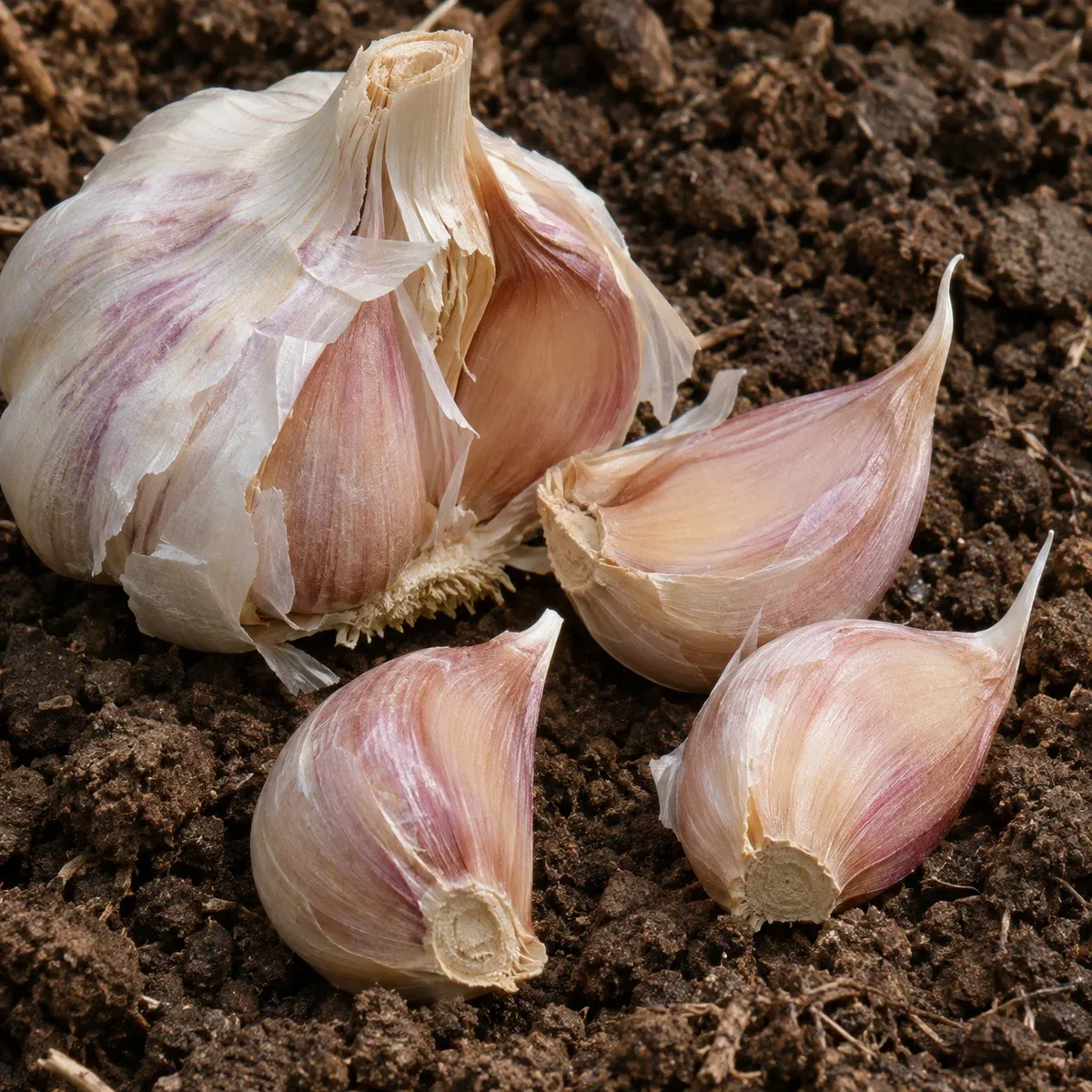
A clove is a segment detached from the garlic bulb. For this first attempt, choose planting stock with an identified variety. The PROSEMAIL and SEMAE leaflet allows you to compare the types available in certified planting stock. Keep the label: it will be useful both when planting and when comparing results.
Plant garlic in full sun. Soil that retains water for a long time in winter is the main point to watch. The SNHF advises planting on a ridge, a small elongated mound, when the soil is damp. If water remains on the plot for a long time, it is better to choose another location rather than relying on a ridge to solve everything.
Can you plant sprouted garlic?
Yes, a sprouted clove can be planted. Oregon State University describes this planting with the roots facing downwards and the shoot upwards.
However, distinguish between planting stock intended for the garden and sprouted garlic intended for cooking. The RHS advises against supermarket garlic, particularly due to the risk of introducing diseases. A visible sprout does not guarantee the health of the clove. Choose a named variety intended for planting, then follow the timing and planting steps in this guide; sprouting does not make waterlogged soil suitable.
Can you grow garlic in a pot?
The RHS suggests this option if the soil drains poorly or if space is limited: a container at least 25 cm deep, with a suitable growing medium and water drainage. Its width determines the number of cloves; maintain planting spacing instead of filling a small pot with tightly packed cloves. RHS
Regularly check the moisture level of the growing medium, which can dry out quickly. Growing in a pot does not change garlic’s seasonal needs or remove the risk of waterlogging; the container gardening guide offers further advice on choosing your setup.
How to plant, step by step
The dimensions below follow the RHS guidelines. Adjust them if your variety’s supplier provides different instructions.
- Prepare the row. Remove competing weeds and loosen the planting area.
- Separate the cloves. Keep the firm and intact cloves with their skins.
- Set them the right way up. Place the base downwards and the tip upwards.
- Cover lightly. Aim for about 2–3 cm of soil above the tip, without planting deeply in heavy soil.
- Space them. Leave about 15 cm between cloves and 30 cm between rows.
- Label the planting. Note the variety, date, and chosen location.
For a small trial, a few cloves are sufficient. Sketch your row and note how many cloves you have planted: you can then compare the number planted, the number that emerged and the number harvested, without relying on memory.
Should you water, and when should you harvest?
Watering depends on actual moisture levels, not a fixed schedule. The RHS recommends watering during dry periods in spring and early summer, then stopping when the bulbs are large and well-formed: yellowing foliage accompanies this stage of maturity. Continuing to water at this stage encourages rot. Before this, check the soil moisture before each watering.
Deciding when to harvest is a separate step: use the harvest guidelines below when the bulb reaches maturity.
What should you do with a garlic scape?
Hardneck garlic varieties, as described in the British source, are more likely to produce a scape; softneck types rarely do so except under unfavourable conditions. The RHS advises removing scapes as they form to favour bulb development and storage. This refers to the flower stalk, not an invitation to cut back all the foliage. RHS
The presence of a scape does not prove that all bulbs are ready. Keep a record of the variety and check the bulb’s stage of development with the harvest guidelines.
Orange pustules: should you consider rust?
Allium rust can affect garlic. The RHS describes raised orange pustules on both sides of the leaves, which release powdery spores when they open. Severe infection can cause premature leaf drying and reduce vigour. Yellowing alone is not enough to identify this problem.
Observe several leaves and keep dated photos. To reduce conditions that favour rust, avoid overcrowding and do not automatically apply nitrogen: the RHS links more severe attacks to certain nutritional imbalances. This does not mean that adding potassium constitutes a treatment. Remove affected crop debris at the end of the growing season and check local guidelines for disposal. RHS
If the foliage changes rapidly, also compare the condition of the bulbs and their stage before deciding to harvest; the garlic harvest guide provides the guidelines. Do not rely on the colour of diseased leaves alone in place of these checks. Do not copy a treatment recommendation: advice in a British source does not establish which treatments are authorised in France.
Harvesting and drying the bulbs
If you want to store your harvest, watch for the foliage drying out. The SNHF suggests looking for the upper half of the leaves to have dried out. First remove one bulb to check its condition, then dry the harvest in a dry, ventilated place before storage. The garlic harvest guide details bulb inspection, drying, and sorting before storage.
Questions before getting started
Is garlic sown like a tomato?
In the practice described here, you plant a clove. The sowing guide concerns starting from seeds: these are two different techniques, to be noted separately in your notebook.
Can I plant in November in all gardens?
November may be suitable for autumn garlic. However, the variety and drainage determine whether planting is appropriate. If in doubt, photograph the plot after rain and observe where water remains before choosing the location.
What should I note to do better next year?
Record four things: the variety, planting date, location, and harvest result. Add your own observation, for example, “bottom of the row remained damp.” This specific note will be more useful than a general judgement like “bad year.”
Key points for this crop
Practical guidance
- Exposure
- Full sun
- Soil
- Free-draining, no waterlogging
- In-row spacing
- About 15 cm between cloves
- Between rows
- About 30 cm
Sources and references
- Cultivated garlicFrench National Horticultural Society (SNHF) Accessed on 15 October 2026.
- How to grow garlicRoyal Horticultural Society (RHS), in English Accessed on 18 October 2026.
- Garlic: varieties available in certified planting stock — 2025 editionPROSEMAIL and SEMAE Accessed on 15 October 2026.
- Garlic (Spring)Oregon State University Extension Service, in English Accessed on 17 October 2026.
- Leek rustRoyal Horticultural Society, in English Accessed on 18 October 2026.