
The vegetable garden notebook / Crops
Harvesting garlic: checking maturity, drying and storage
Harvesting garlic for storage involves more than lifting the bulbs. Check that they are mature, handle them carefully, then let them dry before choosing which to store.
Adapt this guidance to your garden’s climate and conditions.
When should you harvest garlic for storage?
This guide covers garlic bulbs intended for drying. Fresh garlic, harvested green, should be used quickly: it does not keep like a dried bulb. The SNHF clearly distinguishes these two harvests. For clove selection and planting, refer to the garlic cultivation guide.
Variety and climate affect maturity: a fixed date is not sufficient. When the foliage begins to yellow and dry, examine the plants. The University of Minnesota advises checking whether the crop is ready when the lower leaves turn brown while part of the foliage remains green. It also suggests lifting one head and cutting it open to verify that the cloves fill their skins.
So use one bulb as a test before harvesting the whole row. Do not wait until all leaves are completely dry: harvesting too late may cause the bulbs to split and reduce their storage potential. This risk is noted by the RHS.
Lifting Heads Without Damaging Them
First, prepare the space where you will dry them. Then, loosen the soil with a fork, keeping the tines away from the bulbs, and lift the plants gently. The RHS recommends this tool and careful handling to avoid bruising.
Keep the stems attached during drying, following the method for home gardeners described by the University of Minnesota. Gently remove large clods of soil. If the harvest is damp and soil sticks to the bulbs, this cleaning requires particular care: soil obstructs airflow. Avoid knocking the bulbs to clean them; damage makes them more likely to deteriorate later. See the BSV guide on drying.
Drying Before Storing
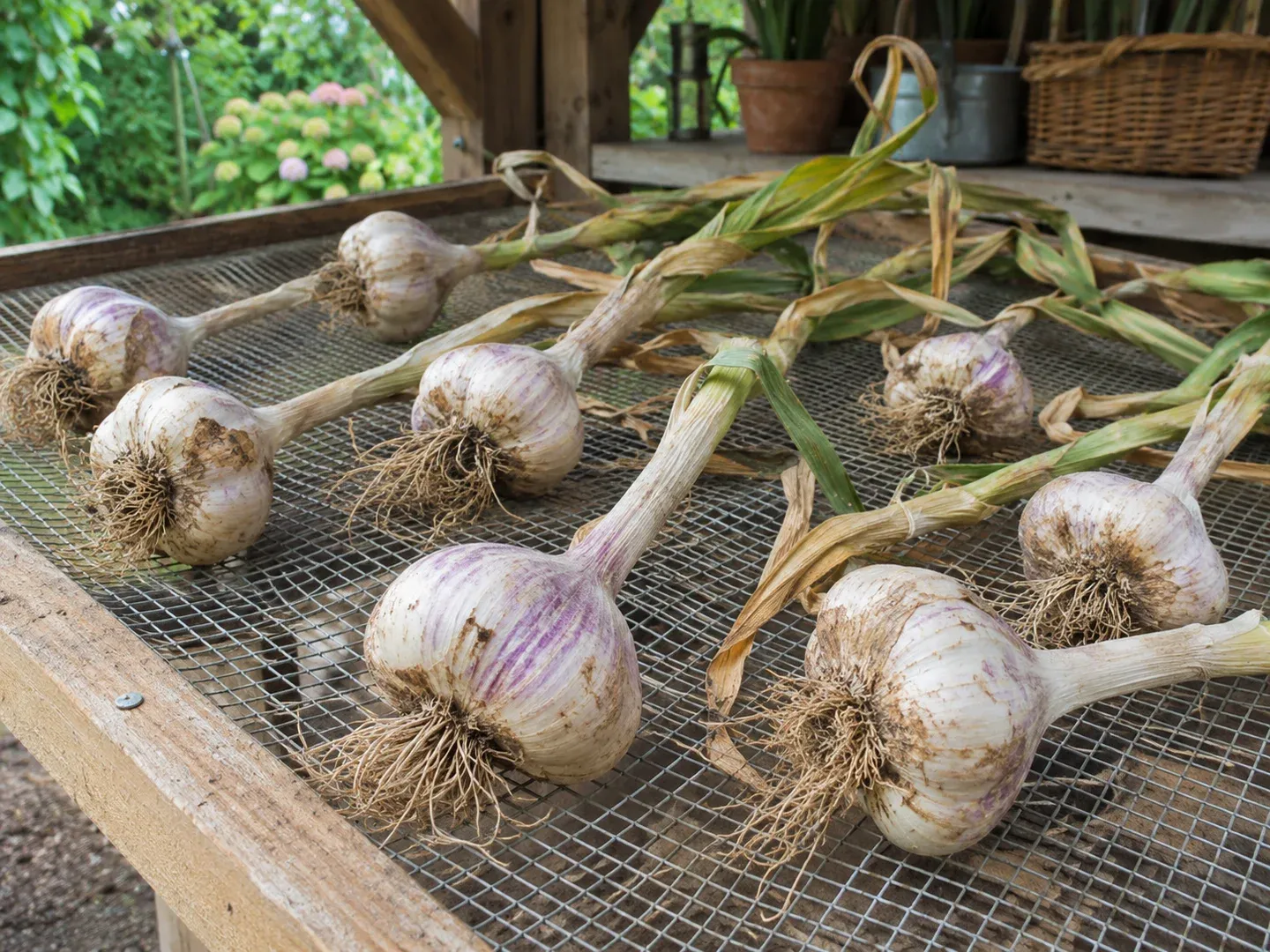
Spread the plants in a single layer in a dry, well-ventilated shelter. Drying under cover is an option described by the RHS. Choose a location protected from direct sunlight and high temperatures, in accordance with the precautions outlined in the BSV. A compact pile or full crate allows less air circulation.
Think in weeks rather than hours: the RHS suggests two to four weeks as a guide, depending on the weather. This is a guide, rather than a fixed deadline. The foliage should be dry and papery; the neck and outer skins should also be dry. These are the signs described by UC Davis. You may then cut the stems if you wish to store the bulbs separately.
Sorting and Monitoring Stored Heads
Before storage, remove damaged bulbs or those showing signs of rot from the batch intended for keeping, as recommended by the BSV. Split bulbs do not keep as well: set them aside to use first, provided they are healthy. Do not confuse a torn skin with a mouldy head. The RHS explains the risk associated with split bulbs.
Store healthy bulbs in a dry, airy place, avoiding moisture build-up. Check their condition each time you take some out, and remove any that are deteriorating. UC Davis highlights that moisture encourages mould and rooting, and that insufficient drying increases storage problems.
How Long Will Your Garlic Keep?
How long garlic keeps depends on the variety, the condition of the bulbs and where they are stored. The RHS distinguishes, in particular, hardneck and softneck garlic, which differ in how long they keep. Keep the variety name with your harvest.
The long storage times quoted for commercial facilities depend on controlled temperature and humidity, as well as suitable airflow. The UC Davis fact sheet specifies these conditions: they do not guarantee the same storage life in a kitchen or garage.
Note the harvest date, drying location, and whether any bulbs become soft or start sprouting. This will give you a record specific to your variety and home for the following season.
Key points for this crop
Practical guidance
- Maturity
- Partly dried foliage; confirm maturity by checking a bulb
- Drying
- Protected from rain and direct sunlight, with airflow
- Sorting
- Reserve healthy and intact bulbs for storage
Sources and references
- Cultivated garlicFrench National Horticultural Society (SNHF) Accessed on 15 October 2026.
- Growing garlic in home gardensUniversity of Minnesota Extension, in English Accessed on 15 October 2026.
- How to grow garlicRoyal Horticultural Society (RHS), in English Accessed on 15 October 2026.
- Optimising Drying in Garlic Production — BSV, June 2025 Special IssueOccitanie Regional Chamber of Agriculture, Garlic Sector Accessed on 15 October 2026.
- Garlic — Produce Fact SheetUniversity of California, Davis, Postharvest Research and Extension Center, in English Accessed on 15 October 2026.