
The vegetable garden notebook / Techniques
Container Permaculture: a Vegetable Garden for a Balcony, Terrace or Courtyard
On a balcony, terrace, or in a courtyard, start with a few potted crops you enjoy and can maintain. Observe the light, wind, and water access before choosing containers and their placement; also check the site-specific constraints.
Adapt this guidance to your garden’s climate and conditions.
Practical steps
- Observe the balcony
Identify direct sunlight, shelter from wind, how much rain reaches the area, and where water flows.
- Check the installation
Clarify the permissible loads and modifications for your building.
- Match crop and container
Choose based on light, mature size, roots, and drainage.
- Monitor and adapt
Check the substrate, leaves, and time commitment before adding more pots.
Applying the Approach to Your Balcony
A collection of pots does not alone define permaculture. As David Holmgren describes, it is a design framework that connects people’s needs, resources, and the environment. Observation and small-scale trials are integral to this.
For your balcony, translate this approach into a concrete goal: harvesting a few leaves or herbs, maintaining comfortable access, and ensuring upkeep during your absences. The project does not promise food self-sufficiency or the elimination of water and nutrient inputs.
Verify What the Building Allows
Before filling large containers, ask the landlord or building management for available information on permissible loads and building regulations. Have any uncertain points clarified by a competent professional. The RHS notes that filled containers, plants, and people must all be accounted for; a general capacity found online does not validate your balcony’s safety.
Consider the weight of moist substrate, water reserves, and supports, not just the empty pot. The University of Maryland highlights this discrepancy. Any supports or fixings require site-specific verification: this guide does not provide designs for attaching items to railings.
Survey Light, Wind, and Water
On a sketch, note where sunlight actually reaches future plants at different times of the day. Repeat this survey when the season changes. The aspect alone does not account for shadows from neighbouring buildings.
As horticultural benchmarks, the University of Maryland indicates 6 to 8 hours of direct sunlight for tomatoes, peppers, or aubergines, compared to 3 to 5 hours for lettuces, spinach, and other cool-season leafy vegetables. Also identify surfaces that accumulate heat and the route required to bring water.
Wind and heat can quickly dry out pots. A covered balcony may receive very little rain: the RHS advises considering the overhang of the balcony above. Observe already sheltered areas before investing in new equipment.
Choose Few Crops, Suited to the Available Space
Start with vegetables you actually use, while leaving space to move, water, and store equipment. The RHS suggests salad crops, dwarf French beans, bush tomatoes, and herbs; it favours low-growing plants in wind-exposed situations.
A lettuce is a good option for the less sunny area, based on the earlier benchmarks. A tomato requires more sunlight, space, and monitoring; consult the different tomato growth habits and check its mature size before choosing.
If space for sowing and repotting is limited, a few young plants can simplify the start. Keep each pot accessible to observe the leaves and spot pests early, as the RHS advises.
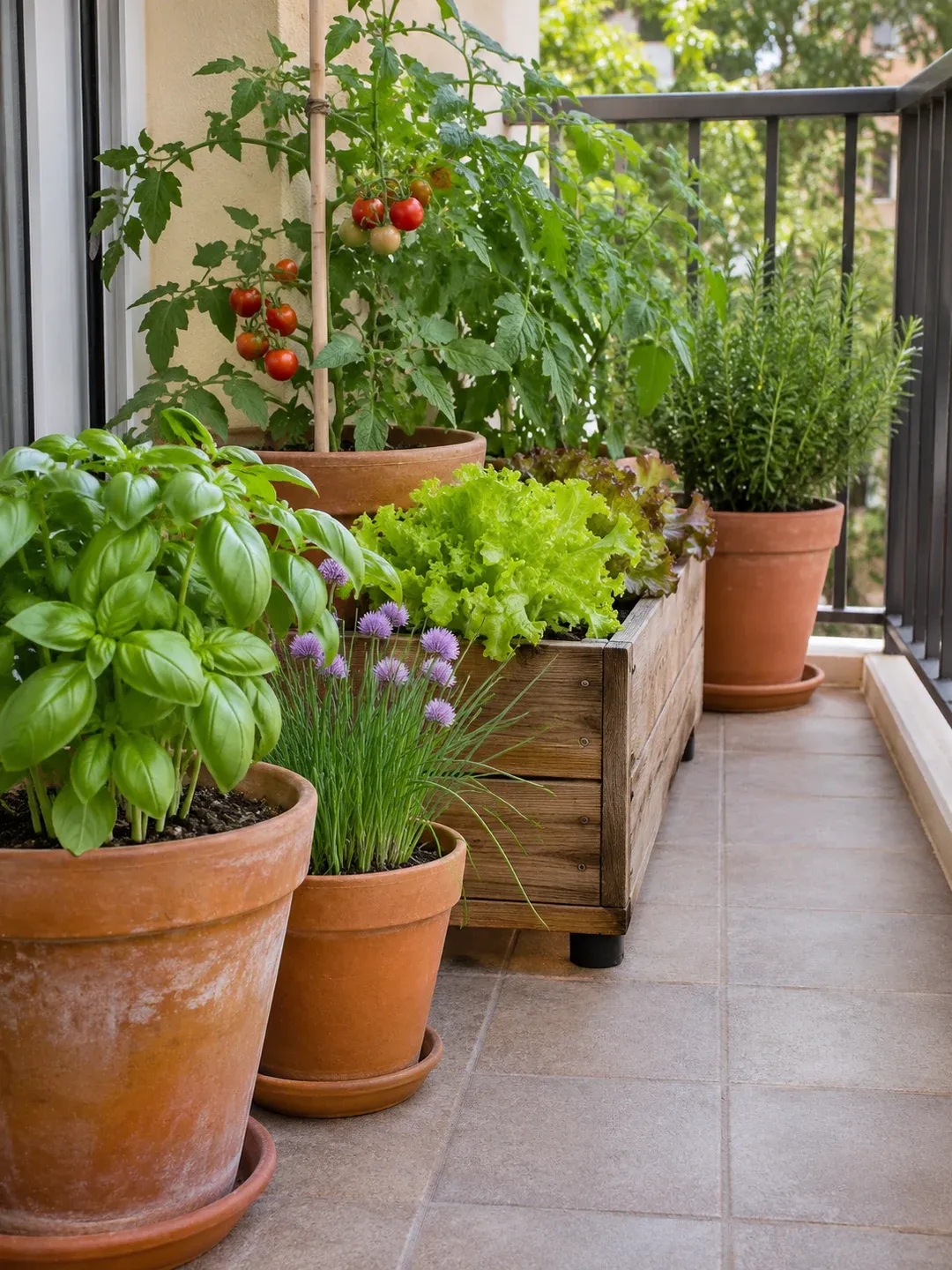
Choose the Pot for the Roots, Then the Substrate
Consider usable depth and available volume together. A deep but narrow pot and a wide but shallow planter do not offer the same root space. The University of Maryland distinguishes the needs of small crops from those of large vegetables and advises against compressing large plants into small containers. Check the requirements of the chosen variety before purchase.
Select a potting compost designed for container growing and the intended use. The substrate must retain water while allowing air circulation; roots cannot explore beyond the pot. Dense garden soil used on its own may have poor aeration and drainage, explains the University of Maryland. There is no universal mix recipe for all crops here.
Two Initial Pots, Based on Available Light
These horticultural examples come after verifying the building’s capacity and access; their dimensions do not validate the balcony’s permissible load.
- A lettuce in the moderately lit area: For a first plant, the RHS suggests a container at least 30 cm wide and deep, filled with multipurpose potting compost. Allow space for the mature variety rather than crowding several large lettuces into this minimum. The choice of an area receiving the 3 to 5 hours of sunlight benchmark cited earlier comes from Maryland; it does not mean a spot in deep shade. The lettuce guide details spacing and maintenance.
- A compact tomato in the sunniest area: Choose an identified bush variety and a single plant in a 30 to 45 cm pot, as per the RHS. This source distinguishes growth habits: do not automatically remove side shoots from a bush tomato. Allow room for its mature spread and any supports needed for branches laden with fruit; then follow the tomato guide. Sunlight, water, and access must remain available throughout its growth.
These two suggestions do not require filling all available spaces: start with what you can maintain, then note light, drying, and harvests before adding another pot.
Plan for Water Drainage
For a standard pot, check for drainage holes and ensure they are unobstructed. A layer of gravel at the bottom does not improve drainage and does not replace holes. If a saucer collects water to protect the floor or prevent runoff to a neighbour, empty it after watering. These precautions follow the University of Maryland. A container designed with a water reservoir is managed according to its own system.
Adjust Maintenance Before Expanding
Check the substrate with your finger before watering. For a standard pot that needs it, apply water at the base until it begins to drain, then allow it to drain fully. Frequency depends on the plant, volume, exposure, and weather; small pots generally require more vigilance. The University of Maryland advises against quick, superficial watering. Our guide on watering frequency expands on this observation.
Also check if the potting compost already contains fertiliser. Subsequent needs vary by crop: follow the product’s instructions without doubling doses to compensate for slow growth. The same source warns of the risks of excess.
Record your harvests, drying episodes, and time spent on the pots. If maintenance becomes difficult, first reconsider the number of plants or their placement. This feedback extends the observational approach of Holmgren.
Sources and references
- Essence of PermacultureDavid Holmgren, Holmgren Design, in English Accessed on 16 October 2026.
- Roof gardens and balconiesRoyal Horticultural Society (RHS), in English Accessed on 16 October 2026.
- How to grow edibles on your balconyJulie Henderson, Royal Horticultural Society (RHS), in English Accessed on 16 October 2026.
- Growing Vegetables in ContainersUniversity of Maryland Extension, in English Accessed on 16 October 2026.
- Types of Containers for Growing VegetablesUniversity of Maryland Extension, in English Accessed on 16 October 2026.
- Growing Media (Potting Soil) for ContainersUniversity of Maryland Extension, in English Accessed on 16 October 2026.
- Maintaining Container Grown VegetablesUniversity of Maryland Extension, in English Accessed on 16 October 2026.
- How to grow lettuceRoyal Horticultural Society, in English Accessed on 8 November 2026.
- How to grow tomatoesRoyal Horticultural Society, in English Accessed on 8 November 2026.