
The vegetable garden notebook / Crops
Planting and Growing Tomatoes, from Seedling to Harvest
Choose a tomato plant based on its growth habit. Prepare its location and support, wait for sufficiently mild conditions, then monitor soil moisture and fruit development.
Adapt this guidance to your garden’s climate and conditions.
Choosing a Plant and Understanding Its Growth Habit
For a first attempt, start with a plant whose name you know. The SNHF distinguishes varieties by their earliness, fruit characteristics, and use: for eating fresh, stuffing, or cooking. Also note the growth habit, which determines much of the ongoing care.
| Type indicated on the label | What to prepare for |
|---|---|
| Determinate, often bushy | Keep the side shoots. Support may become necessary under the weight of the fruit. |
| Indeterminate, with prolonged growth | Prepare a tall, sturdy support. For single-stem training, remove side shoots and tie the stem as it grows. |
This distinction follows the RHS: removing “suckers” is not a practice to apply to all tomatoes. These are young shoots located between a leaf and the stem, not the flower clusters. If the label is missing, identify the type before pruning.
When purchasing, prefer a stocky plant with a robust stem and leaves without suspicious spots, according to the University of Minnesota criteria. Ask if it is grafted and whether it has already been acclimatised outdoors. Keep its label. If you wish to start from seeds, the tomato sowing guide details the starting process, light requirements, and transplanting specific to this crop.
When to Plant Tomatoes Outdoors?
Tomatoes are sensitive to cold. The SNHF waits until the risk of frost has passed; the University of Minnesota adds that the soil should be warmed. There is no single date valid for all gardens in France. Base your decision on the local climate, forecasts, and the plot’s situation, particularly at altitude or in a frost pocket.
A plant grown under cover needs a transition. The RHS generally recommends two to three weeks of acclimatisation, to be adapted to initial conditions and the weather. Start by putting the plants outside during the day in a sheltered spot, then gradually increase exposure. Bring plants indoors at night initially and keep protection against forecasted cold snaps.
Acclimatisation does not make a tomato frost-resistant. If conditions deteriorate, postpone planting rather than relying on a calendar date.
How Late Can You Plant Tomatoes?
There is no national deadline. Late planting must allow the plant enough time to fruit before the return of cold weather. Minnesota notes that tomatoes require a long frost-free season; the RHS specifies that ripening depends on the variety, weather, and fruit size.
To decide, compare the stated time to maturity for your variety, checking whether it starts from sowing or planting, with the length of the mild season usually remaining in your garden. A well-developed plant skips the sowing stage; an early variety with small fruit may be better suited to a short season. The RHS observes that small fruits ripen faster than large ones.
For very late planting, choose an early variety and ensure there is a sufficiently long mild season left to harvest it. Refer to the June calendar guidelines and adapt them to your climate.
Preparing the Site and Planting
Choose a sunny spot, sheltered from wind, in fertile soil that retains moisture without becoming waterlogged: this is the framework adopted by the RHS. If water stagnates for long periods, find another location.
For planting in rows, the SNHF suggests 60 to 70 cm between plants and 1 m between rows. This guideline is not universal: adapt it to the expected growth and training method indicated for your variety.
- Install the planned support before planting or at the same time; the tomato staking guide helps choose and position this support according to the growth habit.
- Moisten the root ball, remove it from the pot, and prepare a hole wide enough to accommodate it without compressing it.
- Adjust the depth. For a non-grafted plant, you can bury part of the stem up to just below the first leaves. Keep the leaves above ground.
- Backfill the hole, firm gently, and water to ensure soil contact with the root ball.
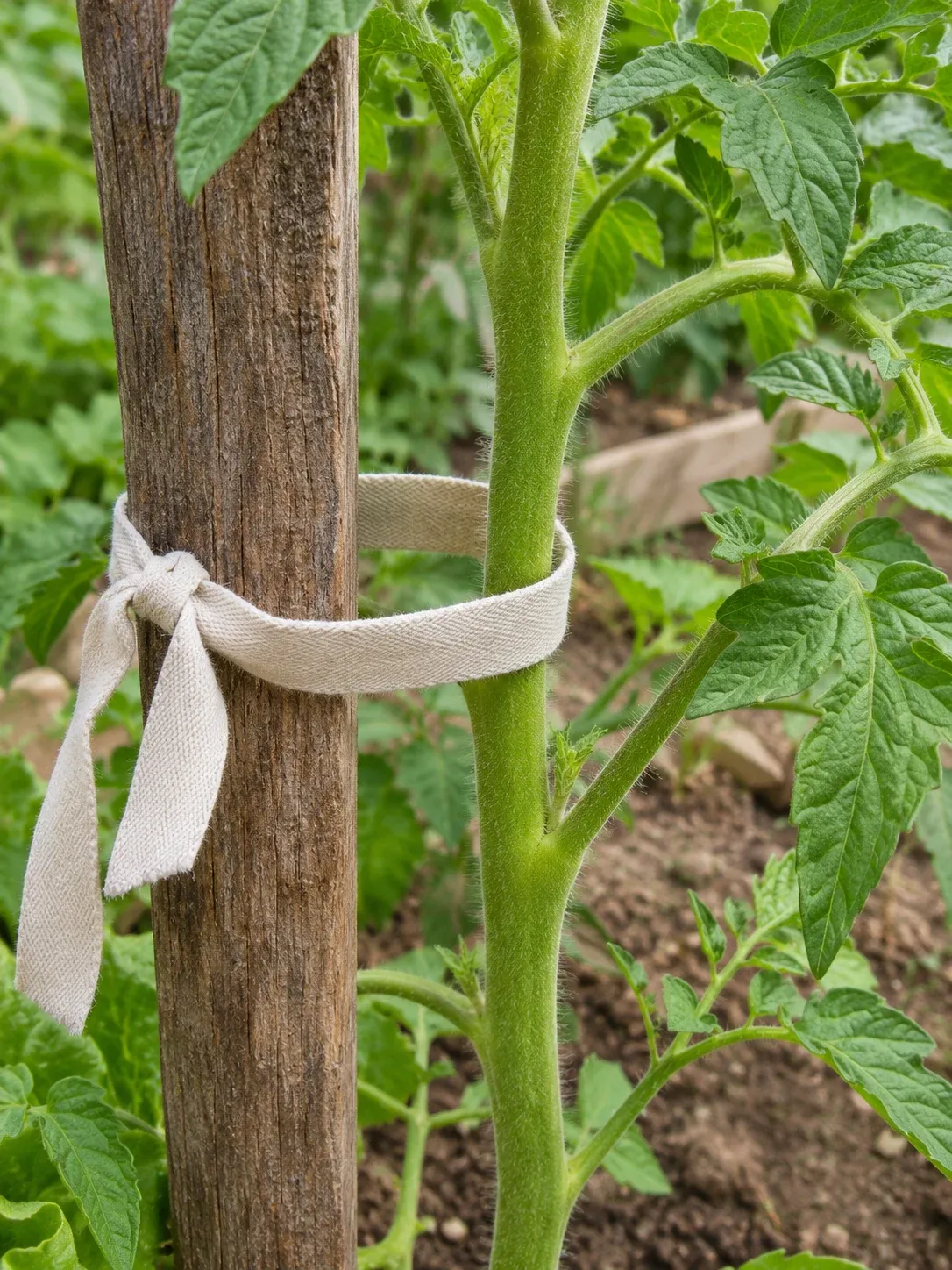
- Tie loosely if the plant needs staking, then label it.
These steps follow the planting instructions from the SNHF and the University of Minnesota, with the flexible tie recommended by the RHS.
Exception for a grafted plant: Do not bury the graft point, the junction between the two parts of the plant. The University of California, Davis guide keeps it at least 2.5 cm above the soil to limit rooting of the upper part. Identify this junction before planting and also follow the supplier’s instructions.
Growing Tomatoes in Pots, Outdoors or Under Cover
Pots are suitable when ground space is lacking, under cover or in a warm, sunny, sheltered outdoor spot. The RHS recommends one plant in a pot 30 to 45 cm in diameter, filled with peat-free potting compost. This guideline refers to the final container size; it does not specify a volume in litres, which also depends on depth and shape.
Compact bush types are suitable for containers. An indeterminate type can also grow in a large container, with a tall support; the height and weight make the setup more prone to toppling. Therefore, check the growth habit and stability before installation, as the RHS advises. Keep the graft point above the substrate if the plant is grafted.
Choose a pot with drainage holes and allow water to drain away, as per the RHS on containers. Plan frequent access to monitor moisture. The guides on watering tomatoes and fertilisation detail this care. For a greenhouse, also consult managing an unheated greenhouse.
Watering and Monitoring During Growth
Aim for fairly consistent moisture. Before watering, check the soil beneath the surface and account for recent rainfall. Water at the base, allowing water to penetrate without wetting the foliage; the University of Minnesota advises against light watering that only moistens the surface. Needs vary with soil and weather: do not turn this advice into a fixed number of litres per plant.
Mulching helps maintain more consistent moisture, as INRAE notes. It does not replace checking the soil’s condition. Regarding fertilisation, tomatoes planted in already enriched soil may not need additional fertiliser, according to the RHS: avoid routine fertiliser applications.
Use these checks to inspect ties, look under leaves, and monitor fruit. Note changes: a single affected area or multiple plants, a spreading spot, a heatwave, or persistently damp soil. A dated photograph helps compare progress but is not sufficient for diagnosis.
Does a Black Spot Under a Fruit Indicate a Lack of Fertiliser?
Not necessarily. A dark lesion at the end opposite the stem may suggest blossom-end rot, but not all black spots have this cause. INRAE describes a disorder linked to calcium supply in the fruit, with several possible factors: irregular watering, impaired uptake or transport, damaged roots, among others. This does not prove the soil lacks calcium. Check growing conditions and have the problem identified before adding any product.
Harvesting and Preparing for the Next Season
Pick when the fruit has reached the maturity corresponding to its variety, particularly its expected colour. The SNHF reminds us that not all tomatoes are red. At the end of the season, if frost threatens, sort the fruit before bringing it indoors. The University of Minnesota distinguishes tomatoes that have reached full size but not final colour from small, clearly immature fruit: the latter may never develop satisfactory flavour. The green that lightens to white or pink is a sign of ripening; the final colour depends on the variety.
Spread the fruit to ripen in a single layer, without touching, at room temperature. Light is not necessary according to this source: a windowsill is not essential. Check them often and use them as they ripen, separating any that spoil. A split or spotted tomato requires its own sorting; do not store the entire batch without inspection.
To compare your trials, note the first harvest, taste, problems encountered, and the space actually used. Along with the variety and planting date, these observations will help you decide which plants to grow again and how many to plant.
Is the Tomato a Fruit or a Vegetable?
A fruit in the botanical sense, used as a vegetable in cooking. The tomato is a berry: these two classifications serve different purposes. The thesis by Céline Chanforan, in its section “Structure and Composition”, explicitly distinguishes these two meanings. This does not alter the cultivation practices described here.
The steps in pictures
Tomatoes in rows: read both distances
Two different measurements: between two plants, then between two rows.
Top view · schematic plan, not to scale
The arrows connect the plant positions. Do not measure from the edge of the leaves. Adapt this illustrative plan to the variety and growing method.
Following SNHF guidance for planting in rows, space plants 60 to 70 cm apart within a row and rows 1 m apart. Measure between plant positions and between row centrelines, rather than from the edges of the foliage.
Adapt this illustrative plan to the variety’s growth and training method. The symbols do not represent the plants’ mature spread.
Based on SNHF, row planting.
On a stake: leave a loose tie
The tie holds the stem to the stake without compressing it.
On the plant
Top view detail · not to scale
Check during growth: the tie remains loose and does not tighten around the stem. This detail shows the slack to leave, without specifying a knot or size.
Install the support before or at the time of planting. For a staked tomato, tie the stem loosely, then check the ties during growth.
Adapt the support to the variety’s growth habit. Retain side shoots on determinate (bush) types.
Based on SNHF, support installation · RHS, growth types · RHS, ties and space around stems.
Key points for this crop
Practical guidance
- Exposure
- In full sun, sheltered from wind
- Soil
- Fertile and well-draining, retaining moisture
- Planting out
- After acclimatisation, when frost risk has passed
- Training
- According to determinate or indeterminate growth habit
Sources and references
- TomatoFrench National Horticultural Society (SNHF) Accessed on 15 October 2026.
- How to grow tomatoesRoyal Horticultural Society (RHS), in English Accessed on 18 October 2026.
- Hardening off tender plantsRoyal Horticultural Society (RHS), in English Accessed on 15 October 2026.
- Growing tomatoes in home gardensUniversity of Minnesota Extension, in English Accessed on 15 October 2026.
- Tomato Grafting GuideUniversity of California, Davis — Horticulture Innovation Lab, in English Accessed on 15 October 2026.
- Tomato — Blossom-end rot on fruitINRAE, e-phytia — D. Blancard Accessed on 15 October 2026.
- Stability of tomato microconstituents — Structure and composition, page 57Céline Chanforan, thesis, Université d’Avignon and INRA, 2010, INRAE archive Accessed on 17 October 2026.
- Growing plants in containersRoyal Horticultural Society (RHS), in English Accessed on 18 October 2026.