
The vegetable garden notebook / Crops
Tomato diseases: observe the symptoms before taking action
A tomato that turns yellow or becomes deformed is not necessarily suffering from an infectious disease. Look at where the problem starts, what accompanies it and how it develops. These observations help you choose the next step without turning an isolated sign into a diagnosis.
Adapt this guidance to your garden’s climate and conditions.
What to look for before choosing an intervention?
Start by describing what you see: “lower leaves spotted” is more useful than “sick tomato”. The INRAE diagnostic procedure emphasises possible misidentifications and the growing context. Note:
- Location: one plant, several neighbouring plants or the entire row?
- Onset of the problem: first observed date and progression since that date.
- Recent conditions: rain, heat, watering, fertilisation, pruning or nearby treatment.
- Cultivation: variety, pot or open ground, soil condition and previous crops.
Next, examine the leaves on both sides, the stems and the fruit. Also look at the collar, the area where the stem meets the soil. INRAE distinguishes these different plant parts in its observation method: a single leaf does not provide information about the entire plant. A root problem may require further examination.
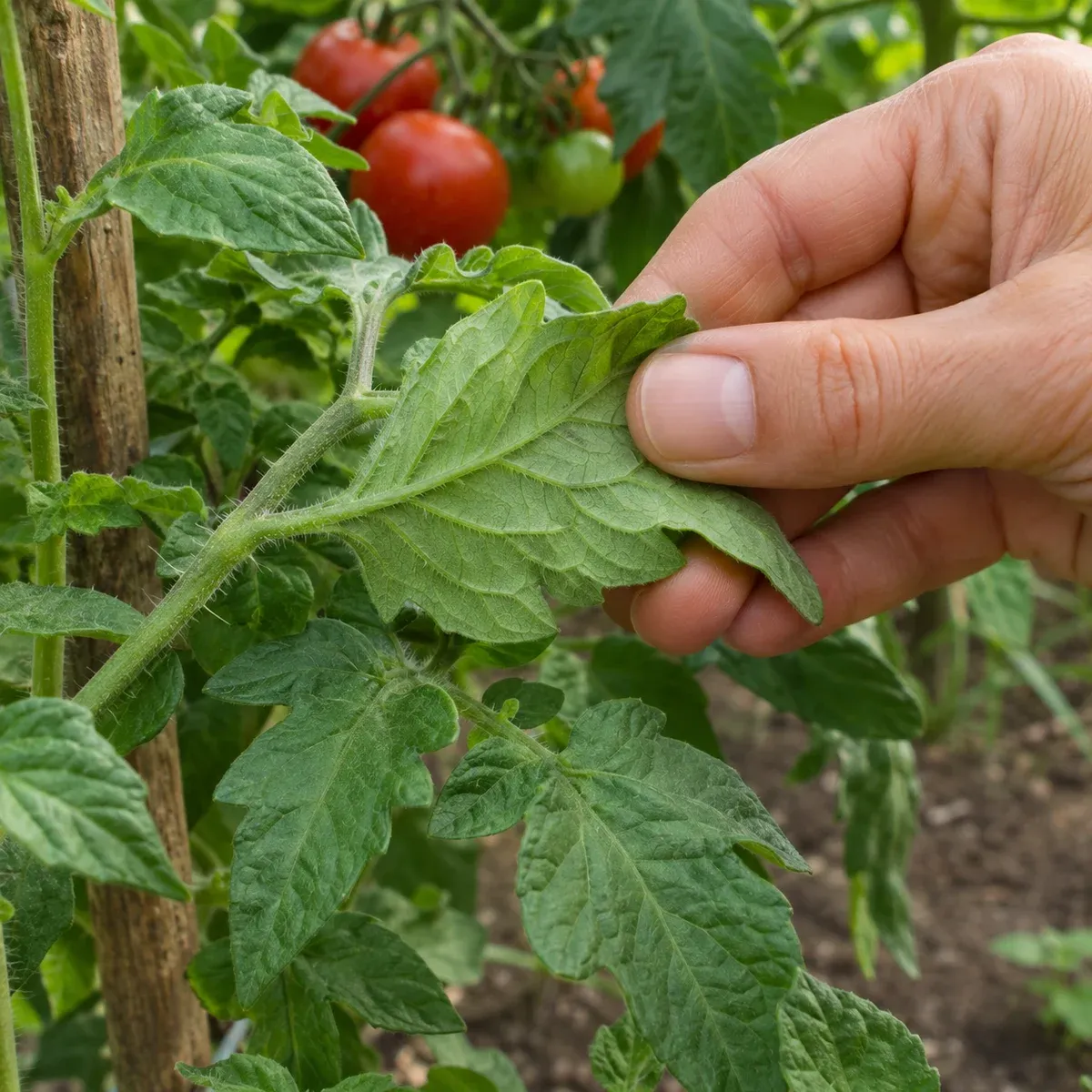
Disease, pest or physiological disorder?
The INRAE index separates several categories of problems:
- Infectious diseases, caused notably by fungi, bacteria or viruses.
- Pests, such as aphids or mites.
- Non-parasitic disorders, including sun scorch, root asphyxiation and blossom-end rot.
This distinction guides the search for the cause. It does not impose exclusive categories: aphids can also transmit viruses. Their presence does not, however, prove that a plant is infected.
Which clues guide the next check?
The table provides avenues to explore, not a key for definitive diagnosis. Location, other affected organs and progression remain necessary.
| Observation | Possible cause | Also check |
|---|---|---|
| Sunken brown or black area at the end of the fruit | Blossom-end rot is a physiological disorder. | Check that the lesion is opposite the peduncle, on the side of the former flower. INRAE guidelines. |
| Brown spots on leaves | Several diseases may look similar. | Concentric patterns may suggest early blight; yellow areas on top with olive-brown velvety growth underneath point to leaf mould. Similar problems described by INRAE. |
| Young leaves deformed with insect colonies | Aphids are among the possibilities. | Inspect the underside of leaves: white cast skins and honeydew may accompany colonies. INRAE description. To continue the check, consult the aphid guide for tomatoes. |
| Wilted plant or yellowing leaves | Lack of water cannot be deduced from this alone. | Check soil moisture and water drainage: saturated soil can also cause wilting. Root asphyxiation. |
| Pale, whitish patch on the exposed side of a fruit | Sun scorch is possible. | Note any leaf loss or pruning that has exposed the fruit. University of Minnesota guidelines. |
Oily-looking leaf spots that spread, accompanied by damage to stems or fruit, may suggest late blight as described by INRAE. The guide to tomato late blight details the signs, possible lookalikes and decisions after identification.
If you have identified aphids, the guide dedicated to aphids on tomatoes helps you decide on the next steps based on colonies and observed beneficial insects.
Which instinctive responses should you avoid?
Do not automatically add water to a wilted plant. If the soil or substrate remains saturated, INRAE recommends reviewing quantities, frequency and drainage. To adjust your watering, start again by observing the soil with the watering guide.
Do not conclude that there is a lack of calcium in the soil when faced with blossom-end rot. The University of Minnesota distinguishes between calcium available in the fruit and that present in the soil; moisture variations can disrupt its uptake. A fertiliser application does not, therefore, follow from this symptom alone.
Do not treat every curled leaf as an infection. Physiological curling may accompany heat, drought or pruning, according to the same source. Observe other signs before attributing a cause. Also avoid excessive defoliation: suddenly exposed fruit are more prone to sun scorch.
Which preventive measures are useful?
To limit several diseases that spot the foliage, the University of Minnesota recommends:
- watering at the base to avoid wetting the leaves;
- mulching to limit soil splashing onto lower leaves;
- maintaining air circulation with appropriate spacing and support;
- waiting until foliage is dry before pruning, tying or weeding between plants, to limit the spread of bacteria.
These measures reduce certain risks; they do not allow you to identify a disease or cure all damage. The tomato growing guide covers planting and care decisions.
When to request further examination?
If symptoms progress, affect several organs or remain difficult to interpret, have the plant examined by a competent horticultural advisor before choosing a targeted treatment. Prepare views of the entire plant, both sides of the leaves and other affected parts, along with your cultivation notes.
Keep observations distinct from hypotheses: “spots appeared after rain” describes a fact; “confirmed late blight” requires identification. The INRAE procedure includes examining representative plants, including roots. Ask for sampling instructions if this examination is necessary.
Key points for this crop
Practical guidance
- First step
- Observe the entire plant and neighbouring plants
- Three possibilities
- Infectious disease, pest or physiological disorder
- Watering
- Check the soil before changing your watering
- Diagnosis
- Cross-reference signs, their location and their progression
Sources and references
- Tomato — Diagnostic procedureINRAE, e-phytia — D. Blancard Accessed on 16 October 2026.
- Tomato — Location and characterisation of symptoms on the plantINRAE, e-phytia — D. Blancard Accessed on 16 October 2026.
- Tomato — Index of tomato diseases and pestsINRAE, e-phytia — D. Blancard Accessed on 16 October 2026.
- VigiJardin — Tomato late blight: risks of confusionINRAE, e-phytia Accessed on 16 October 2026.
- VigiJardin — Tomato late blight: symptoms and damageINRAE, e-phytia Accessed on 16 October 2026.
- Tomato — AphidsINRAE, e-phytia — D. Blancard Accessed on 16 October 2026.
- Tomato — Root asphyxiationINRAE, e-phytia — D. Blancard Accessed on 16 October 2026.
- Tomato disordersUniversity of Minnesota Extension, in English Accessed on 16 October 2026.
- Tomato leaf spot diseasesUniversity of Minnesota Extension — Michelle Grabowski, in English Accessed on 16 October 2026.