
The vegetable garden notebook / Crops
Tomato late blight: observing the signs and taking action
A single brown spot is not enough to identify late blight. Examine the leaves, stems, and fruits, then monitor the problem’s progression. Prevention and removal of diseased parts serve different purposes: limiting risks before infection and then reducing sources of contamination.
Adapt this guidance to your garden’s climate and conditions.
What signs may suggest late blight?
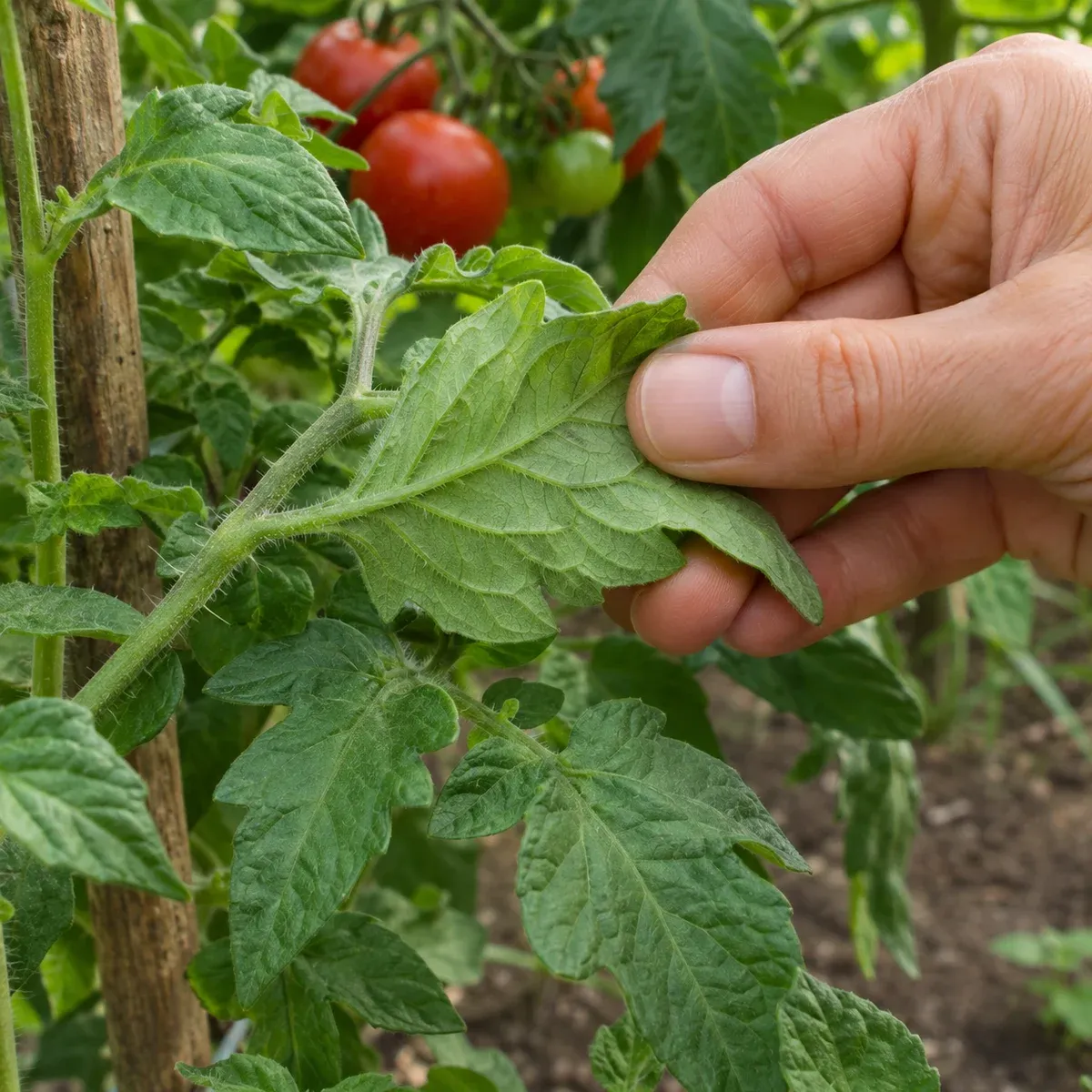
Tomato late blight is caused by the microorganism Phytophthora infestans. It can affect several parts of the plant, as described by VigiMildiou from INRAE. Examine the upper and lower sides of the leaves, then the stems and fruits.
| Part observed | Compatible signs |
|---|---|
| Leaves | Damp-looking areas, initially greenish, which turn brown and dry out. A fine white down may sometimes appear on the underside of the leaf, at the edge of the lesions. |
| Stems and petioles | Brown lesions with irregular edges, which may encircle the stem or the leaf attachment. |
| Fruits | Brown marbling, sometimes accompanied by bumps; the affected fruit may remain firm. |
These indicators come from the INRAE symptom sheet. The down may be subtle and short-lived: its absence is not enough to rule out late blight. Under favourable conditions, lesions can progress rapidly.
These signs guide observation but do not alone establish a diagnosis. A single photograph or a brown leaf does not allow a definitive conclusion among all possible causes.
What could be mistaken for late blight?
INRAE lists several similar problems. Their location and appearance provide clues, which should be examined together.
| What you see | Alternative possibility to check |
|---|---|
| A sunken lesion at the end of the fruit, opposite the stem | Blossom-end rot, called “cul noir” in French, is a physiological disorder. |
| Leaf spots with concentric rings and a yellow halo | Early blight may produce this appearance. |
| Yellow areas between the veins, with persistent olive-brown velvety growth on the underside | Cladosporium leaf mould is one possibility. |
This table is not a complete diagnostic key. If in doubt, have the problem examined by a competent horticultural advisor before choosing a specific intervention. Prepare views of the entire plant and both sides of the leaves, the date of appearance, and recent growing conditions.
Why monitor more closely after a spell of wet weather?
Rain, dew, and overhead watering favour late blight when foliage remains damp. Moderate temperatures combined with high humidity are particularly conducive. Rain and wind can also carry spores to other plants: contamination does not necessarily come from the soil in your plot. These mechanisms are described in the INRAE biology sheet.
Monitor tomatoes regularly after such episodes. Spots may appear several days after contamination: the visible condition on any given day does not tell the whole story of the infection. Improved weather does not prove the plant has recovered.
Reducing risks before symptoms appear
Start by limiting moisture on the foliage. VigiMildiou recommends watering at the base, ventilating shelters, and, if necessary, mulching to reduce water splash. These measures do not make plants invulnerable.
Also, allow enough space for air to circulate between plants, with appropriate support for their growth. The University of Minnesota, in its section on home gardening, links spacing and staking or caging to keeping foliage drier. This does not imply pruning all varieties in the same way.
For future plantings, research the late blight resistance of the chosen variety. Resistant does not mean immune under all conditions: the same source notes that symptoms may still occur when conditions are highly favourable for the disease.
What to do after the first spots appear?
- Assess the extent of the problem. Note which plants and which parts are affected. Also check neighbouring plants, without automatically assuming the same diagnosis.
- If late blight is identified at a very limited stage on the leaves, promptly remove the infected leaflets. This is the early action described by VigiMildiou, before the infection spreads to stems and fruits. It aims to reduce initial sources of contamination.
- If the infection has spread, do not rely on repeated defoliation to cure the plant. The University of Maryland recommends removing plants affected by late blight from the garden to limit their role in spreading the disease. This decision applies to confirmed diseased plants, not every tomato with an undetermined spot.
Avoid placing diseased residues in your garden compost, as advised by VigiMildiou. Check with your local authority about their disposal methods. Continue monitoring the remaining plants: removing a source of contamination does not indicate whether they have already been infected.
Can tomatoes from an affected plant be eaten?
Check and sort the fruit itself. The University of Wisconsin distinguishes between tomatoes that appear healthy, which can be consumed even if the plant is affected, and fruits showing late blight symptoms: these must not be eaten, canned or preserved in any other way. Simply removing the spot is not a validated way to salvage the fruit.
Re-examine stored fruits before use. At the slightest compatible symptom or sign of deterioration, discard them. For preserving, do not infer any sterilisation method from this disease sheet: use a proven food preservation method with acceptable fruits, as explained in the harvest preservation guide.
Is Bordeaux mixture effective against late blight?
Distinguish between protection before infection and cure. Bordeaux mixture is a preparation based on copper sulphate and lime, described by the University of California. For tomato late blight, the University of Maryland explains that protective copper-based fungicides can protect foliage before infection; they do not cure the disease after symptoms appear.
Copper acts preventively; it does not repair already affected tissues. Copper formulations are not interchangeable: a recipe or programme used on vines or trees does not become advice for your tomatoes.
This does not justify automatic spraying. First, verify the problem, the intended use, and the conditions of use for the product you are considering, then follow its label and seek advice if in doubt. Jardiner Autrement emphasises this tailored choice and precautions, including for products marketed as natural. The prevention and management measures for affected plants described above remain necessary.
Can a homemade remedy cure the plant?
Do not expect a homemade preparation to restore affected tissues. The University of Maryland distinguishes between protection before infection and cure, which it does not promise after symptoms appear.
INRAE reports that some plant extracts have shown activity in the laboratory but often failed to control epidemics in the field. A laboratory result does not demonstrate the effectiveness of a recipe in the vegetable garden. It does not justify an improvised dose or a promise of curative treatment.
What notes should be kept for the next season?
Record the variety, location, first observation date, affected parts, and actions taken. Write “brown spots under several leaves” if the diagnosis is not confirmed, then add the diagnosis and its source if you obtain confirmation.
These notes help compare observations; they do not alone prove the effectiveness of an action. You can refer to them during the November vegetable garden review to prepare for the next season.
Key points for this crop
Practical guidance
- To observe
- Leaves, stems, and fruits, along with their progression
- Favourable conditions
- Persistent humidity and moderate temperatures
- Prevention
- Water at the base and promote airflow
- Diagnosis
- A single isolated spot is not sufficient
Sources and references
- Tomato — Main symptoms of Phytophthora infestansINRAE, e-phytia — D. Blancard Accessed on 15 October 2026.
- VigiJardin — Tomato late blight: risks of confusionINRAE, e-phytia Accessed on 15 October 2026.
- Tomato — Phytophthora infestans: biology and epidemiologyINRAE, e-phytia — D. Blancard Accessed on 15 October 2026.
- VigiMildiou — Tomato late blightINRAE, e-phytia Accessed on 15 October 2026.
- Tomato — Phytophthora infestans: protection methodsINRAE, e-phytia — D. Blancard Accessed on 15 October 2026.
- Late blight of tomato and potatoUniversity of Minnesota Extension, in English Accessed on 15 October 2026.
- Late Blight of Tomato and PotatoUniversity of Maryland Extension — Jon Traunfeld, in English Accessed on 15 October 2026.
- Bordeaux MixtureUniversity of California, Statewide IPM Program, in English Accessed on 17 October 2026.
- Precautions to take before treatmentJardiner Autrement, French National Horticultural Society Accessed on 17 October 2026.
- Late BlightUniversity of Wisconsin–Madison Extension, in English Accessed on 8 November 2026.