
The vegetable garden notebook / Crops
Tomato varieties: choosing based on growth habit, use, and season
To choose a tomato, start with your location and what you want to harvest. Then compare the growth habit, fruit use, earliness, and specific resistances of each variety.
Adapt this guidance to your garden’s climate and conditions.
Start with the plant’s growth habit
The growth habit describes how the plant grows. It helps you choose your support and the harvest pattern you want. The University of Minnesota distinguishes the following two behaviours; training advice comes from the RHS.
| Growth habit | Growth and harvest | Training required |
|---|---|---|
| Determinate | Terminal growth stops with the formation of flowers and fruit. The harvest tends to be more concentrated. | Retain the side shoots. Support may be needed under the weight of the fruit. |
| Indeterminate | The plant continues to grow, flower, and fruit as long as conditions allow. | Plan for a sturdy support. Training to a single stem requires ties and the removal of side shoots. |
A concentrated harvest may suit you if you want to prepare a quantity of sauce at once; a harvest spread over time may better suit regular picking. These are selection criteria, not yield guarantees. To prepare the support, consult the staking guide.
“Cherry tomato” does not mean “small plant”. The University of Maryland describes cherry tomato varieties ranging from dwarf to very tall. Check the growth habit and stated dimensions separately from the fruit size.
Choose fruit for your kitchen
The categories described by Iowa State University allow an initial selection:
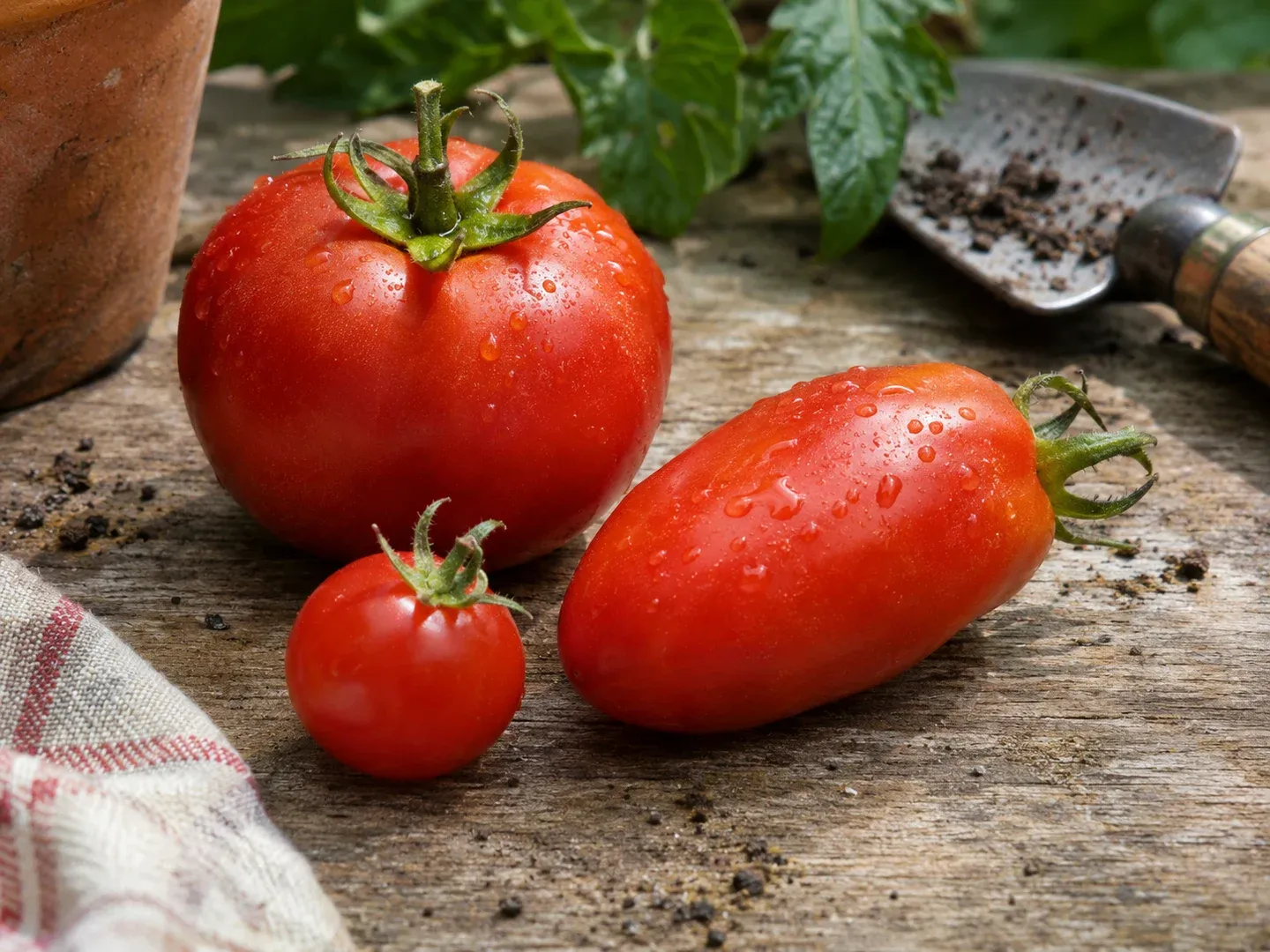
- Small fruit for eating fresh: look for cherry, pear, or small elongated types.
- For slicing: consider round tomatoes and large-fruited types, then choose the size that suits you.
- For sauce preparation: cooking types generally have thick flesh and small seed cavities.
These uses may overlap. Note your taste and texture preferences after tasting; a category or colour does not constitute a quality ranking.
In a short season, prioritise earliness
If cold often limits your final harvests, start your selection with varieties labelled as early. The University of Minnesota links varietal choice to the length of the favourable season and reminds us that ripening depends heavily on the weather. A late variety therefore requires more caution in this context.
When a catalogue lists a number of days, check the starting point of the count. Maryland, for example, gives its timings after transplanting: counting from sowing would produce an inaccurate harvest date. Compare indications defined in the same way, then use them as benchmarks.
Earliness does not make the tomato frost-resistant. Maryland notes its sensitivity to cold and waits for warmed soil and the end of frost risk before planting. To plan how to raise your seedlings, use the tomato sowing guide.
Check the space and growing conditions
The RHS recommends a warm, sunny, and sheltered outdoor location. For a pot, check the final dimensions and stated training: compact types are practical, but an indeterminate tomato can also grow in a large container with suitable support. The whole setup must remain stable and protected from wind.
Before selecting a name, ensure the data sheet describes your situation: open ground or container, outdoors or under cover. If it does not specify the growth habit or expected development, request this information from the supplier. The general tomato guide then details planting and care.
Interpret resistance claims as specific protections
The mention “disease-resistant” deserves clarification. Look for the organism concerned, any specified races, and the stated level. In the ISF terminology, IR denotes intermediate resistance and HR high resistance. Even an HR variety may show symptoms under high pressure: resistance and immunity are different.
This protection applies to the specified organisms, sometimes only certain races. It does not automatically extend to all tomato diseases. If you seek resistance after a garden problem, first have it identified; a label does not replace diagnosis. The late blight guide helps assess this particular risk.
Four examples to apply these criteria
Use these examples to compare growth habit, earliness, and fruit type, then choose based on the length of your season.
- Limited space: ‘Gold Nugget’. The RHS describes a yellow cherry tomato with a compact bushy habit. It is a candidate to consider for a container; still check the required volume and its stability. “Compact” does not mean a small pot will suffice.
- Short season: ‘Cristal’. The RHS describes it as early, salad-type, and trained as a cordon. Earliness is its advantage in this choice, but the growth habit still requires support and care: rule it out if you cannot provide these.
- Staggered pickings: ‘Sungold’. The RHS indicates small orange fruits and a cordon habit. The indeterminate nature allows continued growth as long as conditions suit; this option requires height and does not guarantee a harvest until a fixed date.
- Sauces and more concentrated harvest: ‘Roma VF’. Iowa State classifies it as determinate, with red pear-shaped fruit. Its fruit type lends itself to sauces; its growth habit better suits a concentrated harvest than the previous objective. The letters in the name do not remove the need to check the resistance traits actually stated for that batch.
For example, on a balcony where no tall support is possible, ‘Cristal’ and ‘Sungold’ are excluded from this selection even before comparing their fruit. For a short season, the name ‘Roma’ does not prove earliness: look for this indication in the batch’s data sheet, along with its starting point. The British and American descriptions above do not provide a French calendar.
Keep a simple selection record
For each variety considered, note the exact name, growth habit, use, earliness, and detailed resistances. Rule out those whose requirements exceed your space or equipment.
In the garden, record the planting date, first harvest, actual space occupied, and your assessment of the fruit. Add notable seasonal conditions. You can then compare your next trials without attributing all results to the variety name alone.
Key points for this crop
Practical guidance
- Growth habit
- Determinate or indeterminate: different training methods
- Use
- Small fruits, slicing, or sauce preparation
- Earliness
- A benchmark to compare with the local season
- Resistance
- Targeted protection, with no guaranteed immunity
Sources and references
- Growing tomatoes in home gardensUniversity of Minnesota Extension, in English Accessed on 16 October 2026.
- How to grow tomatoesRoyal Horticultural Society (RHS), in English Accessed on 16 October 2026.
- Recommended Cultivars and Types of Tomatoes for the Home GardenIowa State University Extension and Outreach, in English Accessed on 16 October 2026.
- Growing Tomatoes in a Home GardenUniversity of Maryland Extension, in English Accessed on 16 October 2026.
- Garden planning in the new yearUniversity of Minnesota Extension, in English Accessed on 16 October 2026.
- Definitions of the Terminology Describing the Reactions of Plants to Pests for the Vegetable and Ornamental Seed IndustryInternational Seed Federation (ISF), September 2022, in English Accessed on 16 October 2026.