
The vegetable garden notebook / Crops
Yellow, curled, or spotted tomato leaves: what to observe?
A single yellow or curled leaf does not reveal the cause of the problem. First, identify which leaves are changing, describe their appearance, and look for associated signs. This approach helps you gather information for a closer examination without diagnosing from an isolated photograph.
Adapt this guidance to your garden’s climate and conditions.
Which leaves should you examine first?
Compare the older leaves at the base, those in the middle, and the young leaves at the top. Note where you first saw the change and where it is now. INRAE describes yellowing that begins at different levels: “a few yellow lower leaves” and “young leaves turning yellow in turn” are not the same observation.
Next, inspect an affected leaf on both sides, then an intact leaf from the same plant. Describe the colour, shape, and spots separately, as in INRAE’s localisation approach. Also examine the stem, the collar—its junction with the soil—and the fruit. Root or stem damage may have visible effects on the leaves: the location of the symptom is not necessarily where the cause lies.
Across the vegetable garden, note whether a single plant, a few neighbours, or the entire row are affected. Add the variety, cultivation method, recent weather, and interventions. This context is part of the diagnostic procedure.
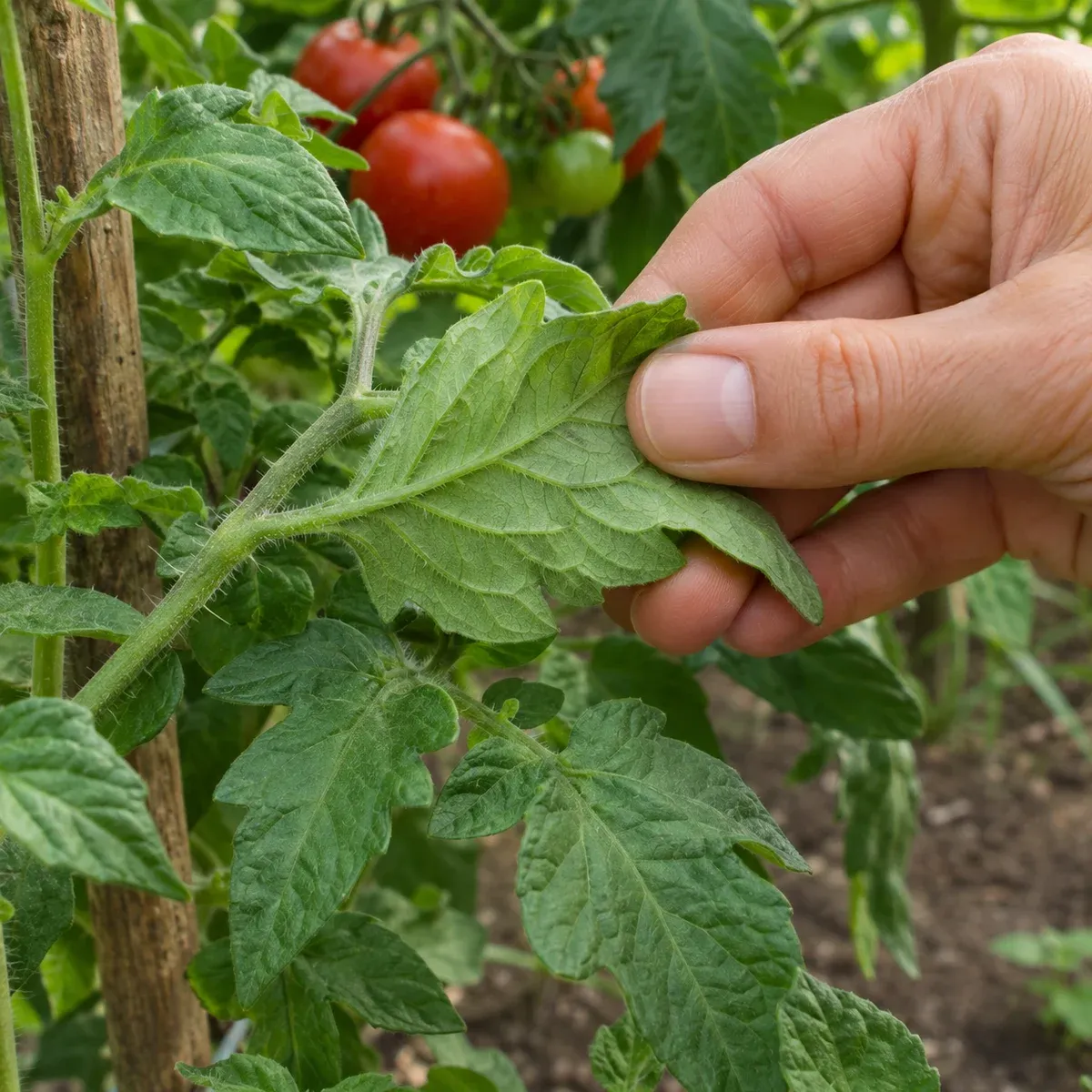
Yellow leaves: tracking the pattern of yellowing
The term chlorosis refers to yellowing. It does not mean “lack of iron” or “lack of fertiliser”. INRAE emphasises that it can accompany infectious problems, nutritional issues, or damage from products, among other possibilities.
To describe the pattern, observe whether:
- the entire surface turns yellow or only part of it;
- the yellow appears between veins that remain green;
- only one side is affected;
- the yellow surrounds a distinct spot;
- the change remains on the lower leaves or spreads to other levels.
The age of the leaves guides the investigation without confirming a deficiency. For example, INRAE describes more pronounced yellowing of older leaves in nitrogen deficiency, and chlorosis between the veins of young leaves in iron deficiency. These examples do not provide a diagnosis or treatment prescription based on appearance alone: other conditions may produce similar appearances.
Before adding fertiliser, review the history of inputs, watering, and soil condition. Nutrients may be present but not readily available to the plant; INRAE cites poor irrigation, unfavourable pH, or damaged roots as factors. Expert advice and, where necessary, analyses are required to identify the cause. The tomato fertilisation guide helps you decide what nutrients to apply.
Curled leaves: observe age and associated signs
Physiological curling occurs in tomatoes. In INRAE’s description, it primarily affects lower leaves first: their edges gradually curl upwards, and the foliage may become thicker and glossier. It is often associated with water supply imbalances, severe pruning, damaged roots, or excess nitrogen. The direct impact on yield is often minor, though not necessarily zero.
This observation does not allow all curled leaves to be classified as a benign disorder. Also note changes in colour, deformations in young shoots, and any slowdown in growth. Do not automatically conclude that water is lacking: INRAE mentions both prolonged drought and temporarily waterlogged soil as contexts for physiological curling.
Therefore, check soil moisture and recent practices before adjusting inputs. The tomato watering guide details this observation. Removing all curled leaves will not help you identify the cause.
Deformed young leaves: inspect the underside and history
Look for insects under young leaves and on shoots. The aphids described by INRAE may form colonies, deform young leaflets, and leave white moult skins and honeydew. Deformation alone is not enough to identify them: look for the insects and associated signs. The guide on tomato aphids provides further details for verification.
Also note any products applied to the crop or nearby. Certain phytotoxicities can produce narrow, crumpled, or curled leaves and slow their development. Record the product and date if known; a temporal coincidence remains a lead to investigate, not proof of responsibility.
Spotted leaves: describe before naming
Observe whether the marks are small and separate or widespread, yellow or brown, dry or accompanied by a deposit. Examine both sides at the same spot and look for possible damage on the stem or fruit. INRAE’s assessment guide distinguishes these symptom categories to guide further examination.
A brown spot does not automatically identify blight. Lesions caused by products, for example, may be confused with other leaf spots, according to the phytotoxicity fact sheet. Keep your description and consult the general tomato disease guide for key leads and associated signs. Avoid selecting a treatment based solely on colour.
Why do tomato leaves dry out?
A dry leaf does not indicate a single disease. Maryland describes scorched edges, browning, and leaf drop after prolonged drought, as well as browning linked to poorly drained soil. Therefore, check the soil before adding water.
Describe whether the drying follows spots, affects the edges, or spreads across the entire plant. Also examine stems and collar, following INRAE’s assessment guide. If the issue progresses despite corrected watering conditions, have the plant examined: dry foliage alone is not enough to establish whether the cause is blight, a deficiency or insufficient watering. The guide on overwatered tomatoes complements initial checks.
How to monitor progression and seek advice?
Prepare a simple record: date, affected plant, leaf level, precise appearance, and other affected organs. Take a photo of the entire plant, then photos of both sides of a representative leaf. In subsequent observations, distinguish between the enlargement of existing marks and the appearance of symptoms on new leaves. This format documents the distribution and progression required by INRAE’s diagnostic procedure.
If the problem spreads, affects growth, or remains difficult to interpret, have these details examined by a competent horticultural advisor. Request their instructions before removing a plant: an examination may also require the roots.
In cases of suspected virus, a resemblance to a photograph does not provide certainty. INRAE recommends specialised testing in case of doubt, as colour and shape anomalies overlap between several conditions. In your notes, keep “deformed and mottled young leaves” as an observation; retain the name of a disease as a hypothesis until confirmed.
Key points for this crop
Practical guidance
- Location
- Distinguish between lower leaves and young leaves at the top
- Examination
- Inspect both sides and other plant organs
- Progression
- Note what is spreading and which new leaves are affected
- Caution
- Yellowing does not prove a deficiency
Sources and references
- Tomato — Diagnostic procedureINRAE, e-phytia — D. Blancard Accessed on 16 October 2026.
- Tomato — Localisation and characterisation of symptoms on the plantINRAE, e-phytia — D. Blancard Accessed on 16 October 2026.
- Tomato — Leaflets or leaves partially or completely yellow (chlorotic), sometimes whiteINRAE, e-phytia — D. Blancard Accessed on 16 October 2026.
- Tomato — Nutritional disorders (deficiencies)INRAE, e-phytia — D. Blancard Accessed on 16 October 2026.
- Tomato — Physiological leaf curlingINRAE, e-phytia — D. Blancard Accessed on 16 October 2026.
- Tomato — AphidsINRAE, e-phytia — D. Blancard Accessed on 16 October 2026.
- Tomato — Various phytotoxicitiesINRAE, e-phytia — D. Blancard Accessed on 16 October 2026.
- Tomato — Abnormal colouring of leaflets and leavesINRAE, e-phytia — D. Blancard Accessed on 16 October 2026.
- Wilting of Vegetable PlantsUniversity of Maryland Extension, in English Accessed on 17 October 2026.