
The vegetable garden notebook / Crops
Aphids on tomatoes: how to identify them and decide what to do
Aphids are insect pests, not a tomato disease. Before taking action, inspect young leaves, track colony development, and note any natural enemies present. A small colony and a young plant with distorted growth do not necessarily call for the same response.
Adapt this guidance to your garden’s climate and conditions.
Identifying aphids on a tomato plant
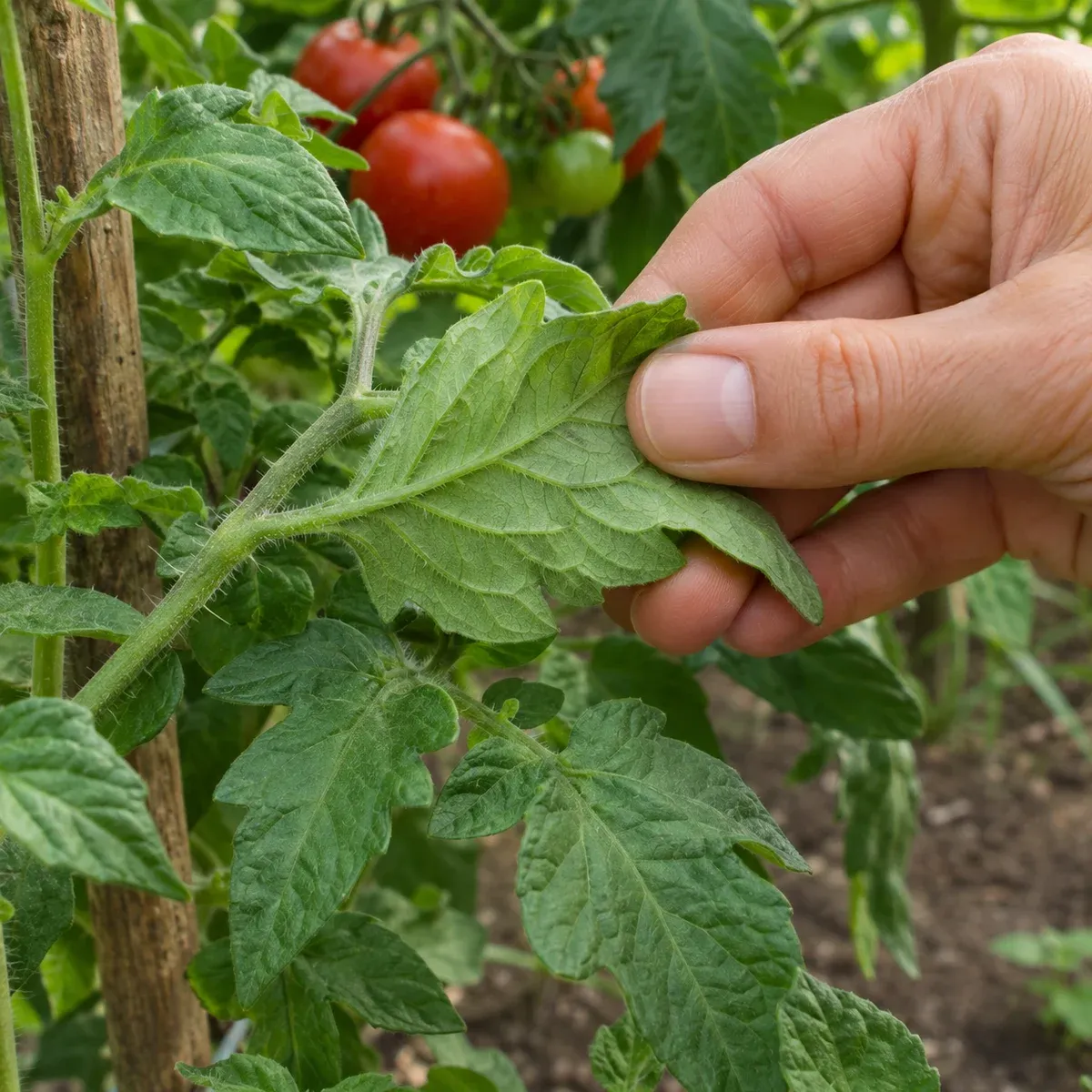
Turn over young leaves and examine the shoots. On tomatoes, aphids can form colonies as early as the nursery stage; they are often found on the undersides of leaves, sometimes on stems. White cast skins and a sticky deposit, honeydew, may accompany the insects. These signs are described by INRAE.
Aphids have a soft body, often pear-shaped, and their colour varies: green colouring alone is not enough to identify them. Some have wings. The University of California also describes two small tubes at the rear of the body in most species, easier to examine with a magnifying glass.
Their feeding punctures can distort young leaflets and slow growth. A dark sooty mould may develop on the honeydew. This does not turn aphids into a disease: distinguish the insect, its damage, and the fungi present on this deposit. Seeing distorted leaves without finding insects is not enough to conclude that aphids are responsible. Source INRAE.
Should you intervene at the first sign of aphids?
The RHS recommends tolerating their presence where possible and frequently monitoring plants. To decide, compare the same plants from one observation to the next: is the colony spreading? Are new shoots becoming distorted? Are natural enemies present?
- A few aphids, continuing growth, and stable colonies: continue observation, allowing natural enemies to act.
- Colonies spreading to young shoots and damage progressing: targeted removal may be appropriate, particularly on a young plant.
- A plant declining without visible colonies: broaden the diagnosis with the tomato disease observation guide; do not keep trying control measures against an unidentified pest.
These pointers help you monitor the plants; they do not constitute a numerical threshold valid for all tomatoes. Note the affected plants, the parts involved, and the progression, rather than aiming solely for zero insects.
Spotting natural enemies before acting
Adult ladybirds and their larvae, lacewing larvae, and hoverfly larvae are among the aphids’ natural enemies. The University of California’s tomato gallery shows these different stages: an elongated ladybird larva does not resemble the rounded adult.
Also look for aphids turned into ‘mummies’, appearing swollen, beige, golden brown, or sometimes black depending on the parasitoid. These indicate parasitism and should not be confused with white cast skins. In their presence, monitor colony development before deciding to intervene. Source and illustrations.
Avoid broad-spectrum interventions that destroy these natural enemies: the University of California highlights the impact of broad-spectrum insecticides on their populations.
Two physical control methods
For a small, accessible colony, the RHS suggests crushing aphids between thumb and forefinger. Work locally, without crushing the young shoot or any natural enemies spotted.
On a sufficiently robust plant, a jet of water can dislodge aphids. The University of California reserves this action for sturdy plants and recommends doing it early in the day to allow foliage to dry quickly. Adjust the jet: a stem bending sharply or a leaf tearing indicates it is too strong. Prefer manual removal on a fragile plant.
Afterwards, recheck the affected areas and new shoots. The aim is to see whether the situation is improving; no fixed frequency or permanent elimination is promised here.
Aphids and viruses: two different decisions
Some aphids can transmit viruses to tomatoes. For cucumber mosaic virus, or CMV, the vector acquires the virus from an infected plant and can transmit it through a very brief feeding puncture. A passing aphid may suffice: a large colony is not necessary. The presence of aphids alone does not prove your tomato is infected. CMV epidemiology, INRAE.
Reducing a colony does not cure an already established viral infection. INRAE states there is no effective cure for CMV, and treatments against aphids do not prevent epidemics of non-persistently transmitted viruses. The physical actions described here therefore do not guarantee antiviral protection. Limitations of CMV protection.
If you suspect a viral disease, the disease guide details the observations and notes needed to request an examination: it helps describe symptoms without turning a hypothesis into a diagnosis.
For the future, inspect plants before introducing them into the crop, as recommended by INRAE. Find other cultivation practices in the tomato guide.
Key points for this crop
Practical guidance
- Observation
- Young shoots and undersides of leaves
- Decision
- Colony development, damage, and natural enemies
- Intervention
- Targeted action suited to the plant’s sturdiness
Sources and references
- Tomato — AphidsINRAE, Ephytia, D. Blancard Accessed on 16 October 2026.
- Aphids — Home and LandscapeUniversity of California, Statewide IPM Program, in English Accessed on 16 October 2026.
- AphidsRoyal Horticultural Society (RHS), in English Accessed on 16 October 2026.
- Tomato — Natural Enemies of AphidsUniversity of California, Statewide IPM Program, in English Accessed on 16 October 2026.
- Tomato — CMV: ecology and epidemiologyINRAE, Ephytia, D. Blancard and G. Marchoux Accessed on 16 October 2026.
- Tomato — CMV: protection methodsINRAE, Ephytia, D. Blancard and G. Marchoux Accessed on 16 October 2026.