
The vegetable garden notebook / Crops
Staking Tomatoes: Choosing the Support and Tying Them Correctly
Select support for the mature tomato plant, considering its stems and fruit. Identify the growth habit of your variety, decide on a training method, then prepare supports at planting.
Adapt this guidance to your garden’s climate and conditions.
Starting with the Growth Habit and Training Method of the Tomato
The label or seed packet should help you distinguish between a determinate tomato, typically bushy, and an indeterminate one, whose growth continues. The latter requires support, notes the University of Minnesota.
For an indeterminate tomato trained to a single stem, the RHS describes a tall, sturdy stake, with side shoots removed. This training method does not require pruning all tomatoes. Retain the shoots of a bushy variety; if its branches bend under the fruit, local supports may suffice. Identify your variety before pruning.
If you opt for multiple stems on an indeterminate tomato, plan their supports: the NMSU describes several stakes, a trellis, or strings corresponding to the retained stems. Do not prepare only one attachment point for the central stem.
| Solution | For Which Training Method? | Work required |
|---|---|---|
| Individual stake | Indeterminate trained to a single stem, as per the RHS method. | Progressively tie the stem to the support. |
| Cage surrounding the plant | Multiple stems retained; the NMSU describes training without pruning in a cage. | Choose openings large enough to reach through for harvesting. |
| Stakes and strings on either side of a row | Several plants arranged in a line; system described by Clemson. | Add levels of string as the plants grow. |
To support a whole row, strings run along both sides of the row and are secured around intermediate stakes. Plants are held between them. This setup requires monitoring the entire row; its presence alone does not determine how many stems to retain. Clemson describes the system without presenting it as a universal solution for all gardens.
Installing Supports at Planting
Prepare the support at planting, as recommended by the University of Minnesota. Iowa State University warns that driving stakes in later can damage roots. Do not postpone their installation until the first fruits cause the plant to lean.
Two Examples of Supports in Open Ground
For single-stem training, Iowa uses a stake 7 to 8 feet in total length, approximately 2.1 to 2.4 metres, driven 30 to 60 cm into the ground. Distinguish between anchoring depth and available height: a 2.4 m stake driven 60 cm deep provides about 1.8 m above ground. This calculation illustrates the setup but does not guarantee stability in all soil types or wind conditions. Install it at planting and choose a material rigid enough for the mature plant.
For a cage, the same source describes a cylinder approximately 50 to 60 cm in diameter and 1.2 to 1.5 m tall, with mesh large enough to reach through for harvesting. The vertical ends at the base serve as legs to drive into the ground; then secure the cage to one or two additional stakes. If using cut wire mesh, remove any accessible sharp points. This setup allows multiple stems inside, which must be guided as they grow. Select its size based on the variety and necessary access, not the size of the young plant purchased. Iowa
In pots, also monitor the container’s balance. A tall tomato on a stake can make the whole pot unstable. The RHS recommends a sheltered location, ideally against a sunny wall. A sturdy stake is insufficient if the entire pot topples.
Tying Without Constricting, Then Monitoring Growth
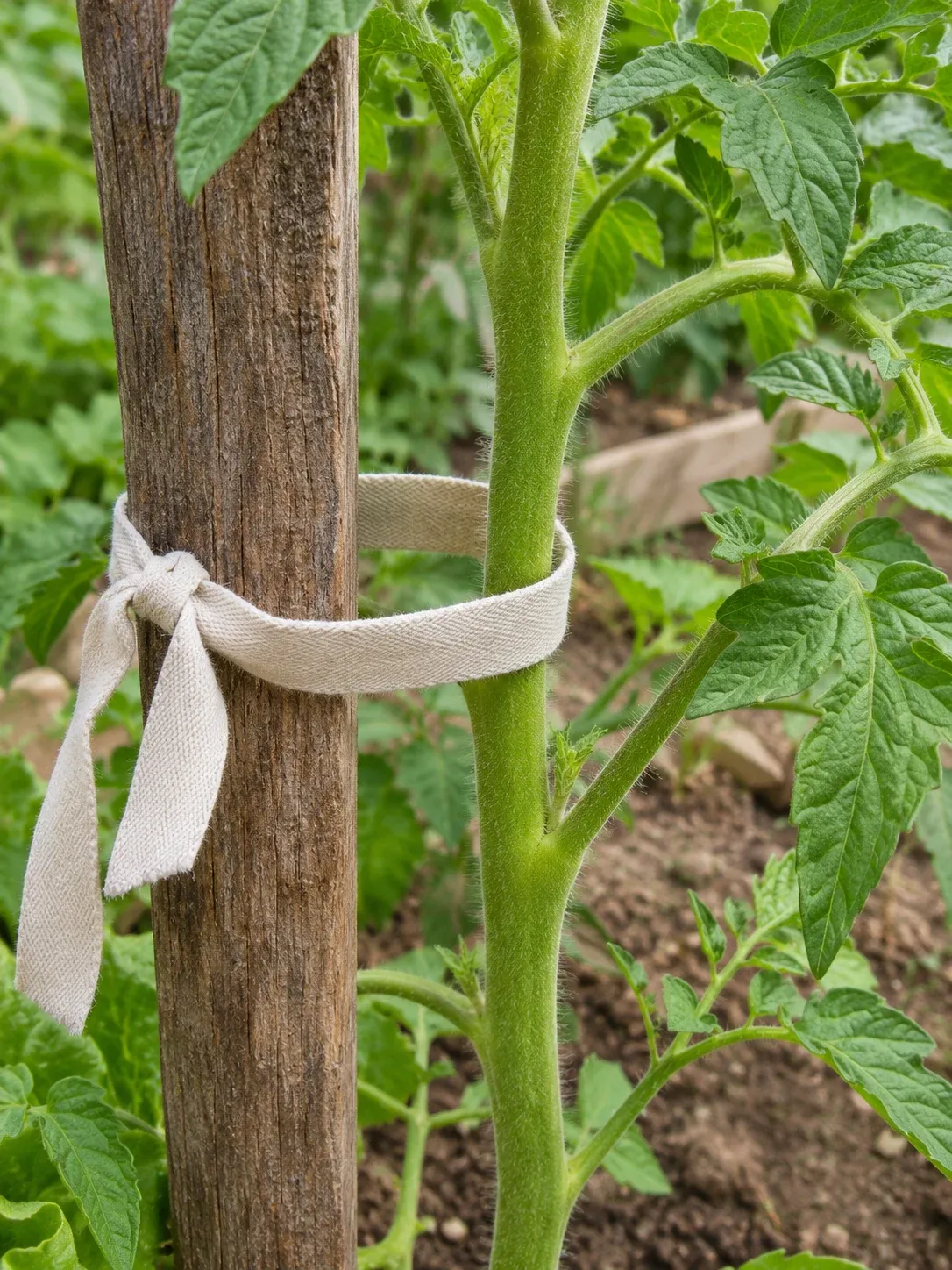
With an individual stake, use a flexible tie or fabric strip. Form a loose figure-eight: one loop around the stake, the other around the stem. This is the method described by Iowa.
Leave slack around the stem: the NMSU requires a loose tie to prevent constriction. During inspections, check that old ties are not tightening; loosen or replace those that compress the stem. Make these checks as the plant grows, rather than waiting for a fixed date.
Add new ties as the stem grows taller. In a cage, guide escaping stems back inside, as per Iowa. For a row held by strings, add successive levels as described by Clemson.
Finally, observe what your setup actually allows: access to fruit, well-supported stems, ties easy to adjust. Note the variety, chosen support, and any necessary corrections. These observations will help you select materials for the next season.
Key points for this crop
Practical guidance
- Support selection
- Based on growth habit and number of stems retained
- Installation
- At planting, before roots spread
- Ties
- Flexible and loose around stems
- Monitoring
- Add supports as the plant grows
Sources and references
- How to grow tomatoesRoyal Horticultural Society (RHS), in English Accessed on 15 October 2026.
- Growing tomatoes in home gardensUniversity of Minnesota Extension, in English Accessed on 15 October 2026.
- How to Train Tomatoes in the Home GardenIowa State University Extension and Outreach, in English Accessed on 15 October 2026.
- Tomato — Staking, Caging, and TrellisingClemson Cooperative Extension, in English Accessed on 15 October 2026.
- Home Vegetable Gardening in New Mexico — TomatoesNew Mexico State University, in English Accessed on 15 October 2026.