
The vegetable garden notebook / Crops
Blossom end rot in tomatoes: identifying apical necrosis
Blossom end rot refers to necrosis located at the end of the fruit, opposite the stem. This physiological disorder concerns the fruit’s calcium supply but does not prove the soil is deficient. Check the location of the lesion, then review watering and growing conditions.
Adapt this guidance to your garden’s climate and conditions.
Where is the blossom end rot patch located?
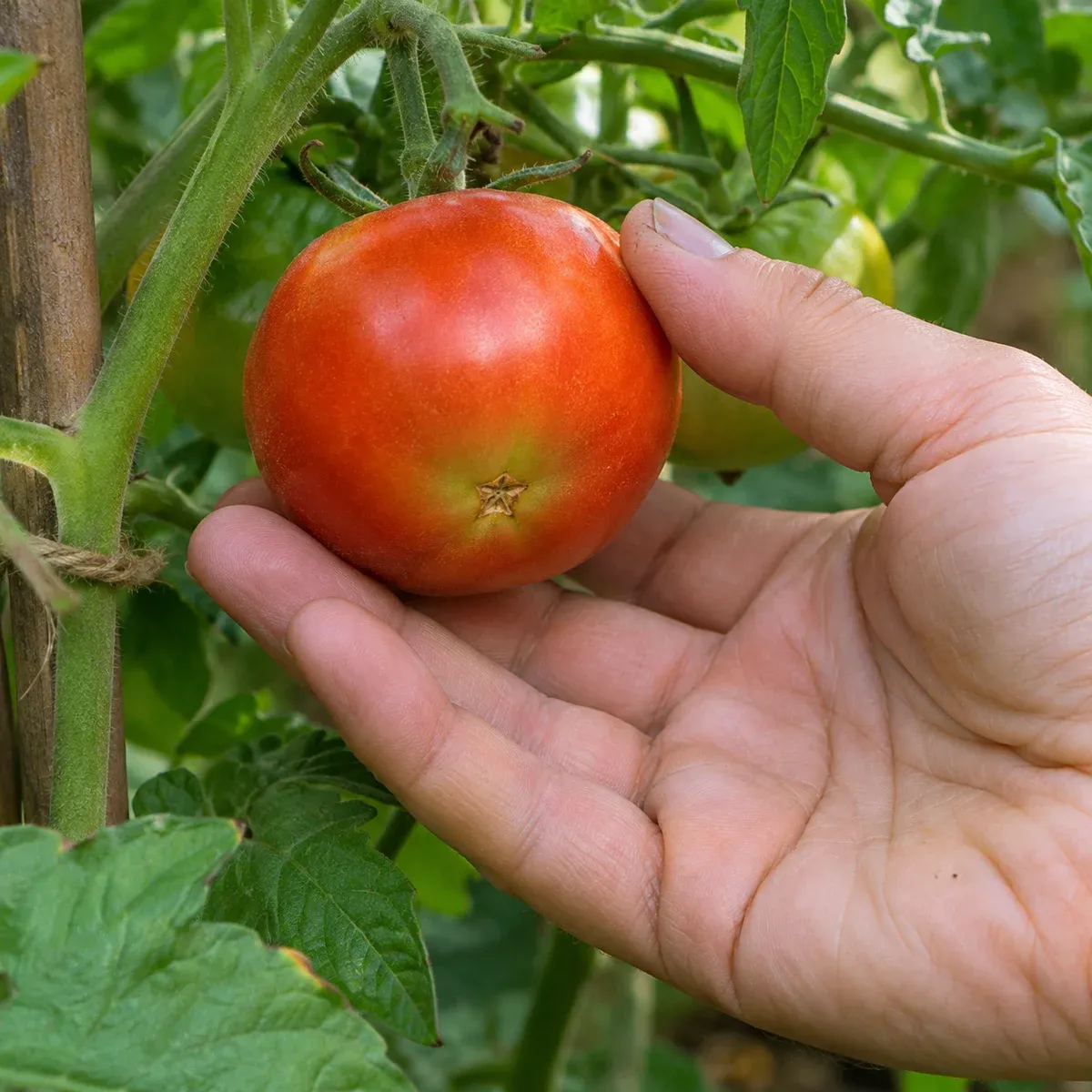
Identify the stem that connects the tomato to the plant. Blossom end rot appears at the opposite end, where the flower was, as specified in the INRAE diagnostic sheet.
The lesion may initially appear damp and poorly defined. It turns brown, widens, and typically becomes dark, sunken, and rather dry. It can affect tomatoes that are still green: waiting for ripening does not confirm or rule out this disorder. INRAE description.
Apical necrosis is not caused by a pathogen. A fungicide treatment will therefore not address the cause, according to the University of California.
Do not label every spotted tomato as blossom end rot
Examine the position of the lesion and the entire plant before taking action:
- Mottling on the fruit, leaves with oily-looking spots, and brown lesions on stems: these signs may suggest late blight affecting the above-ground parts, as described by INRAE. Consult the blight guide to continue your observation.
- Pale or whitish patch on the side exposed to the sun: also consider sun scorch, particularly after foliage loss, according to the University of Minnesota.
- Spots elsewhere on the fruit or unusual appearance: other causes exist; the INRAE guide to similar-looking disorders notably mentions Alternaria blight and anthracnose.
An apical necrosis zone may later be colonised by fungi or bacteria and rot, notes the University of Minnesota. Mould on the patch is therefore insufficient to determine the initial cause. If signs overlap or spread to multiple parts, seek a precise diagnosis before treatment.
Why discuss calcium if the soil contains it?
Calcium must be absorbed by the roots and then transported to the fruit with the xylem sap. Poor absorption or transport can leave the end of the fruit inadequately supplied, even without a general soil deficiency. INRAE explanation.
The RHS highlights the role of water circulation and competition between leaves and fruit for this supply. In pots, the limited root volume makes irregular water supply particularly important to monitor.
Adding calcium does not follow from the symptom alone. In open ground, a soil analysis can guide fertilisation, as recommended by the University of Minnesota. Do not increase fertiliser to “revive” the plant either: the RHS explains that a concentrated application on dry soil can hinder water absorption.
What steps should you take now?
- Check soil moisture around the roots before the next watering. The aim is to avoid both drying out and persistent saturation, according to the University of California. Soil already waterlogged does not require additional watering to combat blossom end rot.
- Adjust watering based on observations. Record rainfall, drying, and watering; aim for more stable moisture without imposing the same volume or frequency on all plants. The watering guide helps organise this check.
- Retain moisture and protect roots. INRAE recommends mulching and avoiding root damage during soil maintenance. The mulching guide details its implementation.
Will affected tomatoes recover?
No: the RHS states that an affected fruit cannot be repaired. The University of Minnesota recommends removing these fruits, which will not develop normally. Cultural adjustments apply to the rest of the crop.
Monitor new fruit and note the affected variety. If a variety remains particularly prone to the issue, the University of Minnesota suggests choosing a different one the following season. Keep this observation with your cultivation notes; a single episode does not justify attributing the entire problem to the variety.
Key points for this crop
Practical guidance
- Key sign
- Lesion at the flower end of the fruit
- Priority
- Consistent moisture without saturation
- Limit
- Necrotic fruit cannot be repaired
Sources and references
- Tomato — Apical necrosis on fruitsINRAE, Ephytia, D. Blancard Accessed on 16 October 2026.
- VigiJardin — Tomato blight: risks of confusionINRAE, Ephytia Accessed on 16 October 2026.
- VigiJardin — Tomato blight: symptoms and damageINRAE, Ephytia Accessed on 16 October 2026.
- Blossom end rotRoyal Horticultural Society (RHS), in English Accessed on 16 October 2026.
- Blossom End Rot — Home and LandscapeUniversity of California, Statewide IPM Program, in English Accessed on 16 October 2026.
- Tomato disordersUniversity of Minnesota Extension, in English Accessed on 16 October 2026.