
The vegetable garden notebook / Crops
Choosing a tomato plant: key points to check before purchase
Select a plant whose variety suits your space, then examine its stem, leaves and root ball. A compact young plant is a better purchase criterion than height alone; however, its appearance does not guarantee the absence of disease.
Adapt this guidance to your garden’s climate and conditions.
Check the label before comparing plants
Keep the exact variety name and look for its growth habit: determinate, indeterminate or dwarf. The RHS recommends this check before purchase, as space and support requirements differ. Also confirm that the variety suits your setup, whether outdoors or under cover.
A young plant may fit in a small pot but become very bulky. On a balcony, therefore, check the mature size and the training method the variety will need. Our guide to tomato varieties details these choices; here, the focus is on selecting a good specimen of the chosen variety.
If the label is missing, ask for this information before choosing. Photograph it or keep it with the plant to refer back to its instructions.
Examine the stem, leaves and root ball
Compare several specimens. The criteria from Iowa State University focus on how sturdy the plant is and on its visible parts, while those from Maryland specify the expected condition of vegetable seedlings’ roots.
| To inspect | To look for | To avoid |
|---|---|---|
| Silhouette and stem | Compact plant, sturdy stem, good structure. | Overly stretched, spindly or drooping plant. |
| Leaves | Green foliage, without mottling or significant damage. | Marked yellowing, numerous spots, dropping leaves. |
| Underside of leaves | No visible pests or damage. | Presence of insects or suspicious signs. |
| Root ball | White, firm and fibrous roots. | Brown and soft roots, or a thick mass of roots circling in the pot. |
| Growing medium | Consistent moisture. | Excessively dry or waterlogged root ball. |
Ask to examine the root ball by gently sliding the pot off. A few long roots circling at the bottom do not necessarily disqualify a plant: Maryland distinguishes this from a dense mass of circling roots caused by a plant being left too long in its container.
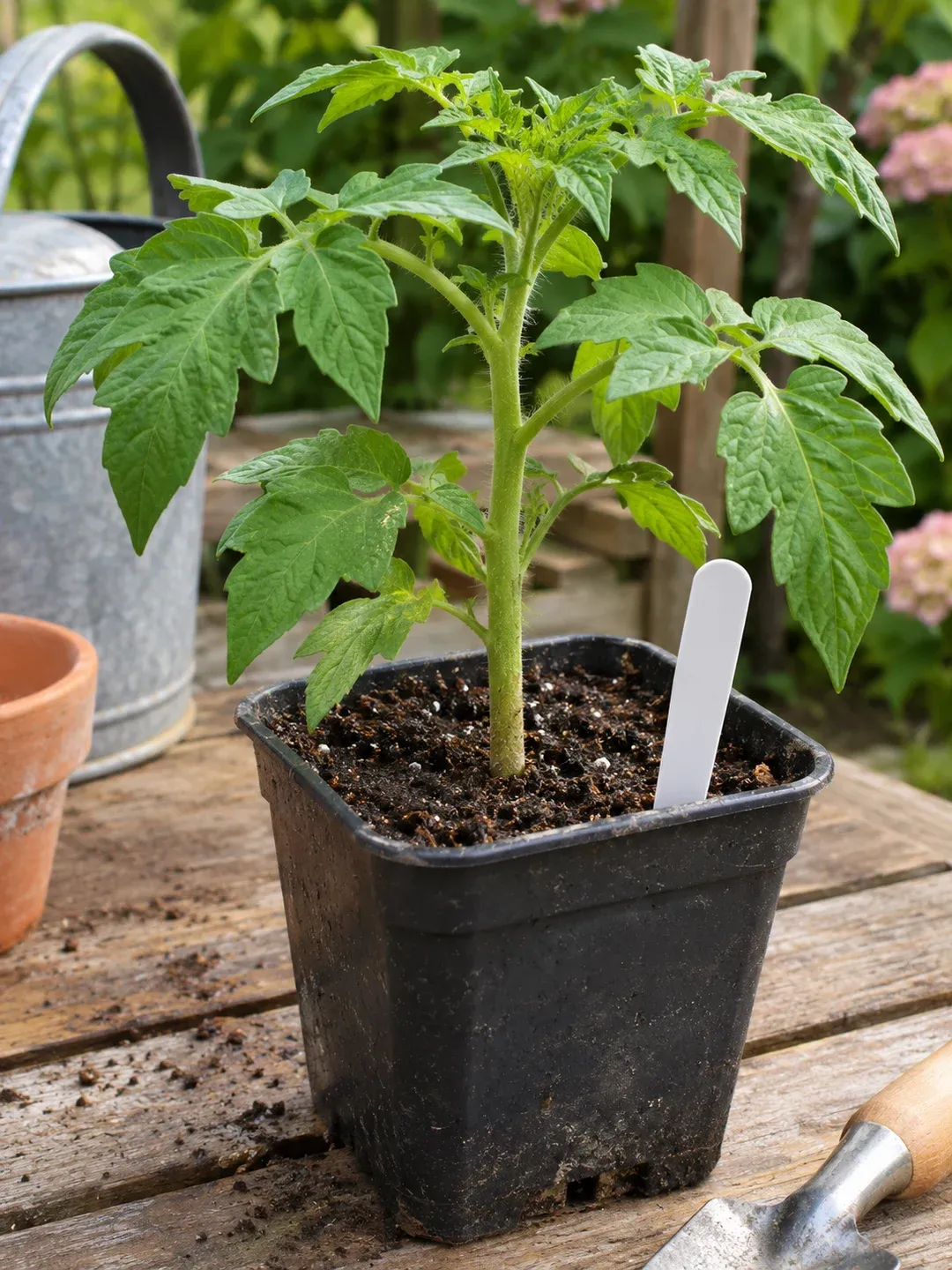
The tallest plant is not necessarily the best choice
Iowa State University advises choosing stocky tomato plants and discourages selecting tall plants already bearing flowers and fruit. When purchasing a young plant for transplanting, do not consider the presence of small tomatoes as a decisive advantage.
The stated age can complement your observations but does not replace examining the root ball and stem. Maryland particularly advises against overly mature plants whose stems become almost woody and whose roots form a dense mass. No single age in weeks guarantees that every plant is suitable.
Is a spot-free plant necessarily healthy?
No. The University of Minnesota explains that plants infected with bacterial canker may show no symptoms before purchase. Inspection helps rule out visible defects but cannot certify the plant’s health. If a plant looks suspect, do not buy it or try to identify or treat the disease on the spot.
Should you choose a grafted plant?
A grafted plant combines a fruit-bearing variety with a rootstock. According to the RHS, the rootstock may provide vigour and resistance to certain soil-borne issues. Its value depends on the specific problem targeted: ask for the rootstock name and advertised resistances. Grafting does not generally protect foliage from common diseases and pests, such as blight.
Identify the junction between the two parts. At planting, keep the graft point above the soil. The training resource from Oregon State University specifies that burying the scion may cause it to form its own roots, which are susceptible to the soil-borne problems the rootstock was meant to help avoid.
Plan for the wait before planting
Ask whether the plants were raised under cover and if they have already been acclimatised outdoors. The RHS notes that a plant grown in protected conditions must gradually adapt to the outdoor environment. This preparation does not make the tomato frost-resistant: wait until the local risk has passed before final planting.
If the plant is not acclimatised, begin with gradual outdoor exposure in a sheltered, shaded spot, then gradually increase sun exposure. Maryland recommends bringing tomatoes indoors at night if temperatures below 10 °C are forecast during this phase. Do not let them dry out to the point of wilting.
If planting must wait, provide a spot protected from strong sun, excessive heat and frost, and check the pot’s moisture. If you cannot ensure these conditions, postpone the purchase. The right time also depends on your ability to keep the plant in good condition until planting.
Finally, keep a record of the variety, purchase date and acclimatisation conditions. When the location is ready, proceed with the tomato growing guide and its planting guidelines.
Key points for this crop
Practical guidance
- Label
- Variety name and growth habit suited to the location
- Plant
- Compact, with a sturdy stem and no visible symptoms
- Roots
- White and fibrous, without a dense mass of circling roots
- Before planting
- Check acclimatisation and plan for shelter
Sources and references
- How to grow tomatoesRoyal Horticultural Society (RHS), in English Accessed on 16 October 2026.
- Tips for Shopping and Selecting Quality PlantsIowa State University Extension and Outreach, Aaron Steil, in English Accessed on 16 October 2026.
- Planting Vegetable TransplantsUniversity of Maryland Extension, Jon Traunfeld, in English Accessed on 16 October 2026.
- When purchasing tomato plants, are big or small plants better?Iowa State University Extension and Outreach, in English Accessed on 16 October 2026.
- Bacterial canker of tomatoUniversity of Minnesota Extension, in English Accessed on 16 October 2026.
- Hardening off tender plantsRoyal Horticultural Society (RHS), in English Accessed on 16 October 2026.
- Grafting vegetablesRoyal Horticultural Society (RHS), in English Accessed on 16 October 2026.
- Principles of Tomato GraftingOregon State University, English training material Accessed on 16 October 2026.