
The vegetable garden notebook / Techniques
Successful Seed Sowing: From Seed to First Leaves
A successful sowing begins before opening the seed packet. Choose where the plant will grow, check the seed’s requirements, and prepare a spot where you can monitor the first few days.
Adapt this guidance to your garden’s climate and conditions.
Practical steps
- Choose
A compatible species, period, and location.
- Sow
At the depth and spacing specified for your variety.
- Observe
Moisture, emergence, and the development of young seedlings.
Choosing Between Direct Sowing and Sowing in Pots
Direct sowing starts where the vegetable will continue to grow. Sowing in pots begins in a container before potential planting in the garden. The choice depends on the species and available conditions, as explained by the RHS.
Some crops are suited to direct sowing, while others benefit from a protected start when outdoor conditions are still too cold. Follow the instructions for your variety. Using pots is not a mandatory step for all vegetables.
Keep the distinction clear: planting a garlic clove does not constitute sowing seeds. In your notebook, clearly distinguish between sown seeds, transplanted seedlings, and planted bulbs.
Which Vegetables Can You Sow Directly in Open Ground?
Carrots and radishes are suited to sowing in their final location; their guides specify preparation and thinning. French beans also require sufficiently warm soil. Conversely, tomatoes and peppers benefit from a protected start when the outdoor season would be too short.
The Maryland guide presents squashes, cucumbers, and melons as suitable for either direct sowing or transplanting. The choice therefore depends on the crop, climate, and available setup; using pots is not a general requirement. To plan the year, use the twelve monthly calendars.
Read the Packet Before Preparing Materials
The SNHF emphasises choosing species and varieties suited to the region, soil, and season. Note the instructions for depth, spacing, and temperature when provided. There is no single temperature or time to emergence valid for all vegetables.
Prepare a label with the name and date. If trying several varieties, assign them separate containers. For a first attempt, a small, manageable quantity will allow you to observe each step without ending up with too many seedlings.
When Should You Start Indoor Sowing?
Start from the planned outdoor planting date and work backwards based on the growing time. The Maryland guide suggests, as an indication, five to six weeks for tomatoes, compared to three to five for cucumbers, squashes, or melons. Include acclimatisation in your planning and reassess the timing based on the weather.
Do not sow all packets on the same day. For each variety, note the intended outdoor date, its planting conditions, the indicated duration, and the space needed for pots. Sowing too early can result in cramped or leggy seedlings, warns the same source.
What Light Should Indoor Seedlings Receive?
A window may seem bright but not provide enough light for seedlings. Thin stems stretching towards it are a sign to investigate. The Maryland guide recommends fluorescent or LED lighting suitable for seedlings, with a benchmark of 14 to 16 hours per day. Follow the distance and usage instructions for your device: no single wattage or mounting height suits all lamps.
Reserve this space before sowing and monitor growth. Increasing heat does not compensate for insufficient light. The propagator guide helps track heat, water, and lighting separately.
Should Seeds Be Soaked Before Sowing?
Not as a matter of routine. For climbing beans, a response from Ask Extension advises against soaking and instead emphasises temperature, soil moisture, and depth. It does not justify soaking all peas or broad beans by analogy.
Follow the packet instructions for the exact species. If pre-treatment is required, adhere to it; otherwise, do not soak the seeds for an arbitrarily chosen length of time. Soaking does not replace good sowing conditions or viable seeds.
Preparing and Sowing
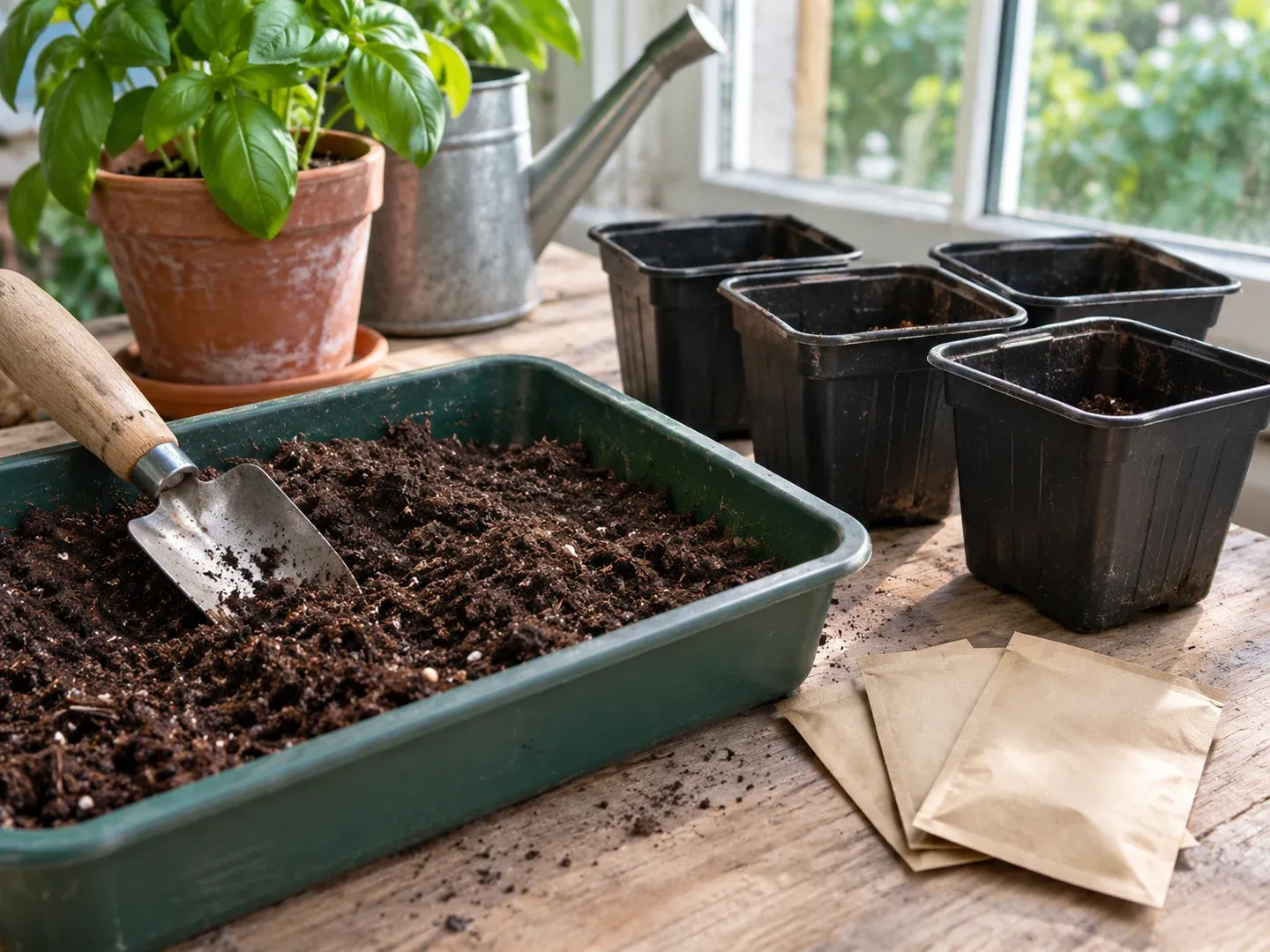
For pots, use a clean container with drainage holes and a substrate suitable for sowing. In open ground, prepare the soil so you can sow at the recommended depth. Here is a simple workflow:
- Identify the variety. Keep the packet handy to check its instructions.
- Distribute the seeds. Avoid sowing too densely; otherwise, you will need to thin more later.
- Cover according to the species. Follow the packet’s indication rather than a universal depth.
- Press lightly and water gently. The goal is not to displace the seeds.
- Label and record your trial. Note the location: windowsill, unheated shelter, or open ground.
The principles of density, depth, and gentle watering are detailed by the SNHF. Heat requirements for indoor starts are presented by the RHS.
How Do You Sow Basil?
For a specific example of this herb, the basil guide adds advice on choosing a plant and caring for it after planting to the steps above.
The RHS advises a warm start in small pots or cell trays filled with moist seed compost. Distribute the seeds sparsely on the surface; it suggests around 20 °C as a favourable benchmark for germination. Also follow the instructions for your variety.
After emergence, keep the seedlings warm and in abundant light without saturating the substrate. Separate them into individual pots when they have several leaves. For transplanting outdoors, acclimatise them and wait for warm conditions: basil dislikes cold, damp conditions.
Supporting Emergence Without Overwatering
Check the substrate’s moisture before each watering. A constantly damp, poorly ventilated environment with overly dense sowing encourages damping off. This disease can affect seeds before emergence or cause young seedlings to collapse, according to the RHS.
To reduce the risk, clean reused containers, use fresh, suitable substrate, and avoid standing water. Provide seedlings with sufficient light and ventilation, considering their temperature needs.
If seedlings collapse, the symptom alone does not confirm damping off. Consult the RHS guide before deciding on next steps. In case of damping off, it recommends not reusing affected pots or trays. For a new attempt, use a different container and fresh substrate.
Record your observations: note “surface still moist,” “first leaves visible,” or “three seedlings collapsed.” You will be able to link changes to the actions actually taken.
After the First Leaves
Seedlings sown too densely need thinning to have enough space. For those destined for outdoors, also plan gradual acclimatisation. The RHS recommends this transition before planting: moving from indoors to the garden changes temperature, wind, and exposure.
Decide the final location in advance. For each batch, keep a small record: sowing date, first observed emergence, number of seedlings kept, and planting date. These notes will allow you to calculate your own timings for future attempts under comparable conditions.
Understanding Common Challenges
Nothing Emerges: Should You Resow Immediately?
Before resowing, use the guide for seeds that do not germinate to assess the batch’s timing, temperature, water, and depth. It also details testing seeds left in a packet: keep your observation record to track separate trials.
Seedlings Collapse: Is It a Lack of Water?
Not necessarily. Damping off can cause this appearance, particularly in overly damp conditions. The symptom alone is insufficient to determine the cause. Examine the substrate, ventilation, and stem condition, then consult the prevention guide.
Adapting Actions to the Month and Weather
First, choose a crop compatible with your month and conditions in the vegetable garden calendars, then return to the corresponding sowing method. The calendar guides the choice; it does not replace the batch’s needs or field observations.
Select the Guide Based on the Next Step
If no seedlings emerge from a sowing, the guide for seeds that do not germinate details checks, testing seeds left in a packet, and storage. To produce your own seeds, start instead with harvesting and storing seeds.
If your goal is to harvest very young seedlings, consult the microgreens method. It covers selecting batches for this use, trays, and hygiene: this project differs from sowing intended for planting in the garden.
The steps in pictures
Two ways to start a crop
- Sow in the gardenIn the final position
- Let it growIn the same soil
- Sow in a potSeed + potting compost
- Raise the seedlingThe seedling stays in the pot
- Harden off the seedlingUnder coverOutdoorsGradually increase the time outside. It remains in the pot.
- Plant in the gardenWhen conditions are suitable
Choose the method based on the species, variety and your conditions. Using a pot is not a mandatory step.
Direct sowing: the seed is sown in the final position. In containers: the young plant first grows in a pot; if destined for the garden, gradual acclimatisation precedes planting.
Choose based on the species, variety and available conditions. Using a pot is not mandatory.
Based on RHS, sowing techniques.
Sources and references
- Seeds and sowing: the main principlesSNHF Scientific Council, Dominique Daviot and Philippe Monchaux Accessed on 15 October 2026.
- Seed sowing techniquesRoyal Horticultural Society (RHS), in English Accessed on 15 October 2026.
- Damping offRoyal Horticultural Society (RHS), in English Accessed on 15 October 2026.
- Starting Vegetable Seeds IndoorsUniversity of Maryland Extension, Jon Traunfeld, in English Accessed on 17 October 2026.
- Soaking pole bean seeds — response no. 746724Ask Extension, D. Lauer, Benton County Master Gardener, Oregon, in English Accessed on 17 October 2026.
- How to grow basilRoyal Horticultural Society (RHS), in English Accessed on 17 October 2026.