
The vegetable garden notebook / Techniques
Seeds That Fail to Germinate: Wait or Resow?
An empty row does not prove the seeds are at fault. Review the sowing conditions, check whether more time is needed or failure is likely, and test the batch without disturbing the whole row.
Adapt this guidance to your garden’s climate and conditions.
Practical steps
- Review
Note the crop, sowing date and conditions
- Compare
Verify the species-specific requirements
- Decide
Correct the cause before attempting again
How long should you wait for seedlings to emerge?
Start with the species, variety and sowing date. Compare the stated timeframe with the actual conditions: the University of Maryland notes that some crops germinate slowly and that soil that is too cold delays emergence or makes it uneven. There is no single number of days that applies to all seed packets.
Do not turn over the entire row during this check. Instead, note the location, chosen depth and rainfall or watering since sowing. If seedlings emerged and then collapsed, you are observing a problem after emergence: the general sowing guide helps distinguish this situation.
Check conditions in the correct order
- Temperature: measure in the sown area and compare with the crop’s requirements. The University of Maryland recommends a soil thermometer. Increasing heat for all species is not a universal solution; the heating mat should be chosen based on the identified need.
- Moisture: examine the substrate throughout its depth. The University of Minnesota warns that misting may wet the surface while leaving the container dry underneath. Maintain consistent moisture and allow excess water to drain.
- Depth and light: refer back to the packet instructions. The University of Minnesota specifies that some seeds require light to germinate. Covering every type of seed in the same way may therefore hinder germination.
- Row condition: look for crusting, clods or signs of seed displacement. The University of Maryland distinguishes these obstacles from a loss of seed vigour.
Record a precise observation, such as “container moist on top, dry at the bottom.” This provides a cause to correct in the next attempt, rather than repeating the exact same sowing.
Test the remaining seeds without resowing the entire row
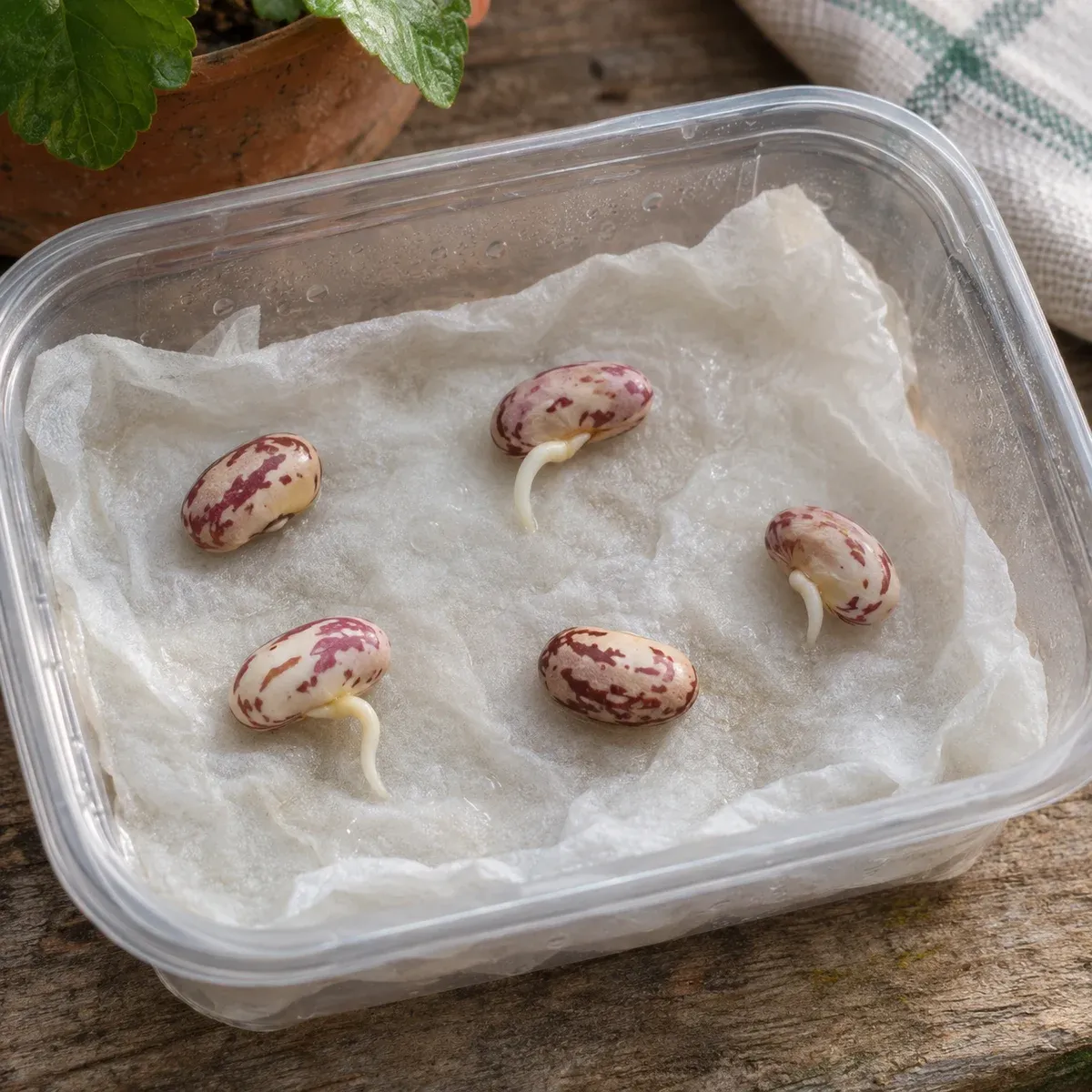
A separate test can help assess the batch. The Iowa method uses at least twenty randomly selected seeds, placed on pre-moistened paper, rolled to keep them separate, then placed in a labelled plastic bag. Follow the species’ temperature and light requirements: the result is only meaningful under suitable conditions.
The rolled paper method is not suitable as-is for seeds that require light to germinate, a need highlighted by the University of Minnesota. For these, follow the species-specific instructions rather than enclosing them in this setup.
Check moisture and root emergence regularly. Iowa begins observations after two or three days; this initial check is not the end of the test for all seeds. The protocol then waits until no new germination occurs for a week before calculating the result.
Divide the number of germinated seeds by the number tested, then multiply by one hundred. For example, 15 germinated seeds out of 20 give 75% for this test.
What should you do with the result?
Seeds germinate in the test, but the row remains empty: review the row conditions, particularly depth, moisture and temperature. The test makes a total loss of viability less likely; it does not, on its own, identify why the outdoor sowing failed.
No seeds germinate in the test: also check its conditions before discarding the batch. Iowa State University emphasises that age and especially storage affect viability. A date on the packet does not replace the test.
You decide to resow: ensure the crop and its cycle remain compatible with the local season. Sow another small, labelled batch after correcting the suspected factor. Use the guide to sowing your own seeds, then compare the two attempts.
Store an opened packet before the next sowing
Keep seeds dry and cool. Iowa State University advises an airtight container, such as a clean, sealed jar, to limit moisture and pest access. Do not store a dampened packet with dry batches. Retain its label: species, variety and producer information; add the opening date to track the history.
How long seeds remain viable varies with the species and storage conditions. Before the sowing period, perform the germination test for old or questionable batches. For seeds harvested from the garden, drying and sorting are separate preliminary steps, detailed in the guide to harvesting and storing seeds. Iowa
Should you add fertiliser to trigger germination?
The University of Minnesota notes that the seed uses its own reserves to germinate. Adding fertiliser to a row with no seedlings does not correct an unsuitable sowing depth or overly dry substrate. Address these conditions first; plant nutrition is a subsequent step.
Sources and references
- Poor Germination of Vegetable SeedsUniversity of Maryland Extension, in English Accessed on 18 October 2026.
- How to Store Seeds and Test Germination RatesIowa State University Extension and Outreach, Aaron Steil, in English Accessed on 18 October 2026.
- Starting seeds indoorsUniversity of Minnesota Extension, in English Accessed on 18 October 2026.