
The vegetable garden notebook / Techniques
Harvesting and Storing Your Seeds for Future Sowing
To save your own seeds, start with a known species and variety. Seed maturity, preparation, and storage conditions are as important as selecting the plant.
Adapt this guidance to your garden’s climate and conditions.
Practical steps
- Select
Identify a healthy plant and a variety with a known origin.
- Harvest
Wait for the species-specific maturity stage.
- Prepare
Separate seeds from debris, then adapt drying to the fruit type.
- Store
Label dried batches and protect them from heat and moisture.
Which seeds should you save to start with?
Peas, French beans, and tomatoes from open-pollinated varieties are accessible starting points. Collect seed from healthy, vigorous plants and label each batch as soon as you harvest it. Carrots and beetroot require a different approach: these biennials produce seeds during a second growing cycle. University of Minnesota
Keep the original packet: the species, variety, and any F1 designation will help you interpret the results. Seeds from an F1 hybrid may germinate, but their offspring may differ significantly from the parent. An open-pollinated variety may also cross with another compatible variety. “Non-F1” alone does not guarantee a true-to-type harvest. Iowa State University
If preserving the exact variety is your priority, learn about its pollination requirements and isolation needs before flowering. There is no single isolation distance that suits every vegetable.
Harvesting at maturity, by species
The stage at which seed is ready to save does not always coincide with the stage at which the vegetable is ready to eat. Organise separate batches rather than a general harvest at a fixed date.
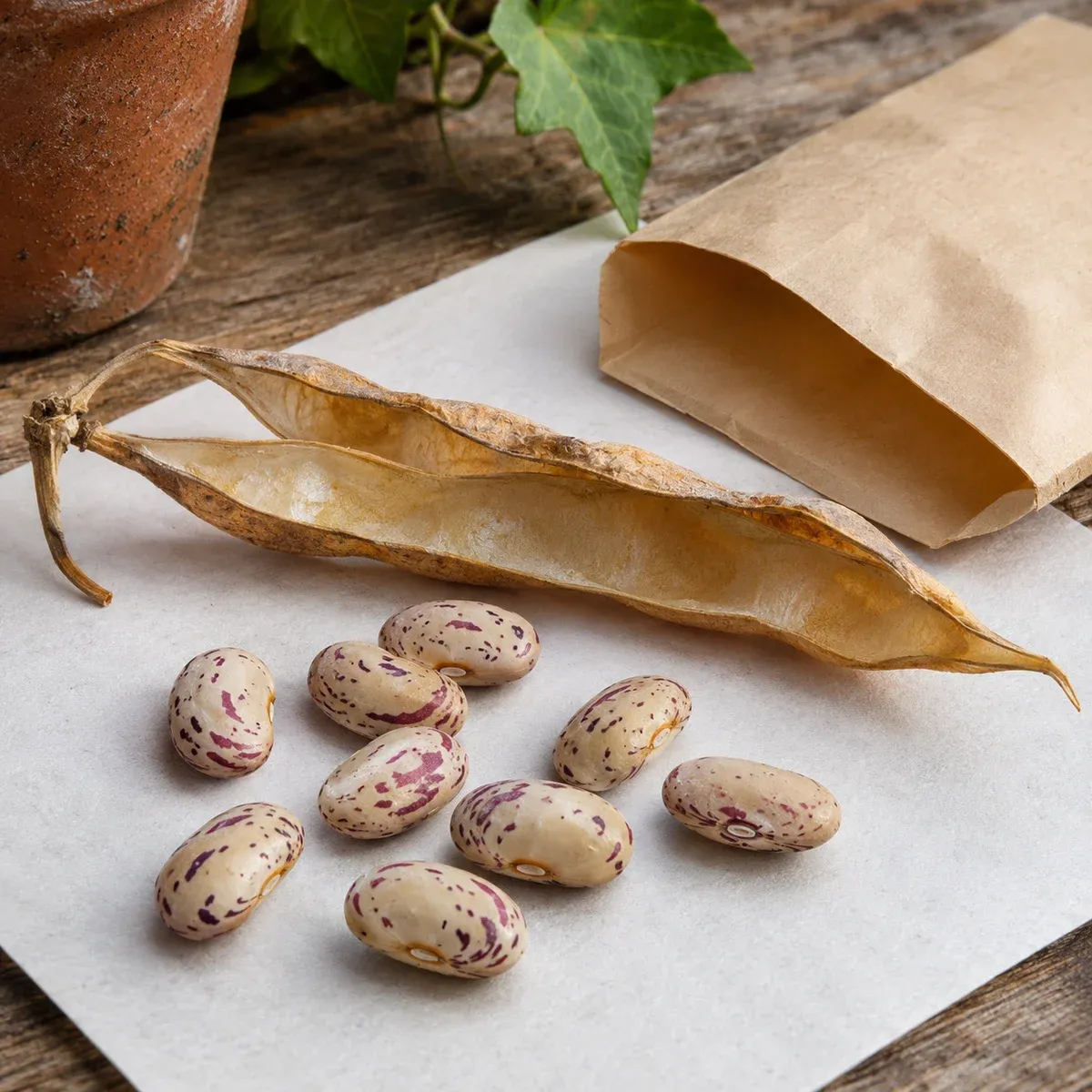
- Peas and French beans: leave the pods to dry and start turning brown on the plant, with seeds that rattle inside when shaken. Continue drying under cover before shelling.
- Sweet pepper: wait for a fully ripe fruit that begins to wrinkle, then extract and dry the seeds.
- Tomato: choose a fully ripe fruit; seeds surrounded by gel require wet cleaning.
These guidelines come from the vegetable-specific sections of the University of Minnesota. They do not provide a date valid in all climates.
For capsules and other dry seed heads, monitor their colour change and harvest before they disperse the seeds, in dry weather. Remove plant debris after extraction. RHS
Cleaning dry seeds and seeds from fleshy fruits
Seeds from dry pods are released by shelling; then separate the husks and debris. Seeds from fleshy fruits require removing the pulp, rinsing, and drying. The treatment must remain species-specific: soaking is not a method to use for every type of seed. Iowa State University
For tomatoes, the University of Minnesota describes fermenting the seeds with their gel in a container with water: stir twice a day and monitor the seeds, which should settle at the bottom within five days according to this method. Then remove the liquid, rinse, and spread out to dry. This step prepares seeds for sowing; it is not for preserving food. Tomato method
Spread the cleaned seeds in a well-ventilated place, away from direct sunlight and strong heat. A sieve or coffee filter can help separate batches. A food dehydrator may overheat and damage the seeds. Iowa State University
Store only when the batch is dry
Keep seeds spread out during drying: a paper envelope or bag used for collection does not mean the batch is ready to be sealed. The final closed container is only used after drying and removing debris. RHS, Iowa State University
For tomato seeds, the University of Arizona presentation suggests a seed that snaps rather than bends as an indicator; for French beans, a seed that shatters under a hammer blow rather than being flattened. This check sacrifices the tested seed: reserve a few for this examination. These drying indicators do not prove the health of the batch or its germination capacity; do not extend them to all species without verification. Drying tests, slide 24
Place the dry seeds in labelled envelopes, then in a sealed container kept cool and dry. Indicate the species, variety, date, and origin of the batch; add any known uncertainties about cross-pollination. Storage does not replace prior drying. RHS, Iowa State University
A forgotten envelope in a hot greenhouse or a damp shed does not offer the same conditions as a protected jar. Viability depends on the species, initial quality, and storage; no set number of years applies to all seeds. Before dedicating a row to an old batch, conduct a germination test and consult the guide to seeds that do not germinate. Iowa State University
What should you do with a questionable batch?
Do not save seeds from a diseased plant for your next sowing. Some infections, particularly bacterial canker in tomatoes, can be transmitted via seeds without obvious signs on them. Washing does not prove their health status. University of Minnesota
This process applies to seeds intended for sowing. For cultivation, continue with the sowing guide, following the germination requirements of the species.
Sources and references
- Seed: collecting and storingRoyal Horticultural Society, in English Accessed on 18 October 2026.
- Saving vegetable seedsUniversity of Minnesota Extension, in English Accessed on 18 October 2026.
- How to Harvest and Store SeedsIowa State University Extension and Outreach, in English Accessed on 18 October 2026.
- How to Store Seeds and Test Germination RatesIowa State University Extension and Outreach, in English Accessed on 18 October 2026.
- Seed Saving — Tests for Seed DrynessUniversity of Arizona, Yavapai County Cooperative Extension, September 2022, in English Accessed on 8 November 2026.