
The vegetable garden notebook / Techniques
Leggy Seedlings: Understanding Long and Fragile Stems
Very long and thin stems may indicate insufficient light or excessive heat. Start by correcting growing conditions; a seedling that collapses with a soft base requires further inspection.
Adapt this guidance to your garden’s climate and conditions.
Practical steps
- Observe
Compare stem elongation and its condition at the compost surface.
- Correct
Check light, temperature, and spacing between seedlings.
- Monitor
Observe new growth and prepare a new attempt if necessary.
Identifying a Leggy Seedling
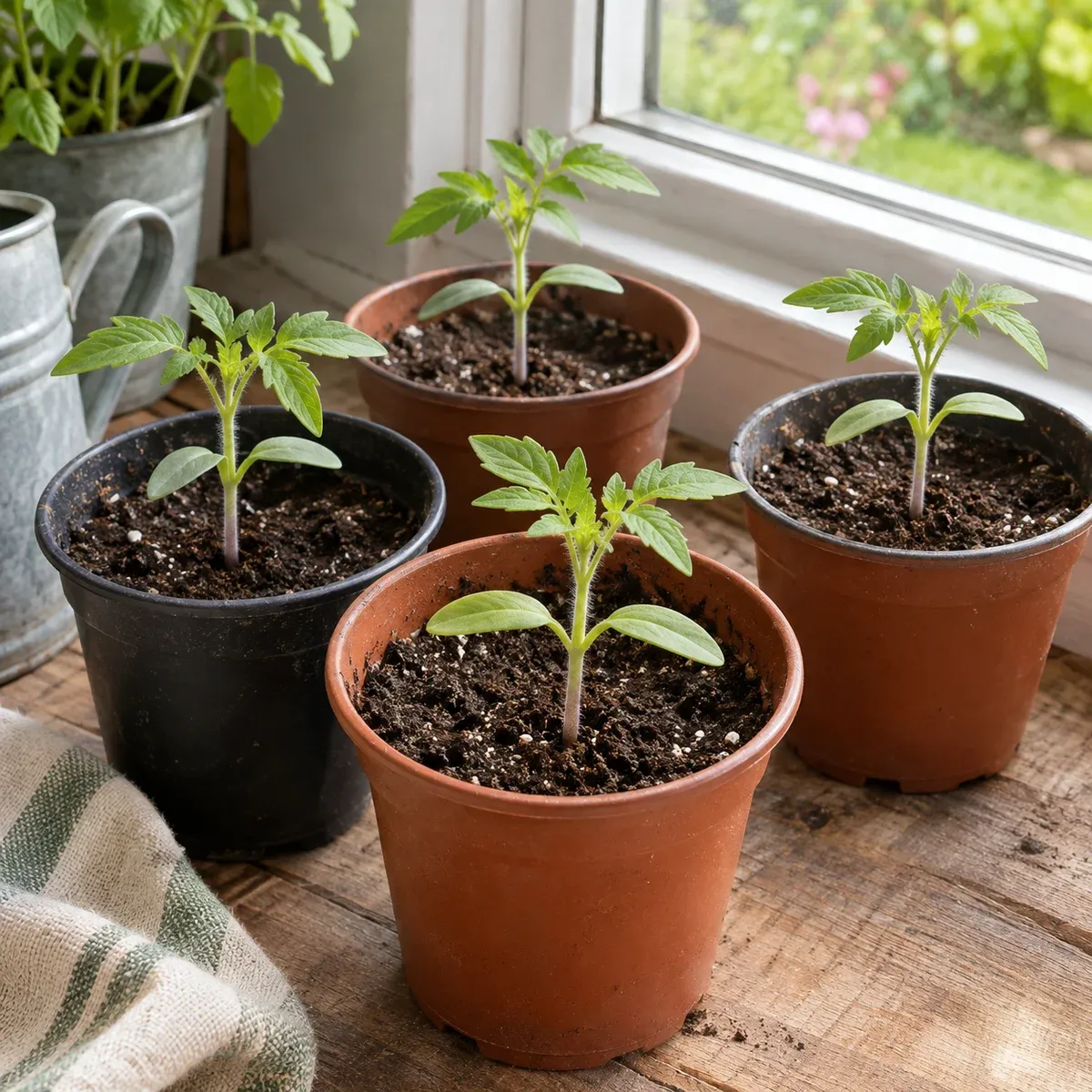
A leggy seedling develops a long, thin, and weak stem. It may lean towards the window. The University of Maryland links this weak growth to insufficient light, while UMass also notes excessive temperature. Height alone does not determine seedling quality.
Also examine its base. An area that has become soft, damp, and very thin may indicate damping off. This is not the same as a merely elongated stem: adding light will not treat an infection.
Checking Light After Emergence
A well-lit window does not necessarily provide enough light for seedlings. The University of Maryland emphasises this difference. Check the actual exposure of your containers and any obstacles in front of them.
If using a lamp, review its installation instructions and adjust its position as the seedlings grow. Distances recommended for fluorescent tubes do not apply universally to all lamps. Selecting appropriate lighting should precede the next round of sowing.
Adjusting Heat and Providing Space
Conditions suitable for germinating seeds may not be ideal for subsequent growth. Excessive heat promotes elongation, according to UMass. Verify the species’ requirements before maintaining supplementary heating; do not abruptly place a cold-sensitive vegetable outdoors to slow its growth.
As leaves develop, avoid keeping all seedlings crowded in the same tray. UMass suggests thinning or separating into pots, depending on the sowing method and the seedlings’ stage. The tomato sowing guide provides specific guidance for this crop, which does not automatically apply to all vegetables.
Deciding What to Keep for the Next Stage
First, correct the conditions, then compare new growth, rather than judging only the height already achieved. Continue monitoring seedlings whose bases remain firm and whose new leafy growth is more compact after adjusting light, heat, and space. Use this to assess progress after correcting the causes described by UMass.
However, a base that has become soft, thin, and unable to support the seedling suggests checking for damping off rather than waiting longer under the lamp. The University of Minnesota notes that affected seedlings rarely survive to become vigorous plants. If seedlings remain too weak to handle and you cannot provide better conditions, starting a small new batch is a possible decision; do not set a fixed deadline for discarding seedlings of every species.
Do not routinely bury the stems of all vegetables to “repair” them. A method specific to tomatoes requires its own cultivation guidelines; it does not treat damping off nor serve as a general rule for seedlings. If you start again, prepare light, space, and containers before sowing; seedlings sown too early can take up too much space and become difficult to care for, as the University of Maryland notes.
If you suspect damping off, consult the prevention measures from the University of Minnesota: clean equipment, fresh potting compost, and good drainage. Find these precautions in the seed compost guide, then review the general organisation of your container sowing.
Sources and references
- Starting Seeds Indoors: Caring for Your SeedlingsUniversity of Massachusetts Amherst, in English Accessed on 7 November 2026.
- Starting Vegetable Seeds IndoorsUniversity of Maryland Extension, in English Accessed on 7 November 2026.
- How to prevent seedling damping offUniversity of Minnesota Extension, Michelle Grabowski, in English Accessed on 7 November 2026.