
The vegetable garden notebook / Techniques
Seed compost: which should you choose for starting your seeds?
For small seeds in containers, choose a fine, well-draining growing medium with low nutrient levels. A dedicated seed compost is suitable; a suitable sieved multipurpose compost may also work. Garden soil and pure garden compost are not direct substitutes.
Adapt this guidance to your garden’s climate and conditions.
Practical steps
- Choose fineness
Opt for a fine texture for small seeds.
- Check the mix
Verify its intended use, structure, and existing nutrient content.
- Prepare
Moisten dry substrate, then fill clean containers with drainage holes.
- Monitor
Maintain moisture without saturation and observe young stems.
Should you use a special seed compost?
For small seeds, a fine, well-draining seed compost with low nutrient levels is a suitable choice. The RHS also accepts a peat-free multipurpose compost passed through a sieve. The goal is to achieve a smooth surface; sieving does not eliminate the need to check the nutrient content indicated for the mix.
For medium or large seeds, the RHS states that a multipurpose compost may suffice. It is therefore unnecessary to seek the same fineness for all batches. However, ensure the mix is intended for this purpose: “multipurpose” alone does not describe its texture. For depth and container choice for large seeds, refer to the courgette sowing guide.
This page covers pots, cell trays, and seed trays. The general sowing guide helps you decide whether your crop should start directly in the garden.
Garden soil, compost, and potting compost: three different uses
| What you have | For sowing in containers | Useful check |
|---|---|---|
| Special seed compost | A suitable choice for small seeds | Fine texture, drainage, and low fertility. RHS |
| Multipurpose compost | Possible depending on the mix and seed size | Check intended use and nutrients; sieve to achieve necessary fineness. RHS |
| Garden soil | Not a direct substitute for seed compost in trays | May be too dense and introduce unwanted organisms. University of Maryland |
| Pure garden compost | Do not use alone for starting seeds | Sieving does not reduce its nutrient content or transform it into seed compost. Garden Organic |
Potting compost is a prepared mix for container growing; garden compost is primarily used to improve soil. To compare their roles with fertiliser, see potting compost, garden compost, or fertiliser. Garden Organic
Check four criteria before filling pots
- Fineness: The texture must match the seeds. A fine mix facilitates sowing the smallest seeds; larger seeds can use a medium-textured mix. RHS
- Drainage: Opt for a light, aerated structure that allows excess water to drain. University of Maryland
- Moisture: The substrate must remain moist without becoming saturated. If watering from below, remove pots once the mix is moistened. RHS
- Fertility: Check the indicated nutrient content. Do not add fertiliser reflexively: some mixes already contain nutrients, and excess can damage seedlings. University of Maryland
Ingredients do not constitute a universal recipe. For a first attempt, start with a mix designed for sowing, then note its performance in your containers before modifying the composition.
Prepare the substrate without waterlogging
- Moisten before filling. If the mix is dry, gradually incorporate water in a clean container, stirring. The University of Maryland uses the benchmark of a wrung-out sponge, with no dripping water.
- Fill clean containers with drainage holes. Level the substrate and lightly firm, then sow at the depth appropriate for the seed. RHS
- Water gently and allow excess to drain. If watering from below, remove pots once the mix is moistened. RHS
The guide preparing a sowing session covers organising batches and labels. If no seedlings emerge, review the possible causes of non-germination before enriching the mix; if seedlings stretch, continue with leggy seedlings.
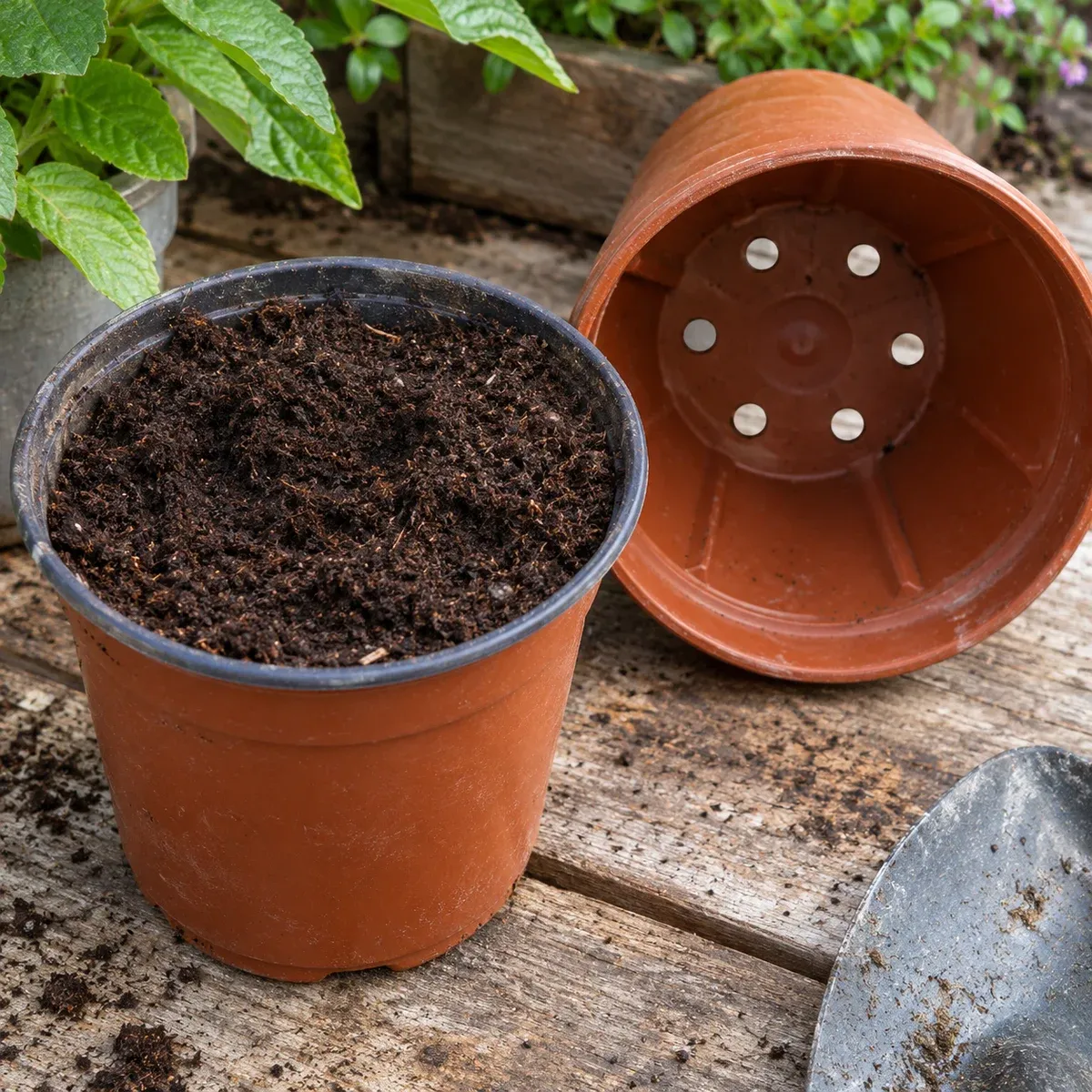
New potting compost does not guarantee the absence of damping off
Do not assume all potting composts are sterile. Damping-off pathogens can enter via tools, containers, or water shared between pots. The University of Minnesota recommends fresh substrate, clean and well-draining containers, and moisture without excess.
Insufficient light, a temperature too cold for the crop, or over-fertilisation also encourage this disease. Stems becoming soft and very thin may be a sign; wilting alone does not identify the cause. Refer to the damping-off guide and do not reuse substrate from an affected batch for restarting seeds.
Sources and references
- How to sow seeds indoorsRoyal Horticultural Society (RHS), in English Accessed on 16 October 2026.
- Grow to Eat — Seed Sowing IndoorsRoyal Horticultural Society (RHS), in English Accessed on 16 October 2026.
- Starting Vegetable Seeds IndoorsUniversity of Maryland Extension, Jon Traunfeld, in English Accessed on 16 October 2026.
- Garden compost or potting compost?Garden Organic, in English Accessed on 16 October 2026.
- How to prevent seedling damping offUniversity of Minnesota Extension, Michelle Grabowski, in English Accessed on 16 October 2026.