
The vegetable garden notebook / Techniques
Potting compost, garden compost or fertiliser: which to choose for your vegetable garden?
Potting compost provides a growing medium for roots; garden compost mainly improves garden soil; fertiliser supplies nutrients. To choose, start with the task at hand, then check the intended use and fertilisation indicated on the product.
Adapt this guidance to your garden’s climate and conditions.
Practical steps
- Define the use
Distinguish between container cultivation, repotting and soil improvement.
- Read the bag
Check which plants the mix is intended for, its instructions for use and any added nutrients.
- Prepare the container
Keep drainage holes clear and use a mix suited to the roots.
- Adjust maintenance
Monitor moisture and decide on feeding according to the potting compost, the plant and the instructions.
Is potting compost a fertiliser?
Potting compost is a growing medium; fertiliser provides nutrients. Potting compost may already contain fertiliser, but the two terms do not refer to the same function. University of Maryland · RHS
| Product | Primary role | Your project | Point to check |
|---|---|---|---|
| Potting compost | Provide a prepared mix for roots | Fill a pot or repot | Intended use, plants the mix is intended for and any fertiliser added |
| Mature garden compost | Improve soil and add organic matter | Amend a vegetable garden bed | Not interchangeable with ready-to-use potting compost for containers |
| Fertiliser | Supply nutrients | Supplement plant nutrition when necessary | Suitable product, dose and timing as indicated on the instructions |
Garden Organic distinguishes garden compost from mixes for containers; the RHS describes the nutritional role of fertilisers. Adding fertiliser does not correct overly compact potting compost or a pot without drainage: roots also need air and water. University of Maryland
To start seeds in pots or trays, use the comparison of seed-sowing composts instead. To improve vegetable garden soil, the compost guide explains this different task.
Which potting compost for a pot or repotting?
For vegetables grown in pots for one season, choose a mix labelled for this use. The RHS lists all-purpose potting composts among the options for these crops.
For a plant that will remain in a container for several years, look for a formulation designed for long-term use. Needs also vary by plant: a substrate intended for acid-loving plants is not a universal choice for the vegetable garden. RHS
When repotting an individual plant, choose a new pot sized to suit the root ball. An overly large container leaves a volume of moist potting compost that the roots do not yet occupy; the RHS notes the risk of waterlogging.
For small seeds, refer instead to the seed compost guide, which focuses on the mix’s fineness and fertility.
Should potting compost be used in open ground?
There is no need to routinely replace vegetable garden soil with potting compost. To add organic matter and improve the soil, mature garden compost meets a different need than filling a pot. Garden Organic
The RHS thus recommends garden compost as a soil amendment or mulch, rather than purchasing bagged potting compost for this purpose. If using a planting product, follow its stated use: instructions to mix it with soil do not mean it can be used on its own as a growing medium.
What to check on the bag?
Before filling containers, note three pieces of information:
- Intended use: sowing, repotting, container cultivation or planting, and the plants the mix is intended for.
- Existing feed: any added fertiliser, recommendations for further feeding and how long the initial feed is stated to last.
- Instructions for use: how to use the mix and advice on watering or maintenance.
The RHS emphasises these details: mixes differ in nutrient balance and in how they absorb and retain water. A homemade mix or routinely adding sand does not replace choosing an appropriate blend.
Keep a photo of the bag with the repotting date. You will find the useful instructions when deciding whether to feed, without assuming that two potting composts with the same name behave identically.
Prepare a moist medium that allows excess water to drain
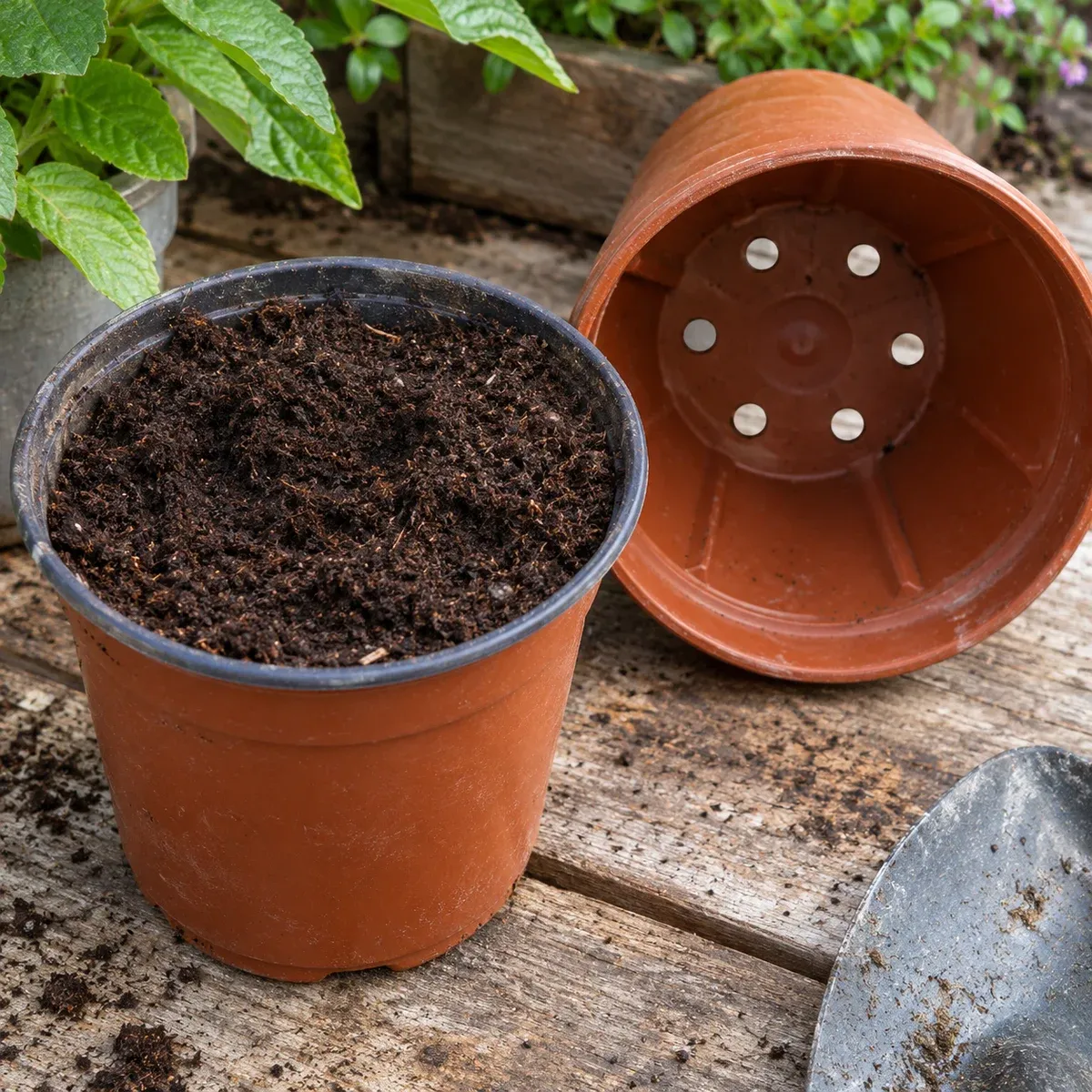
In a standard pot, ensure drainage holes remain clear. A layer of gravel at the bottom does not improve drainage and may encourage saturation of the potting compost above. Garden soil used alone may also be too dense in containers. University of Maryland
If dry potting compost absorbs water poorly, moisten it gradually while stirring before filling. It should be damp, without dripping. University of Maryland
After watering, do not leave the pot standing in a saucer of water for an extended period. The University of Minnesota recommends avoiding this prolonged saturation. To adjust your practices to actual moisture levels, continue with the watering guide.
Should fertiliser be added at repotting?
Do not add it reflexively: start with the potting compost’s instructions. An initial reserve does not guarantee nutrition for the entire season; watering can leach nutrients out of the pot. The timing of a supplement depends on the mix, watering and the plant’s growth. University of Minnesota
If supplementation is needed, follow the method, dose and timing indicated for the chosen fertiliser. No single dose can be carried over from one product to another. RHS The tomato fertilisation guide applies this reasoning to a specific crop.
Water drains from the pot but the root ball remains dry: what to do?
Drainage at the bottom does not prove the core has received water. Dried-out potting compost may allow water to run along the sides instead of penetrating the root ball. Washington State University advises checking the substrate again after watering.
Gently check beneath the surface without damaging the roots. If the core is still dry, loosen only the accessible surface crust, then resume watering slowly and gradually. Recheck the moisture in the root ball rather than immediately pouring a large quantity. WSU suggests breaking the surface and creating channels for water; in an already planted pot, do not dig blindly through the roots.
Let excess water drain and empty the saucer after rehydration. Do not keep the pot in water for an extended period to compensate for the dry spell, as saturation is discouraged by Minnesota. If water no longer drains at all, the issue is different: check the drainage holes and the container’s drainage.
Sources and references
- Garden compost or potting compost?Garden Organic, in English Accessed on 16 October 2026.
- Growing plants in containersRoyal Horticultural Society (RHS), in English Accessed on 16 October 2026.
- Peat-Free Compost ChoicesRoyal Horticultural Society (RHS), in English Accessed on 16 October 2026.
- Growing Vegetables in Containers and Salad TablesUniversity of Maryland Extension, in English Accessed on 16 October 2026.
- Fertilisers: Types and UsesRoyal Horticultural Society (RHS), in English Accessed on 16 October 2026.
- Fertilizing and watering container plantsUniversity of Minnesota Extension, Anne Sawyer, in English Accessed on 16 October 2026.
- Container Gardening, Puget Sound Gardening Tip Sheet 6Washington State University Extension Master Gardener Program, in English Accessed on 18 October 2026.