
The vegetable garden notebook / Techniques
Making your own compost: materials, moisture and maturity before use
Making compost mainly involves mixing different materials, allowing air to circulate and monitoring moisture. The start date alone is not enough to determine if it is ready for vegetables.
Adapt this guidance to your garden’s climate and conditions.
Practical steps
- Set up
Ensure access, dry materials and protection from excessive rain or sun.
- Mix
Combine moist, dry, fine and coarse materials.
- Monitor
Check odour, moisture and decomposition when adding materials.
- Use
Verify maturity and the crop’s needs before application.
Set up a pile or bin that you can monitor
Choose an accessible location for adding waste, turning and removing compost. Jardiner Autrement suggests a pile in the garden or a bin with one side that opens wide. Protect the mixture from drying out and waterlogging; ADEME advises considering shade, sun and rain. SNHF · ADEME
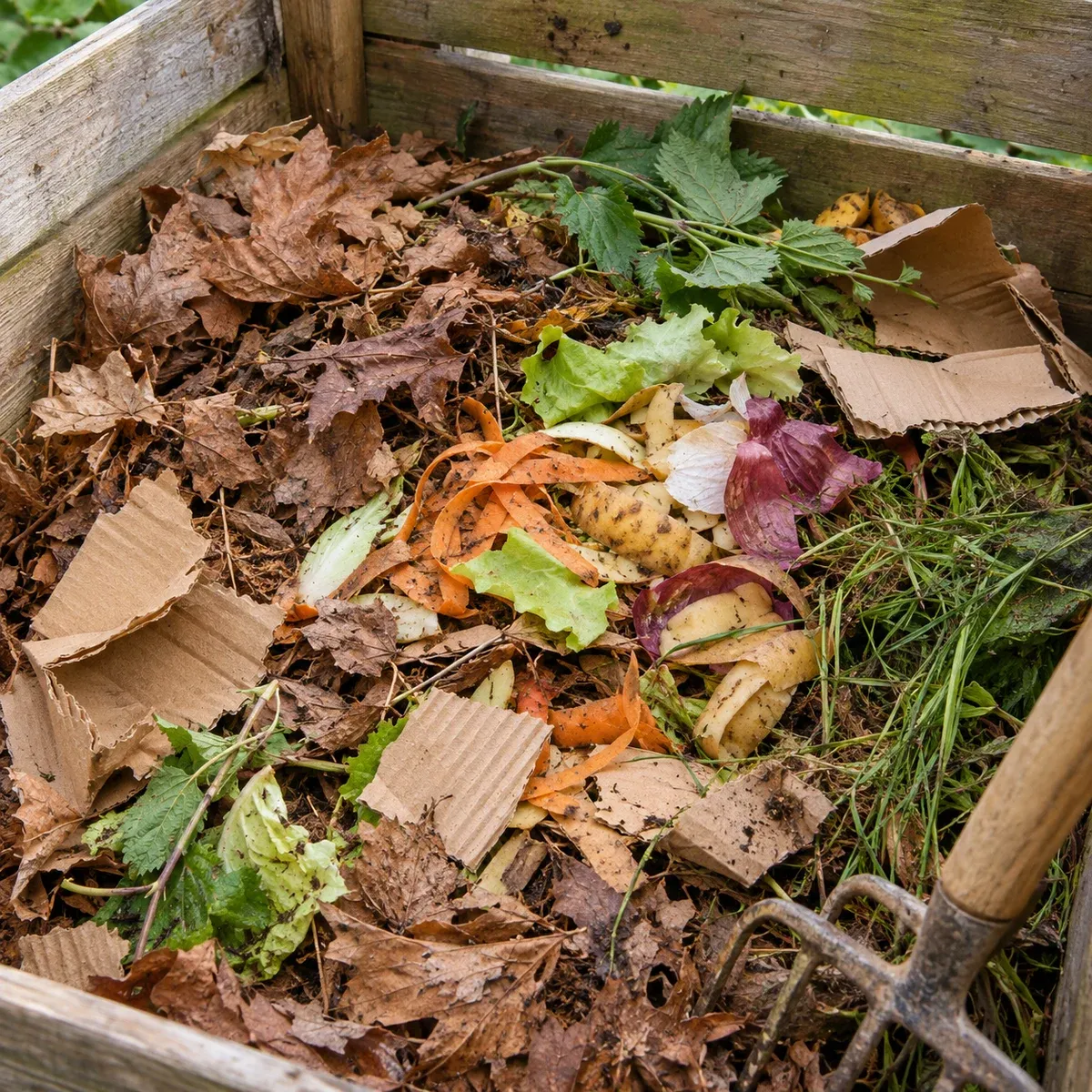
Keep dry leaves or small wood chips nearby to balance future additions. This organisation prevents accumulating only the moist materials available on the day you empty a bucket. SNHF
Which materials should be mixed?
ADEME recommends combining contrasting materials: moist and dry, nitrogen-rich and carbon-rich, fine and coarse. Mix, for example, vegetable peelings with dry leaves and small coarse pieces that help keep the mix open, breaking up bulky plant waste. Do not compact a large mass of a single material. ADEME
Painted or treated wood, plastics and chemical products have no place in this compost. To start simply, stick to plant waste you can identify. A local guideline for shared composting may be more restrictive: follow the one for your site. ADEME
Smells or dry materials: what can you try?
| Observation in the mixture | Point to review |
|---|---|
| Unpleasant odour, very moist or compacted material | Turn to reintroduce air; check protection from rain and lack of dry materials. |
| Dry waste that decomposes slowly | Gradually moisten and mix, then re-examine the interior. |
| A few large pieces still recognisable | Separate them from the mature compost and return them to the next cycle. |
These decisions follow ADEME’s and SNHF’s air and moisture checks. Odour alone cannot tell you whether compost is mature or safe to use. Change one factor, then observe what happens instead of automatically adding an activator.
Recognising usable compost
Jardiner Autrement describes mature compost as dark, crumbly and without an unpleasant odour. Partially decomposed compost retains recognisable elements and does not serve the same purpose. Observe these signs together; the duration varies with materials and conditions. SNHF
The SNHF reserves partially decomposed compost specifically for covering bare soil after autumn harvests or around shrubs. Do not confuse it with seed-sowing medium. For sowing in pots, do not use pure garden compost: choose a mix suited to this purpose, even if the compost appears mature. SNHF
In the vegetable garden, adjust applications to the crop and soil history, as explained by ADEME. Record the quantity applied in your notebook. The fertiliser guide distinguishes soil amendment from nutrition; the potting compost guide explains why garden compost does not automatically replace a seed-sowing medium.
From mature compost to its use on the plot
On an empty bed, start by checking which vegetable will follow and what has already been added. Spread the mature compost over the surface to be improved; if incorporating it, the SNHF describes lightly working it into the top 5 to 10 centimetres. This is shallow cultivation, rather than deep digging. Soil already enriched does not automatically require a new layer.
Between established vegetables, ADEME suggests spreading between rows in spring, before mulching. You might, for example, reserve this application for a tomato plot where the need has been assessed, without carrying the same quantity to all rows. Spread it where the soil is accessible; do not cultivate an area occupied by roots to repeat the method intended for an empty bed.
Quantities depend on the crop, the compost and the history: noting the application on the plan avoids accumulating compost, manure and fertiliser without reassessment. These examples are not a recipe for filling pots or a pure medium for seeds.
Can diseased plants or seeds be added?
Domestic composting does not guarantee the destruction of all pathogens or seeds. ADEME calls for precautions; do not assume your small pile reaches a sanitising temperature throughout. Keep suspect waste out of compost intended for young vegetable plants and check your local authority’s collection guidelines.
Sources and references
- 5 rules for successful compostingADEME, publication of 10 December 2025 Accessed on 18 October 2026.
- Compost: instructions for useJardiner Autrement, SNHF programme Accessed on 18 October 2026.
- How to use your compost in the gardenADEME, publication of 31 October 2025 Accessed on 18 October 2026.