
The vegetable garden notebook / Techniques
Fertilisers in the Vegetable Garden: Deciding Whether an Application Is Necessary
A fertiliser provides essential nutrients. Before adding any, check what the soil or potting compost already supplies, what you have previously applied, and the crop’s requirements. A poorly growing plant does not necessarily lack fertiliser.
Adapt this guidance to your garden’s climate and conditions.
Practical steps
- Assess the situation
Record previous applications, any potting compost used, and soil test results.
- Verify the need
Consider the vegetable, its growth stage, and cultivation conditions.
- Read the label
Examine its composition, intended use, dosage, and application method.
- Monitor applications
Note the quantity applied and the date before planning any further feeding.
Fertiliser, soil amendment, and potting compost: three distinct functions
A fertiliser provides elements essential for plant nutrition. A soil amendment aims to improve soil properties, such as its structure. A growing medium constitutes the environment in which roots develop. These functions are distinguished by the Directorate-General for Enterprises.
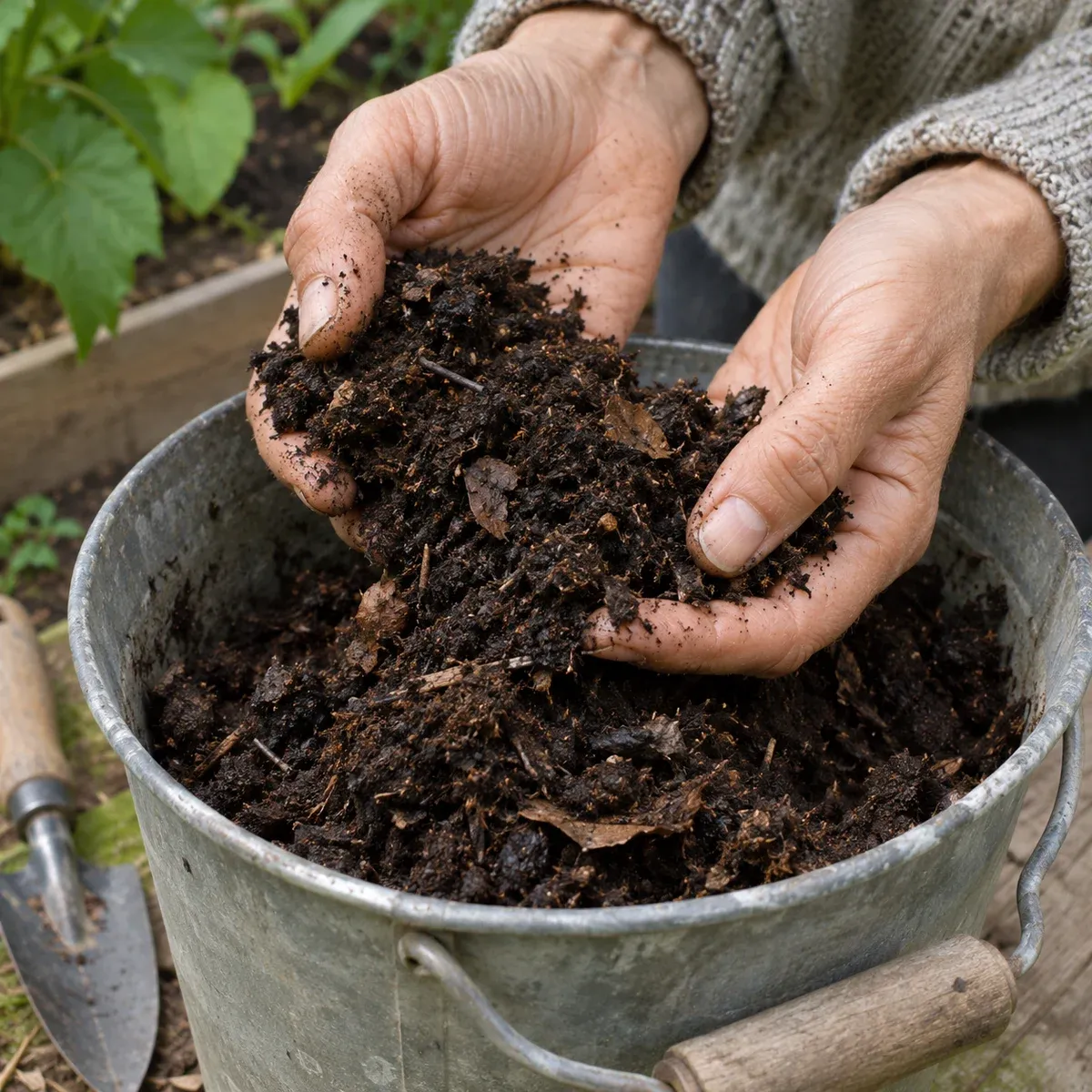
Potting compost used in containers is a growing medium; some blends already contain fertiliser. Garden compost can improve soil while also contributing to its nutrition. These inputs are therefore not independent: do not plan the next fertiliser application as if the vegetable garden had received nothing. RHS, University of Maryland
Start with the soil and previous applications
Before any purchase, gather your information: vegetables grown, garden compost or composted manure applied, fertilisers used, dates, and quantities. For containers, include the name of the potting compost and the feed it is stated to contain.
In open ground, a soil analysis with interpretation for vegetable gardens provides information on pH and nutrient reserves. Ask the laboratory for sampling instructions: a sample must represent the cultivated area. pH affects nutrient availability to roots. University of Maryland
A standard analysis does not necessarily include available nitrogen. This varies with weather and biological activity; recommendations also consider the crop. Therefore, provide the history of previous applications with your interpretation request. University of Maryland
Soil rich in organic matter may reduce the need for additional inputs. If the analysis already indicates high levels of phosphorus and potassium, adding more will not improve nutrition. Choosing not to apply any can therefore be a reasonable decision, to be reassessed based on the crop. University of Maryland
Understanding NPK without seeking a universal formula
N stands for nitrogen, P for phosphorus, and K for potassium. These elements contribute to plant growth; requirements vary by species and growth stage. The NPK composition indicates what a product provides, not what your soil lacks. RHS
A fertiliser containing all three elements is not automatically suitable for every bed. For example, the needs of a tomato differ from those of a French bean: the University of Maryland notes that tomatoes have a higher nitrogen requirement. Therefore, cross-reference the composition with the soil analysis and the vegetable’s needs, without applying the same fertilisation across the entire vegetable garden. University of Maryland
For a specific situation, the tomato fertilisation guide distinguishes between applications in open ground and containers.
Reading the numbers: a fictional example
Consider a solid fertiliser labelled NPK 5-3-7, with contents expressed as a percentage of mass. In 100 g of product, this represents 5 g of nitrogen (N), 3 g expressed as P₂O₅, and 7 g expressed as K₂O. The second and third numbers are therefore not directly grams of pure phosphorus (P) and potassium (K). This reading convention is described by the General Commission for Sustainable Development.
This calculation describes a composition. It does not mean that 100 g should be applied, nor that the soil requires all three elements. You must still read the declared forms and instructions, then compare them to the established need for the crop.
Organic or mineral: also consider the product form
Organic fertilisers derive from plant or animal materials. Mineral fertilisers may come from deposits or manufacturing processes. Organo-mineral formulations combine these origins. Jardiner Autrement
The rate of availability also matters: dry organic fertilisers depend on decomposition, while liquid forms may act more quickly. There are also controlled-release mineral fertilisers. The origin alone does not indicate the time to effect or application frequency. RHS
“Organic” or “natural” does not mean risk-free. Jardiner Autrement notes that an over-applied liquid organic fertiliser can pollute water. A slow-release product does not justify multiplying applications as a precaution. Jardiner Autrement
In containers, check the potting compost first
Watering can leach nutrients from containers. The need for additional inputs depends on the plant, available volume, watering regime, and product. However, a pre-fertilised potting compost provides nutrients for an initial period: read its instructions before adding another fertiliser. There is no universal duration for all potting composts. University of Maryland
Keep the bag or photograph the label. For young plants, the seed compost guide addresses growing medium selection; the amount of fertiliser cannot replace a root-friendly environment.
Pale plants are not a deficiency diagnosis
Yellow leaves, slow growth, or poor flowering may suggest a nutrient deficiency. However, drought, excess water, lack of light, or poor establishment can produce similar symptoms. Several deficiencies also resemble one another. RHS
First, check moisture, drainage, and exposure, then observe symptom distribution: a single plant or the entire bed, older or younger leaves, appearance after an application or weather change. These observations help request a diagnosis but are insufficient to choose an element to add. The watering guide helps assess soil condition.
Do not automatically add nitrogen for yellowing. Excess fertiliser can damage roots; too much nitrogen may promote foliage at the expense of fruit. Excess potassium can also hinder magnesium uptake. University of Maryland, RHS
Apply Fertiliser Only When It Is Needed
Once the need is established, note the product’s intended use, dosage, any dilution, frequency, and application method. These instructions depend on the formulation: a handful or capful is not an interchangeable unit between fertilisers. Follow the instructions and measure the quantity. RHS
Calculation exercise, without recommended dosage: Suppose a product’s instructions specify 30 g/m² for a precisely defined use. A measured area of 2 m × 1.5 m equals 3 m²; the corresponding quantity would be 30 × 3 = 90 g of product. If only half this area is treated, the calculation applies to 1.5 m², or 45 g. Measure the relevant area, excluding paths; do not reuse these figures for your actual fertiliser.
The NPK content and product dosage are not interchangeable: with the fictional 5-3-7 above, 90 g would contain 4.5 g of nitrogen (N). This still does not prove that this input is necessary. This example provides neither an application frequency nor liquid dilution.
Avoid clumps against stems and granules left on leaves. University of Maryland
Record the date, area, and quantity actually applied before deciding on additional input. If problems persist, revisit the diagnosis instead of increasing the dosage.
Manure: check decomposition and origin
Well-decomposed manure contributes to organic matter and nutrition but does not automatically replace all other fertilisers. Choose it based on the soil assessment and planned crops, accounting for this input in subsequent applications. RHS
Ask about the origin, bedding, and composting conditions. Material that is still heterogeneous and poorly decomposed is not equivalent to composted manure. The RHS recommends well-decomposed matter for incorporation and notes that some manures may contain herbicide residues. If in doubt about the origin, discard the batch rather than distributing it throughout the vegetable garden. Dark appearance does not guarantee the absence of contaminants. RHS
Do not apply fresh manure to beds intended for vegetables eaten raw, even without direct contact with the harvested part. Store materials under cover to protect from rain and prevent runoff into ditches and drains: nutrients can be leached. The timing and quantity to apply remain to be determined for your soil; a length of composting time or a particular calendar month does not guarantee that it is safe to use. RHS
Wood ash: check pH before any application
Ash provides potassium, in varying amounts depending on the wood, and increases pH. It is therefore not a complete fertiliser to be spread after every fire. If the soil is already alkaline or the analysis does not justify any input, keep it out of the vegetable garden. Adding it to compost does not eliminate its alkalising effect or the salts it contains. RHS
Consider only ash from untreated wood of known origin. Exclude ash from painted wood, coal, anthracite, briquettes, or mixed or unknown fuels. For these wastes, follow the disposal route indicated by your local authority. RHS
There is no universal handful for all soils and all ashes. Have the pH results interpreted and the need for an application assessed beforehand; handle cold ash without stirring up or inhaling dust and protect your skin. This fertilising use does not establish any effect against slugs. RHS
Nettle or comfrey liquid feeds: specify the intended effect
A nutritional input, biostimulation, and treatment against pests are three distinct effects. The reputation of a liquid plant feed does not demonstrate all three. To fertilise, you must be able to link the preparation’s composition to the soil’s needs; a homemade preparation does not inherently provide a known and reproducible NPK content.
The SNHF scientific council’s 2012 report distinguishes these effects and highlights the limitations of the trials reviewed. In several plant nutrition trials, mixtures or experimental conditions made it impossible to isolate the liquid feed’s effect. This older synthesis neither guarantees the effectiveness of each preparation in 2026 nor concludes that no extract can ever be effective. SNHF
For a purchased preparation, verify the stated function, composition, usage, and instructions. Do not replace an assessment of nutrient needs with routine spraying. For a comfrey liquid feed marketed as “rich in potash”, request a measured composition before counting it as a potassium input. You cannot work out a dose from the plant’s name alone. A claim of crop protection requires separate verification; do not treat it as a homemade pesticide recipe.
Human urine: distinguish a nutrient source from a properly treated product
Urine contains valuable nutrients, but urine collected at home, the stored urine fertiliser known as lisain, and fertilisers from specific treatments are not interchangeable products. The OCAPI/LEESU note from April 2025 examines, among other things, lisain used in agriculture in the Kolos project; this case does not validate every garden practice. OCAPI
Storage can reduce risks associated with pathogens under specific conditions. It does not guarantee the elimination of drug residues and other micropollutants: their fate depends on the substances and treatments. OCAPI
To decide on an application in the vegetable garden, prioritise a characterised fertilising material, with documented usage and conditions for your crop. This page does not provide a protocol for domestic urine collection, storage, or dilution: improvising one based on the Kolos trial would ensure neither appropriate fertilisation nor safety. A satisfactory nutrient balance can be maintained without applying urine.
Sources and references
- Fertilising materials and growing mediaDirection générale des Entreprises Accessed on 16 October 2026.
- Soil Testing and Soil Testing LabsUniversity of Maryland Extension, in English Accessed on 16 October 2026.
- Fertilizing Vegetable GardensUniversity of Maryland Extension, in English Accessed on 16 October 2026.
- FertilisersRoyal Horticultural Society (RHS), in English Accessed on 16 October 2026.
- Nutrient deficienciesRoyal Horticultural Society (RHS), in English Accessed on 16 October 2026.
- Maintaining Container Grown VegetablesUniversity of Maryland Extension, in English Accessed on 16 October 2026.
- Organic and mineral fertilisersJardiner Autrement, French National Horticultural Society Accessed on 16 October 2026.
- Organic matter: how to use in the gardenRoyal Horticultural Society (RHS), in English Accessed on 18 October 2026.
- Wood ash: using in the gardenRoyal Horticultural Society (RHS), in English Accessed on 18 October 2026.
- Plant protection, tradition and nettle macerationScientific Council of the SNHF, J.-L. Bernard, J. My and D. Veschambre Accessed on 18 October 2026.
- Unwanted substances in urine-derived fertilisers used in agricultureOCAPI Programme, LEESU, École nationale des ponts et chaussées, coordinated by F. Brun Accessed on 18 October 2026.
- What is agricultural land fertilisation? — FertilisersCommissariat général au développement durable, notre-environnement Accessed on 8 November 2026.