
The vegetable garden notebook / Crops
Sowing courgettes: in pots or directly in the garden
When planning to sow courgettes, work backwards from when they can grow outdoors. If you start seeds in warmth, you will then need light, space and a gradual move outdoors; wait until the soil has warmed up before direct sowing.
Adapt this guidance to your garden’s climate and conditions.
Choosing between pots and direct sowing
Pots are suitable if you have a warm place followed by a very bright spot to raise the plants before moving them outdoors. The RHS describes an indoor start as generally more consistent, also protecting seedlings from slugs and snails.
Direct sowing eliminates the transition from pot to garden. Wait until the soil has warmed up; young shoots will be exposed to outdoor conditions as soon as they appear. If you cannot monitor pots indoors, waiting to sow in place is a valid option. Both methods are included in the RHS cultivation guide.
When to start without sowing too early?
Courgettes are frost-sensitive: the SNHF advises waiting until frosts are no longer a risk before planting out. Plan based on your local climate, forecasts, and soil conditions. A national date or the Ice Saints alone are insufficient.
The University of Maryland warns that sowing too early can produce leggy plants with cramped roots, which perform poorly after planting. Before sowing, plan space for the pots after the seedlings emerge and allow time for gradual hardening off. If the garden will remain cold for a long time, delay the start.
Working backwards from a provisional planting date
The University of Maryland suggests three to five weeks before planting as a general guideline for preparing cucurbits; elsewhere on the same page, it describes raising them for two to four weeks. The main point is to keep the time before planting out short and adapt it to the plants and conditions.
For example, note a planned planting date, linked to the end of frost risk, then work backwards within this timeframe to prepare sowing. Then distinguish the stages in your notes:
- Sowing and emergence: keep the pots warm; the roughly one-week timescale mentioned below is only a guide.
- Growing on after emergence: provide bright light, monitor growth and allow room for leaves and roots.
- Hardening off: gradual outdoor exposure before final planting, with a return to shelter if the weather cools.
The RHS’s general two-to-three-week hardening-off period should not simply be added to a recommended age for planting out: it is part of preparing the seedling. If the way the seedlings are being raised or the conditions do not allow this gradual transition, postpone planting out rather than forcing the schedule. Maryland, RHS
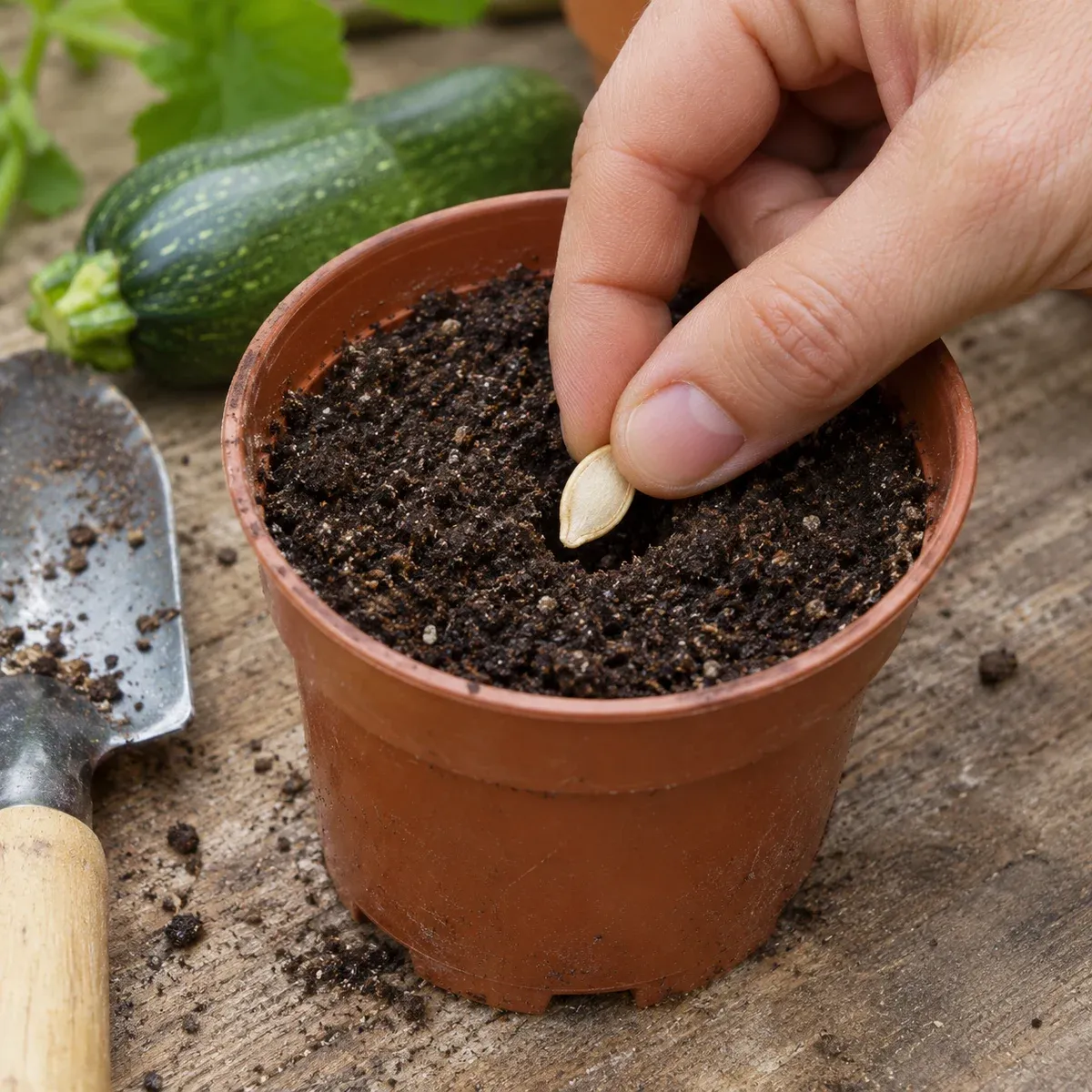
Sowing one seed per pot
Prepare pots with drainage holes and fresh seed compost, as advised by the RHS general guide. For each variety, keep the packet and prepare a dated label.
- Moisten the compost, then allow excess water to drain.
- Sow individually. The RHS suggests placing one seed on its side, about 1.3 cm deep, in a 7.5 cm pot.
- Place in warmth and light. The SNHF recommends around 20 °C, with moist compost but no excess watering.
- Watch for seedling emergence. If you used a transparent cover, remove it when seedlings appear, following the RHS.
These measurements are a guide to this method; also check the instructions on your seed packet. The sowing guide covers container preparation.
Monitoring emergence and growth
The RHS gives about one week as a guide to seedling emergence in pots kept moist at 15–20 °C. Record the actual temperature and when the first seedlings appear so you can track emergence before deciding the sowing has failed.
As soon as seedlings emerge, light becomes critical. The University of Maryland explains that a normal windowsill may not provide enough light: stems stretching and leaning towards it signal this issue. Reassess lighting rather than keeping plants in a merely warm area.
Check moisture before each watering. Waterlogged, poorly aerated compost encourages damping off, according to the RHS. Watering more is therefore not an automatic response when seedlings have not emerged.
If planting is delayed and roots fill the pot, move to a slightly larger pot: this is the RHS guide repotting guideline. This stopgap does not justify starting very early on purpose.
Sowing directly in the ground
Choose a sunny spot with loose, humus-rich soil, as per the SNHF. In warmed soil, the RHS suggests two or three seeds, 2.5 cm deep, at each sowing position, then thinning to the strongest seedling. Keep the soil moist while seedlings are emerging.
Allow at least 90 cm between plants, following the RHS guideline, or more if your variety requires it. Mark locations before sowing: the number of seeds available should not determine how many plants are kept.
If planting must wait
Keep plants in good light and monitor the compost. If roots fill the pot, the RHS guide advises moving to a larger container: transfer the entire root ball, protecting roots, rather than planting out in cold conditions to free up space. If plants become very leggy and cramped, the risks described by Maryland are a reason to prepare a small replacement batch while you can still raise it in good conditions. Starting over is not mandatory at the first delay; the choice depends on the plant’s condition, available space, and remaining season.
Hardening off and planting out
For courgettes raised under cover, the RHS recommends a gradual transition to wind, sun, and temperature variations. Start by putting the pots outside during the day in a sheltered spot protected from strong sunlight, then bring them back under cover at night. Increase exposure according to the weather.
The RHS gives a general guide of two to three weeks, adjusted to the conditions in which the plants were raised. Hardening off does not make courgettes frost-resistant. A return of cold weather requires delaying planting.
Once conditions are favourable, carefully remove each root ball without disturbing the roots, place it in the prepared spot, gently firm the soil, then water: these steps follow the RHS. The courgette cultivation guide covers their care from this point through to harvest.
Key points for this crop
Practical guidance
- Two options
- Pots kept warm or direct sowing in soil that has warmed up
- In pots
- One seed per pot, around 20 °C
- Before planting
- Gradually acclimatise and wait until the risk of frost has passed
- Plan ahead for
- Space for seedlings after emergence
Sources and references
- CourgetteSociété nationale d’horticulture de France (SNHF), Jean-Marc Muller Accessed on 16 October 2026.
- How to grow courgettesRoyal Horticultural Society (RHS), in English Accessed on 16 October 2026.
- Fascinating facts and figures: courgettesRoyal Horticultural Society (RHS), in English Accessed on 16 October 2026.
- Starting Vegetable Seeds IndoorsUniversity of Maryland Extension, in English Accessed on 16 October 2026.
- Sowing vegetable seedsRoyal Horticultural Society (RHS), in English Accessed on 16 October 2026.
- Hardening off tender plantsRoyal Horticultural Society (RHS), in English Accessed on 16 October 2026.