
The vegetable garden notebook / Crops
Watering courgettes: when to water at the base
Drooping courgette leaves at midday do not, on their own, mean the plant needs watering. First check the soil, then adjust your monitoring for young plants, fruit production, and containers.
Adapt this guidance to your garden’s climate and conditions.
Should you water your courgettes today?
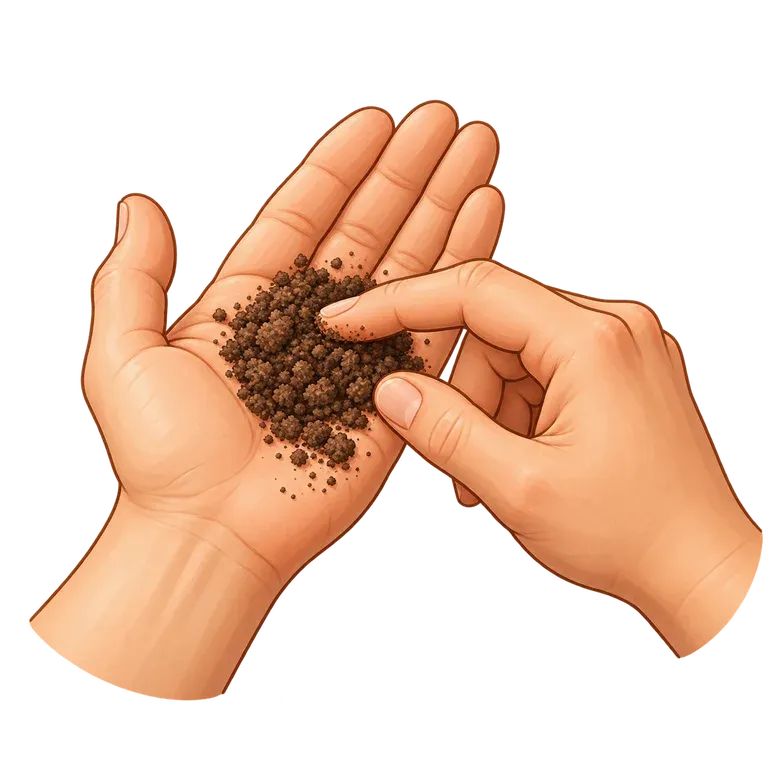
Move the mulch aside and examine the soil beneath the surface, next to the plant, without damaging its roots. The RHS recommends checking moisture in the root zone: wetting only the surface is not sufficient.
- The soil is drying out below the surface: water to moisten the area occupied by the roots.
- It remains moist: wait before watering and check again.
- It is waterlogged: stop watering and check the drainage.
There is no set number of litres or interval valid for all plants. Soil type and growth stage alter requirements, the RHS notes. Recent rain or watering does not replace this check.
Do leaves that wilt at midday indicate a lack of water?
Not necessarily. The University of Maryland explains that in heat, leaves can lose water faster than roots absorb it. A hot, dry wind can produce the same effect even when the soil contains enough water.
If the soil is still moist, observe the plant again when the temperature drops: the foliage may recover by the evening. If the soil is also drying out, the need for watering is confirmed; do not wait until the leaves stay wilted for a prolonged period.
Persistent wilting in very wet soil requires another check. The University of Maryland states that poor drainage can deprive roots of oxygen. Adding water does not correct this issue. If the plant does not recover or shows other damage, investigate the cause instead of increasing water applications.
Monitor young plants, then the fruit
After planting, water once the root ball is in place, as advised in the RHS courgette factsheet. Then monitor moisture around the young plant: young vegetables need consistent moisture, according to the RHS watering guide.
Continue this monitoring until harvest. The courgette factsheet emphasises the need for water during fruiting and when growing in containers. Consistent moisture does not mean keeping the soil saturated or watering automatically every day.
In pots, check the growing medium and saucer
Check the growing medium below the surface in each container. A brief shower may have only wetted the top; heat and wind accelerate drying. These points are included in the RHS container guide.
In a standard pot with drainage holes, apply water slowly to moisten the growing medium. Stop just before, or as soon as, the first drops appear at the drainage holes. Empty any water remaining in the saucer after a few hours: the RHS recommends this to prevent saturation. For a self-watering planter, follow its specific instructions.
Water at the base and retain moisture
Direct water towards the soil around the courgette, avoiding wetting the foliage. The RHS also advises mulching to limit water loss, with a clear space around the base of the stem. Continue to check the soil beneath the mulch. The general watering guide and mulching guide detail these practices.
Powdery mildew, in particular, is not simply caused by wet leaves: the RHS distinguishes between humidity in the air, which favours the fungus, and free water on the leaf. Do not reduce watering at the roots solely for fear of this disease.
For other steps, see the courgette growing guide.
Key points for this crop
Practical guidance
- First check
- Moisture below the surface
- Wilting leaves
- An indicator to compare with soil condition
- Fruiting
- Maintain consistent moisture
- Action
- Water around the base, without saturating
Sources and references
- How to grow courgettesRoyal Horticultural Society (RHS), in English Accessed on 16 October 2026.
- Watering vegetables and fruitRoyal Horticultural Society (RHS), in English Accessed on 16 October 2026.
- Wilting of Vegetable PlantsUniversity of Maryland Extension, in English Accessed on 16 October 2026.
- How to water containersRoyal Horticultural Society (RHS), in English Accessed on 16 October 2026.
- Powdery mildewsRoyal Horticultural Society (RHS), in English Accessed on 16 October 2026.