
The vegetable garden notebook / Crops
Powdery mildew on courgette: recognising the signs and taking action
A whitish courgette leaf is not necessarily diseased. Examine the appearance of the marks, both sides of the leaves, and their progression before pruning or treating.
Adapt this guidance to your garden’s climate and conditions.
White leaves: powdery mildew or cultivar markings?
INRAE describes powdery mildew as white, rounded, powdery to downy spots. These may appear on the upper or lower surface, often on lower and shaded leaves, then merge. Severely affected leaves turn yellow and dry out; petioles may also bear this felt-like growth.
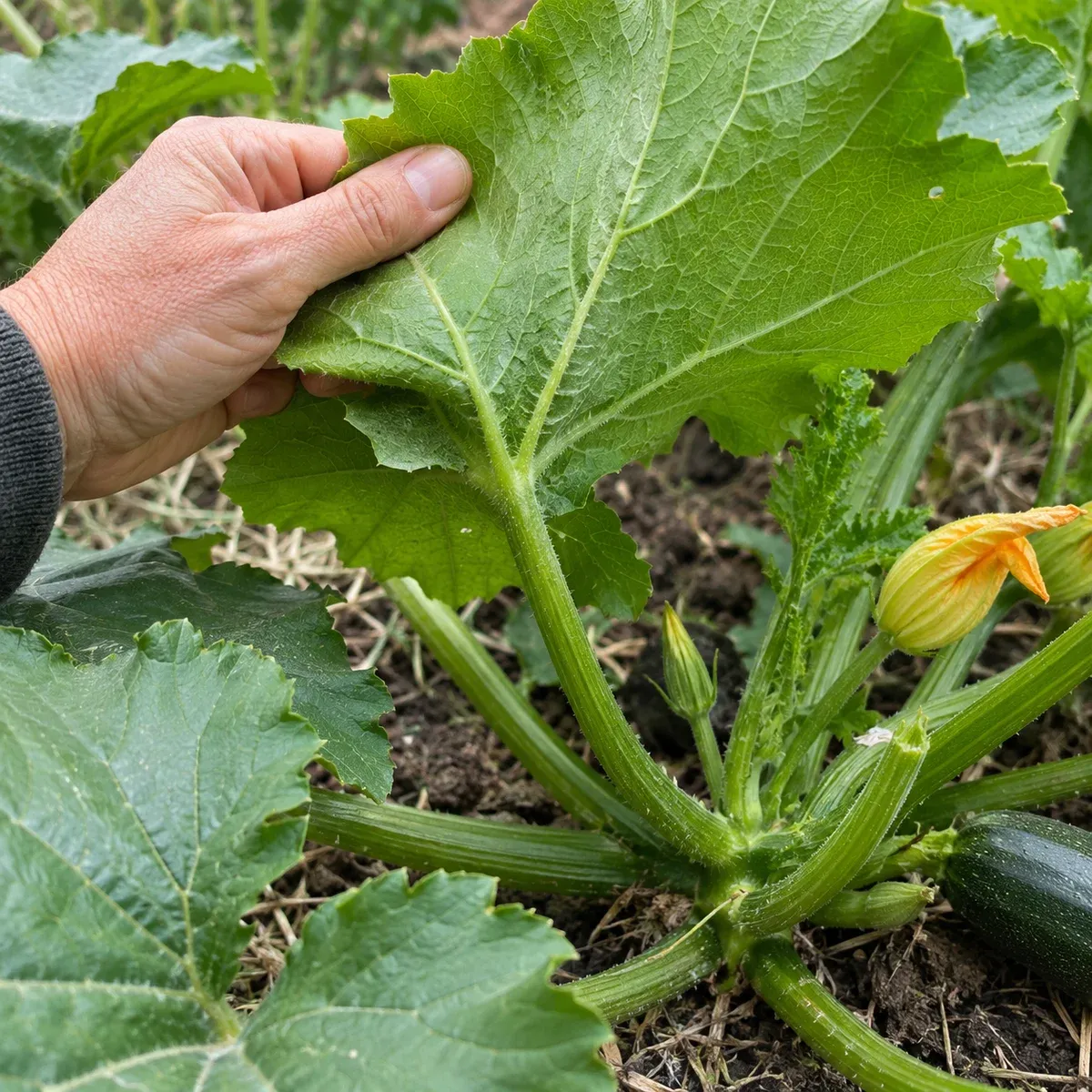
Some cultivars naturally exhibit angular silvery mottling. INRAE explains this as a local detachment of the epidermis, with no impact on the plant. It is a tissue characteristic, distinct from a powdery surface colony. Compare several leaves and, if available, previous photographs.
This distinction serves as an observation guide. Not all silvery areas are cultivar mottling: the same source distinguishes another silvering associated with whitefly. Additionally, powdery mildew may cause less typical yellowish spots on less susceptible cultivars, notes INRAE.
If you observe mainly yellow mottling, deformed leaves, or a collapsing plant, broaden your examination. The RHS also describes viruses, mite damage, and rots among squash problems. These signs alone do not justify selecting a treatment for powdery mildew.
Why does powdery mildew appear even without rain?
Ambient humidity and wet leaves are not equivalent. Powdery mildews of cucurbits do not require a film of water on leaves to develop. Ambient humidity may favour infection, while contact with water can damage spores. INRAE also notes their wind dispersal and the susceptibility of shaded foliage areas.
The source warns that the requirements of the fungi involved are difficult to distinguish. Thus, no universal temperature or humidity threshold can be deduced, nor can every outbreak be explained by watering or rainfall.
Do not, however, let the roots go short of water: the RHS indicates that drought-stressed cucurbits are more susceptible. Water the soil according to its moisture level and use mulch while keeping the base of the stem clear. The watering guide helps you decide when to water.
What should you do when suspicious spots first appear?
Start by examining both sides of several leaves. Note the cultivar, affected parts, and progression; a photo of the whole plant and a close-up will help you seek advice if the signs remain unclear.
When the appearance matches powdery mildew and only a few leaves are affected, INRAE suggests carefully removing them, placing them directly into a bag, and then removing them from the crop. This limits dispersal during handling.
Next, promote air circulation: clear weeds around the plants and ventilate any protective structure. Avoid excessive nitrogen applications that encourage overly dense growth. These measures are included in INRAE’s protection advice.
If many leaves are affected, do not turn this targeted removal into complete defoliation. Foliage also protects fruits from sunburn; INRAE reports more burns when numerous leaves have been destroyed. When the crop is finished, remove affected debris from the plot, following hygiene measures.
Can you still harvest, or should you end the crop?
Powdery mildew on leaves does not mean every courgette is infected. The University of Minnesota states that powdery mildew does not directly infect squash fruits, unlike occasional infections on melon or cucumber. However, foliage destruction reduces yield and exposes fruits to sunburn. INRAE also describes reduced growth and sun damage. Minnesota · INRAE
You can therefore monitor foliage and harvest separately: check whether the plant retains functional leaves and continues to set fruit, then inspect each courgette. This reasoning does not guarantee the safety of a soft, rotten, or differently damaged fruit; in such cases, revisit the fruit observation guide rather than attributing all damage to powdery mildew.
This guide does not set a percentage of affected leaves at which you must uproot a plant. When foliage is largely destroyed and fruits no longer develop, assess the crop instead of continuing endless defoliation. The disease may cause premature ageing; once the crop is finished, remove affected debris following the INRAE measures already described. INRAE, symptoms · Protection
Should you spray something?
The RHS advises against homemade preparations, which are generally untested. Its product references pertain to the UK: they do not constitute a recommendation for French gardens. This page therefore provides no recipe, dosage, or product whose use on courgette in France has not been verified.
Do not improvise a treatment by spraying water either. The RHS explains that water may slow powdery mildew but that leaves that stay wet encourage other diseases. Soil management and ventilation remain the recommended practices here.
Preparing for the next crop
Choose a sunny, sufficiently spacious location to avoid crowded foliage. When selecting seeds, look for cultivars explicitly advertised as resistant to powdery mildew: the RHS notes that some courgettes possess this trait, without guaranteeing the absence of symptoms.
Keep the cultivar name and your observations to compare trials. The courgette growing guide covers general planting and care; this page helps decide what to observe and how to respond to spots.
Key points for this crop
Practical guidance
- Sign to examine
- Powdery white spots that spread
- Common lookalike
- Silvery mottling of certain cultivars
- Prevention
- Space, air circulation and watering suited to the soil
- Limitation
- Rain alone does not explain powdery mildew
Sources and references
- Courgette and squash — Powdery mildew: main symptomsINRAE, Ephytia — D. Blancard and V. Mayet Accessed on 16 October 2026.
- Courgette and squash — Physiological patchesINRAE, Ephytia — D. Blancard Accessed on 16 October 2026.
- Courgette and squash — Powdery mildew: biology and epidemiologyINRAE, Ephytia — D. Blancard and V. Mayet Accessed on 16 October 2026.
- Courgette and squash — Powdery mildew: protection methodsINRAE, Ephytia Accessed on 16 October 2026.
- Courgette, marrow, pumpkin and squash problemsRoyal Horticultural Society (RHS), in English Accessed on 16 October 2026.
- Powdery mildewsRoyal Horticultural Society (RHS), in English Accessed on 16 October 2026.
- Powdery mildew of cucurbitsUniversity of Minnesota Extension, in English Accessed on 8 November 2026.