
The vegetable garden notebook / Crops
Growing courgettes: from sowing to first harvests
Courgettes need warmth and space. Start with your growing conditions to choose between sowing and buying a plant, then monitor soil moisture and fruit development.
Adapt this guidance to your garden’s climate and conditions.
Sow or buy a courgette plant?
Sowing gives you a wider choice of varieties. A purchased plant avoids this step if you lack time or space to raise young plants. For a small vegetable garden, the SNHF recommends non-trailing varieties. Keep the name of the one you choose: it will help you find its dimensions and growing advice.
For sowing in pots, the RHS suggests one seed per small pot, about 1.5 cm deep. Use a container with drainage holes. The SNHF advises using seed compost kept moist but not waterlogged, in light and at around 20 °C. The sowing guide details container preparation and monitoring.
When to plant courgettes in the garden?
Courgettes are frost-sensitive: the SNHF advises waiting until this risk has passed. The RHS adds that the soil should have warmed up. These conditions take precedence over a fixed date for all of France. Check local forecasts before moving your plants outside.
The SNHF also describes direct sowing in the ground. Wait for the same favourable conditions; then follow the depth and spacing indicated on the seed packet.
Before planting courgettes raised under cover, gradually acclimatise them to the outdoors. Allow at least 90 cm between two plants, more if the variety requires it: these are the acclimatisation and spacing guidelines from the RHS.
Preparing the site and planting
Choose a sunny location with soil rich in organic matter. You can prepare the area with well-rotted garden compost. Carefully remove the root ball from its pot, preserving the roots, place the plant, gently firm the soil, then water. These steps follow the RHS growing guide.
Plan the layout before planting: will you still be able to move around and reach the fruits when the leaves occupy the intended space? It is better to adjust the number of plants at this stage than to discover an inaccessible path during harvest.
Planting a courgette in a pot
Choose a compact or non-trailing variety and a final container at least 45 cm wide, in a warm, sunny spot. The RHS plants one plant per pot, in the centre, using multipurpose potting compost or soil-based compost, without peat. The small pot used for sowing is therefore not its container for the entire season.
Water after planting, then regularly check the substrate. The courgette watering guide explains how to monitor the pot, drainage and saucer.
Watering according to soil conditions
The RHS recommends consistent moisture, especially during fruit formation and in pots. Check the soil before watering: a fixed schedule ignores rainfall and heat. Water at the base, avoiding wetting the foliage. Mulching helps retain moisture; leave the area immediately around the stem clear.
Should you feed courgettes?
The RHS distinguishes between containers and garden soil: in prepared soil, additional feeding is generally unnecessary unless the soil is poor. In pots, it advises using a potassium-rich liquid fertiliser once the first fruits begin to swell. Follow the chosen product’s instructions rather than combining extra feeds. Feeding works alongside watering and care of the growing medium; it does not replace checking for poor pollination.
Why does a small courgette stop growing?
A small courgette that turns yellow or shrivels is not enough to diagnose the problem. The RHS describes several causes of fruit abortion: the plant may be too young, growing conditions may be poor, or pollination may be insufficient, particularly in cold weather.
The female flower has a small swelling at its base, unlike the male. Young plants sometimes produce mostly male flowers: this does not justify treatment.
Note the weather, soil moisture and flowers present. If a cover limits insect access, open it in favourable weather. With both types of flowers available, manual pollination transfers pollen from the male to the centre of the female. The RHS describes this step, which does not correct other growing difficulties.
Harvest without letting all the fruits grow large
Harvest courgettes while they are young. Regular picking encourages continued production, notes the RHS. Check under the leaves at each visit. Cut the fruit stalk with a knife or secateurs rather than pulling the fruit, as advised in the growing guide.
Abnormal bitterness is a warning sign: do not consume a bitter courgette. ANSES documents poisonings linked to squashes from home gardens; appearance alone is not enough to determine edibility.
For powdery or spotted leaves, wilted plants or affected stems, start with the guide to courgette symptoms. This guide helps you identify which plant parts are affected and what signs are present before choosing an intervention. The intervention guide continues this process once the cause is examined; a young fruit aborting is not enough to select a treatment.
Keep a record of the first harvest, any interruptions and observed conditions. This log will be more useful for your next trial than a yield quoted for all gardens.
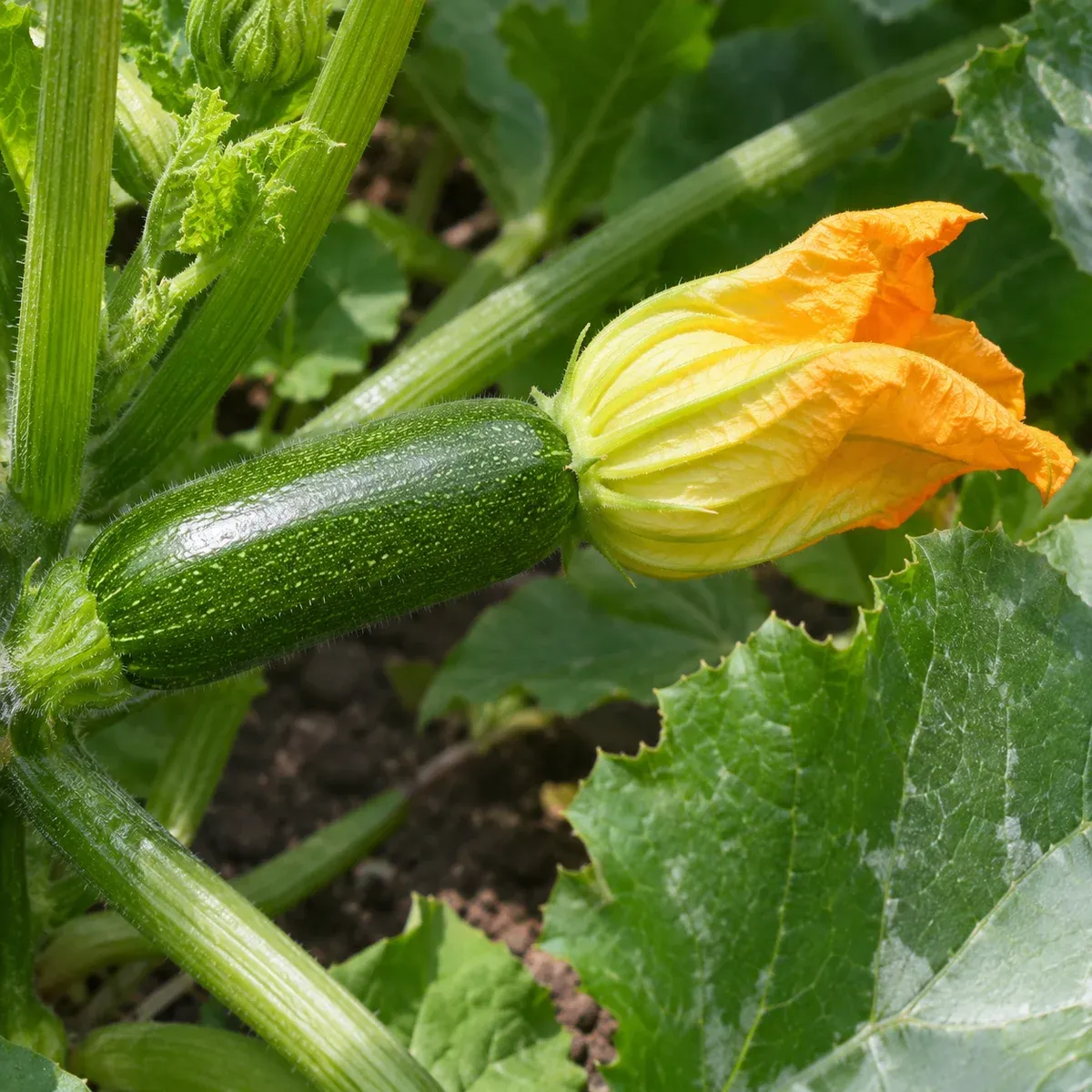
Key points for this crop
Practical guidance
- Exposure
- In full sun
- Planting
- After frosts, in warmed soil
- Spacing
- At least 90 cm, depending on the variety
- Harvest
- Pick young fruit regularly
Sources and references
- CourgetteFrench National Horticultural Society (SNHF) Accessed on 15 October 2026.
- How to grow courgettesRoyal Horticultural Society (RHS), in English Accessed on 18 October 2026.
- Fascinating facts and figures: courgettesRoyal Horticultural Society (RHS), in English Accessed on 15 October 2026.
- Courgette, marrow, pumpkin and squash problemsRoyal Horticultural Society (RHS), in English Accessed on 15 October 2026.
- Not all squashes are edible — Vigil’Anses No. 3, October 2017French Agency for Food, Environmental and Occupational Health & Safety (ANSES) Accessed on 15 October 2026.