
The vegetable garden notebook / Crops
Courgette diseases: choosing the appropriate treatment
Treating a courgette begins with selecting an intervention suited to the identified cause. Improving air circulation, adjusting watering, or removing affected parts may help; spraying is not a solution for every problem.
Adapt this guidance to your garden’s climate and conditions.
Choosing an intervention for the identified cause
Before intervening, note what you aim to correct: an identified disease, observed water deficiency, or a fruiting issue. A small courgette that aborts may result from insufficient pollination or poor growing conditions, as explained by the RHS. This observation alone does not justify using a fungicide.
If the cause remains uncertain, start with the symptom and disease guide for courgettes, then compile the observations described at the end of the page. INRAE highlights the many possible misdiagnoses.
Once the cause is sufficiently established, select the appropriate action:
- Adjust growing conditions for water, air, and plant density;
- Remove affected parts for targeted actions against powdery mildew or botrytis;
- Consider what to do about a viral infection, which cannot be cured with insecticides.
Check any product you are considering after choosing the appropriate action; this check cannot replace identifying the cause.
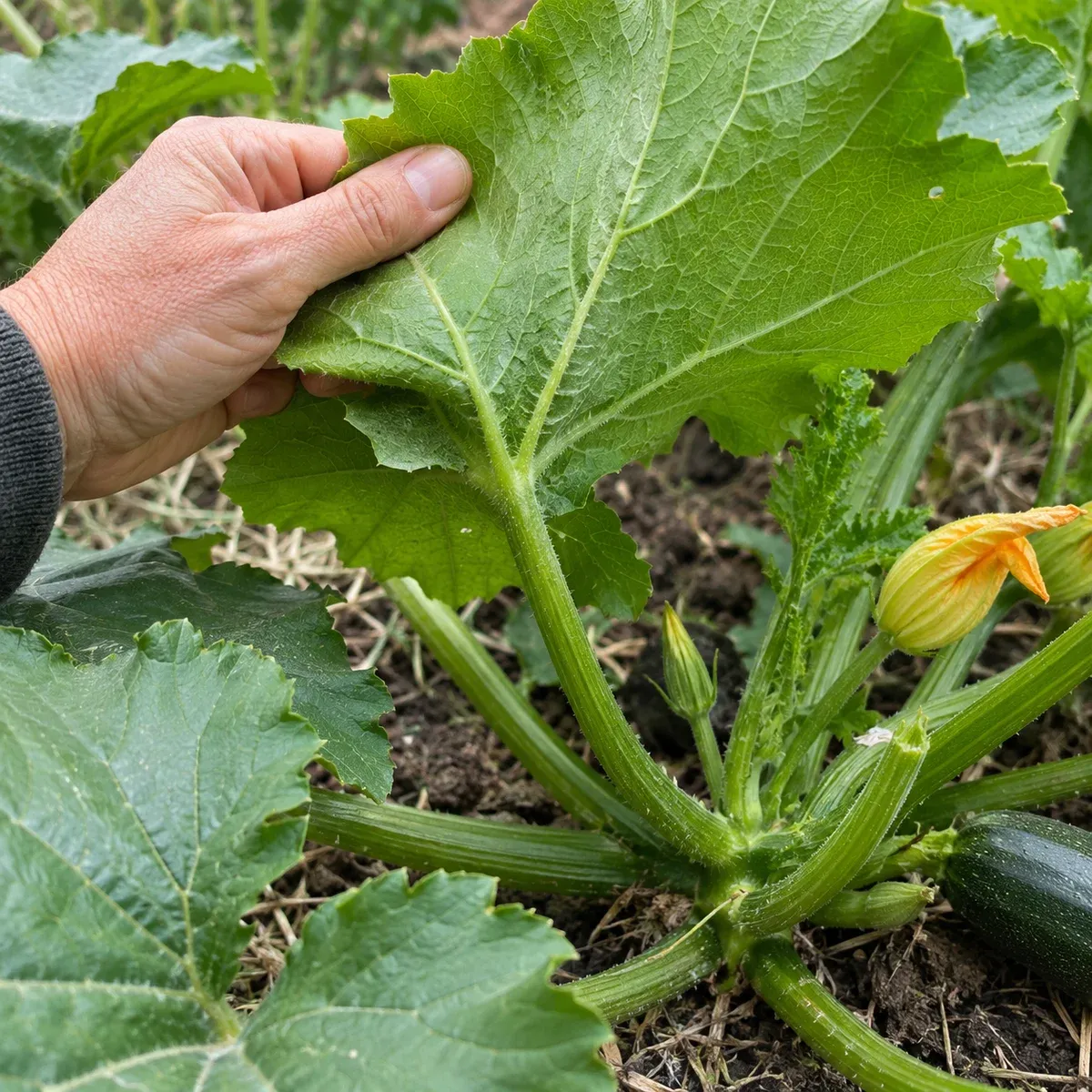
Adjusting growing conditions
For powdery mildew or botrytis attacks, promote air circulation and ventilate any protective structure. Avoid excessive nitrogen applications that encourage overly dense foliage. These measures are included in INRAE’s advice on powdery mildew and botrytis.
Water the soil at the base according to its moisture level. Reducing conditions favourable to diseases does not mean allowing roots to dry out: the RHS notes that drought-stressed plants are more susceptible to powdery mildew. For botrytis, INRAE recommends localised watering that does not wet the foliage. The watering guide helps adjust applications based on soil observations.
Removing only what is necessary
At the onset of powdery mildew, carefully remove the first affected leaves, placing them directly into a bag, then remove them from the growing area. INRAE suggests this action to limit spore dispersal during handling, while emphasising the difficulty of containing an already established disease.
When botrytis is identified, promptly remove rotting fruits on which the fungus develops. Do not use this as a reason to prune the whole plant: wounds left by cutting petioles may encourage attacks on the stem. INRAE also advises against defoliation in overcast and humid conditions.
These actions address specific situations. Do not cut all spotted leaves as a matter of principle, nor scrape a stem lesion in an attempt at improvised treatment. Significant stem damage requires re-evaluating the diagnosis and the advisability of keeping the plant.
A virus-infected plant cannot be cured with insecticide
For zucchini yellow mosaic virus, or ZYMV, INRAE states that there is no cure in open-field crops. Removing the first infected plants may help at the start of an epidemic, particularly under cover, but transmission may have begun before visible symptoms appear.
Treating aphids therefore does not cure the plant. The source also specifies that insecticides generally do not prevent ZYMV epidemics: an aphid can transmit this virus during a very brief probe. Have a suspected viral infection confirmed before deciding to uproot a plant; distorted growth alone is not enough to identify a virus.
Verifying a product before considering its use in the garden
The name of a substance, a “natural” label, or outdated advice does not prove that a product is suitable. For a plant protection product, check its current E-Phy datasheet and label:
- Locate the exact product, using its name or marketing authorisation number. The E-Phy FAQ also describes advanced searches by crop and target.
- Check that the product is approved for home gardeners. The category “Amateur / authorised for use in gardens” corresponds to products that can be purchased and used by private individuals. A mention related to biocontrol or organic farming does not replace this verification.
- Read the full entry for the authorised use. It must cover courgette, the targeted disease and the application method. Check the scope and any restrictions: a heading grouping several crops may be limited by specific conditions, as noted in the usage guidelines.
- Check the status of this authorised use. A product may retain its authorisation while one of its uses has been withdrawn. For an old package, consult the end-of-use dates; in case of contradiction, decisions signed by ANSES prevail. These distinctions are outlined in the E-Phy FAQ.
- Read all usage conditions and the label. Dosage, number and interval of applications, growth stage, pre-harvest interval, protective measures, and environmental restrictions must be verified for this specific use. The datasheet instructions distinguish general conditions from those specific to each use.
If any point remains unclear, seek clarification before use. This page does not recommend any product or dosage and does not propose homemade preparations. Foreign or outdated horticultural references do not constitute current French authorisation.
When to seek an additional diagnosis?
Seek advice if the cause remains uncertain, if several plants deteriorate rapidly, or if the stem and root collar are affected. Prepare photos showing the whole plant and details, without removing all parts showing early signs.
Note the variety, date of symptom appearance, affected parts, number of plants involved, and rate of progression. Include recent watering, fertilisers, treatments, and the weather leading up to the symptoms. This record compiles the information INRAE considers useful for distinguishing causes; photos aid sharing but are not sufficient evidence alone. Request sampling instructions before sending or uprooting a plant for analysis.
After an intervention, record the date and monitor new symptoms. If the situation continues to worsen, re-evaluate the cause before applying additional treatment. To resume planting and routine care, consult the courgette growing guide.
Key points for this crop
Practical guidance
- Before acting
- Identify the cause and extent of the damage
- Removal
- Target the affected parts; avoid systematic defoliation
- Product
- Check approval for home gardeners and the exact authorised use in France
- Follow-up
- Monitor progress and seek advice if the diagnosis remains uncertain
Sources and references
- Courgette and squash — Diagnostic adviceINRAE, Ephytia, D. Blancard Accessed on 16 October 2026.
- Powdery mildew on courgette and squash — Protection methodsINRAE, Ephytia, D. Blancard and V. Mayet Accessed on 16 October 2026.
- Botrytis cinerea on courgette and squash — Protection methodsINRAE, Ephytia, D. Blancard Accessed on 16 October 2026.
- Zucchini yellow mosaic virus — Protection methodsINRAE, Ephytia, H. Lecoq Accessed on 16 October 2026.
- Courgette, marrow, pumpkin and squash problemsRoyal Horticultural Society (RHS), in English Accessed on 16 October 2026.
- Product labels and rangesANSES, E-Phy Accessed on 16 October 2026.
- UsesANSES, E-Phy Accessed on 16 October 2026.
- FAQ and contactANSES, E-Phy Accessed on 16 October 2026.
- Understanding product informationANSES, E-Phy Accessed on 16 October 2026.