
The vegetable garden notebook / Crops
Courgette diseases: checking leaves, fruit and the whole plant
A yellow leaf or a small rotting courgette does not indicate a disease on its own. Examine the entire plant, both sides of the leaves, the fruits and the base of the stem before choosing an intervention.
Adapt this guidance to your garden’s climate and conditions.
What clues should be noted before investigating a disease?
Start with a simple observation sheet, without immediately naming a disease:
- Distribution: one leaf, one plant or several plants; older leaves or new shoots.
- Appearance: powder, spots within the tissue, distorted growth, holes, soft areas or dried tissue. Turn over an affected leaf.
- Other parts: fruit, flowers and the root collar, where the base of the stem meets the soil.
- Progression: date of the first sign and changes since the last visit. Photograph the entire plant, then details, using the same framing for follow-up.
- Context: rain, heat, soil moisture, last watering, fertiliser or product recently applied.
Start with the affected part of the plant: a white deposit on a leaf, yellow spots and distorted growth, damaged young fruit or a wilting plant. Check for the accompanying signs described in each section.
The following guidance helps direct this investigation. It does not constitute a test to confirm all courgette diseases.
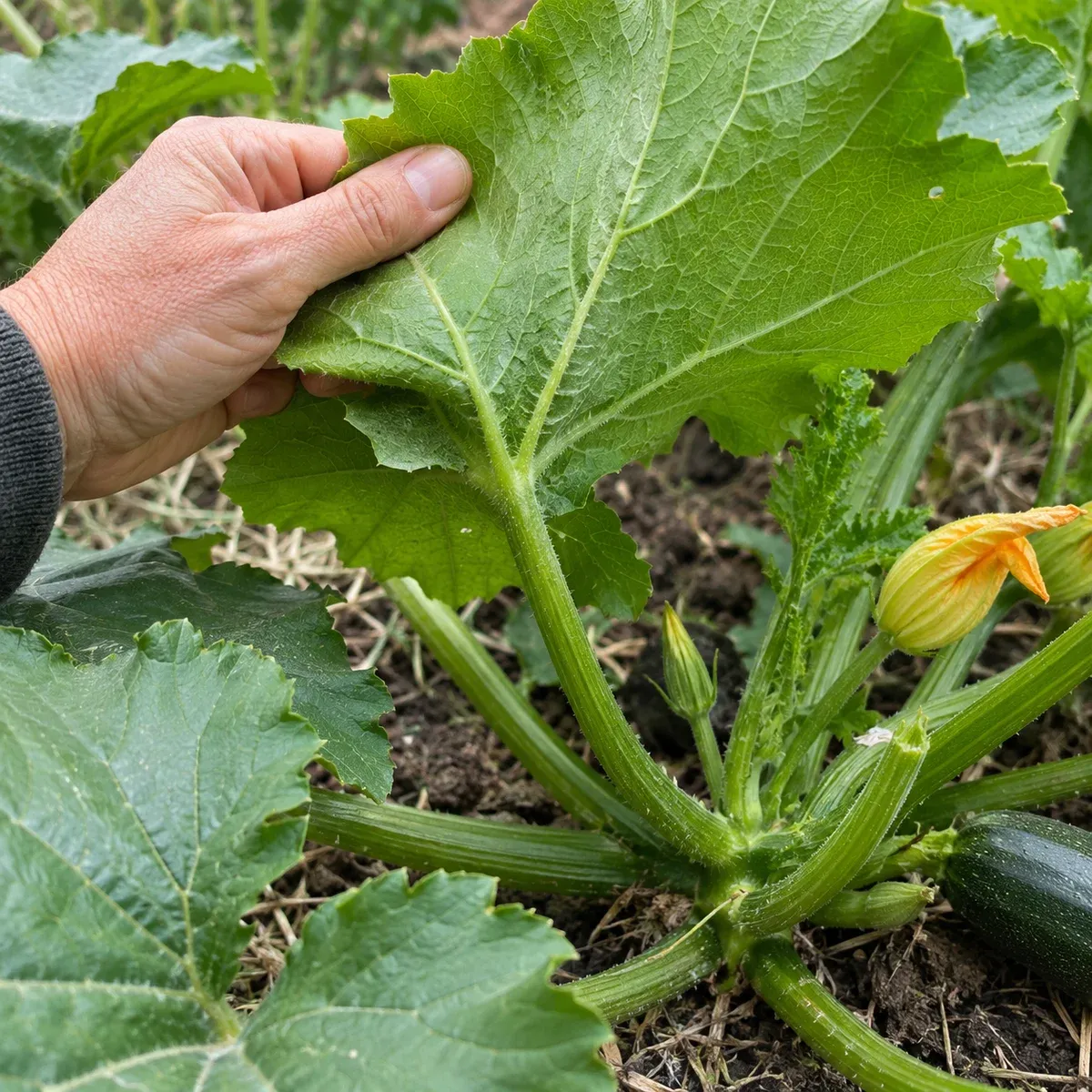
White leaves: powdery mildew or natural markings?
Powdery mildew produces a white, dusty coating on leaves and sometimes other organs, as described by the RHS. Check if you actually observe a deposit, and monitor its spread.
Some varieties naturally display angular silver blotches, with no impact on the plant. INRAE links these to local epidermal detachment. Their surface shows no visible powder, notes the University of Maryland.
White colour alone is therefore insufficient. Do not remove a leaf simply because it bears these natural marks. INRAE also distinguishes these blotches from silvering caused by whitefly: not all leaf whitening is automatically a varietal trait.
If the deposit spreads, what is the first step?
For symptoms consistent with powdery mildew, start by reducing water stress: check the soil, water during dry periods and avoid wetting the foliage. Mulching can limit evaporation, leaving the stem base clear; also ensure air circulation. These management measures, recommended by the RHS, will not remove existing lesions. The powdery mildew guide explains what to look for and the limits of what you can do.
Yellow spots or mosaic: check leaf undersides and distorted growth too
Cucurbit downy mildew may form spots on courgette leaves bounded by veins. Water-soaked at first, these turn yellow and then brown. A faint grey to dark down may appear underneath. INRAE notes that this pattern of spots can resemble a mosaic, but this is not proof of a virus.
A mosaic accompanied by blistering or severe deformations, sometimes also on fruits, suggests a viral infection. However, symptoms vary: those of watermelon mosaic virus (WMV) depend on the strain and variety and may be confused with ZYMV, according to INRAE. A photo alone may not identify the virus. Also photograph new leaves and fruits to seek advice. If a virus is confirmed, the RHS advises removing the plant, as no cure is available. This decision should not be based on a single yellow spot. RHS
Small courgettes that turn yellow or rot: distinguishing three situations
A fruit stops growing very early, then shrivels. Inadequate fertilisation of the flower can cause this fruit abortion. Unfavourable weather for pollinators, among other factors, may contribute. INRAE also describes deformed fruits. Note the flowers present and insect activity: the female flower has a swelling at its base, unlike the male flower, notes the RHS. The initial swelling does not prove that fertilisation has succeeded.
The end near the flower becomes dark, sunken and leathery. Blossom-end rot is possible. The University of Maryland links this to insufficient calcium reaching the developing fruit, which may accompany irregular irrigation. This symptom alone does not demonstrate a lack of calcium in the soil.
The fruit becomes soft and mouldy. Note where this began and whether the fruit had already aborted. INRAE explains that fungi may secondarily colonise aborted fruits or flowers remaining attached in humid conditions. Visible rot does not necessarily reveal the initial problem. Remove aborted fruits to limit secondary colonisation.
Distorted or damaged leaves: check for pests and damage caused by growing practices
Inspect new shoots for aphids; the RHS particularly notes them in these areas. It also indicates that slugs and snails may damage young plants. Photograph any observed animals along with the damage: a deformed or eaten leaf alone is insufficient to identify the culprit.
Also consider recent interventions. INRAE describes yellowing, deformations and lesions following certain product exposures, including herbicide drift. Exposed parts may be more affected. Record what was applied to the crop and nearby; this timeline helps assess phytotoxicity without immediately assuming infection.
A plant is wilting: examine the soil and the base of the stem
Check soil moisture before deciding to water; the watering guide helps you adjust watering to the soil conditions. Also check whether the root collar is intact or has a damp, brown or rotting area.
Temporary recovery of firmer foliage does not rule out disease. In its description of Fusarium collar rot, INRAE notes wilting during the hottest part of the day that may reverse, together with lesions at the stem base. This is one example justifying examination of the stem base; it is not a diagnosis of Fusarium for every wilting courgette.
If the plant has collapsed and the base is rotting, the RHS advises removing the affected plant with its roots. Have any symptoms at the root collar assessed before uprooting a plant that is only wilting: adding water or removing leaves is not a universal response to all causes. RHS
When to seek a more precise diagnosis?
Request horticultural advice when multiple clues contradict each other, lesions progress rapidly or the plant collapses. Prepare your photos, the variety name, number of affected plants and intervention history. Keep the phrasing “symptoms consistent with…” until the cause is sufficiently established.
To review planting conditions and routine care, consult the courgette growing guide. Here, the aim is to identify the next useful observation before choosing a treatment.
Key points for this crop
Practical guidance
- Foliage
- Compare upper and lower leaf surfaces and examine new leaves
- Fruits
- Note the growth stage and where the damage begins
- Context
- Record weather, watering and recent interventions
- Diagnosis
- Cross-reference multiple clues before concluding
Sources and references
- Courgette, marrow, pumpkin and squash problemsRoyal Horticultural Society (RHS), in English Accessed on 16 October 2026.
- Courgette & squash — Physiological blotchesINRAE, Ephytia, D. Blancard Accessed on 16 October 2026.
- Courgette & squash — Downy mildew: main symptomsINRAE, Ephytia, D. Blancard and V. Mayet Accessed on 16 October 2026.
- Courgette & squash — Watermelon mosaic virus: main symptomsINRAE, Ephytia, H. Lecoq Accessed on 16 October 2026.
- Courgette & squash — Fruit abortionINRAE, Ephytia, D. Blancard Accessed on 16 October 2026.
- Key to Common Problems of SquashUniversity of Maryland Extension, in English Accessed on 16 October 2026.
- Courgette & squash — Phytotoxicity: symptomsINRAE, Ephytia Accessed on 16 October 2026.
- Courgette & squash — Fusarium collar rot: main symptomsINRAE, Ephytia, D. Blancard Accessed on 16 October 2026.