
The vegetable garden notebook / Crops
Sowing carrots: preparing the row and monitoring emergence
Sow carrots in their final location on finely prepared ground. Until emergence, monitor the row’s moisture closely; afterwards, ensure each plant has enough space to form its root.
Adapt this guidance to your garden’s climate and conditions.
Choosing the sowing window based on the variety
The SNHF gives the usual outdoor sowing window as March to July. This guideline does not apply to all varieties at every date: early types, forced crops, and carrots intended for autumn harvests follow different practices.
Keep the seed packet and note your variety’s sowing window, cultivation type, and expected size. Cross-reference this information with the season and your garden’s conditions. A national calendar is not sufficient to determine the exact sowing date.
To stagger harvests, the RHS recommends small successive sowings. Set aside several row sections, then decide on subsequent sowings within the variety’s window, based on your needs and availability to monitor emergence. This does not mean sowing at fixed intervals throughout the year.
Preparing the seedbed before sowing
The RHS advises weeding, removing stones, breaking up hard clods, and raking to a fine tilth. This preparation should help you distribute the small seeds and cover them evenly. The SNHF discourages fresh organic matter, particularly undecomposed manure, just before sowing.
Plan the row in its final location. Sowing in pots followed by transplanting can disturb the root and cause deformities, notes the RHS. For guidance on choosing a shape suited to your plot, consult the carrot cultivation guide.
Sowing sparsely at shallow depth
The SNHF gives a sowing depth of 1 cm, with 15 cm between rows for short types, 20 cm for half-long, and 25 cm for long varieties. Check your variety’s instructions; row spacing differs from the space between plants within each row.
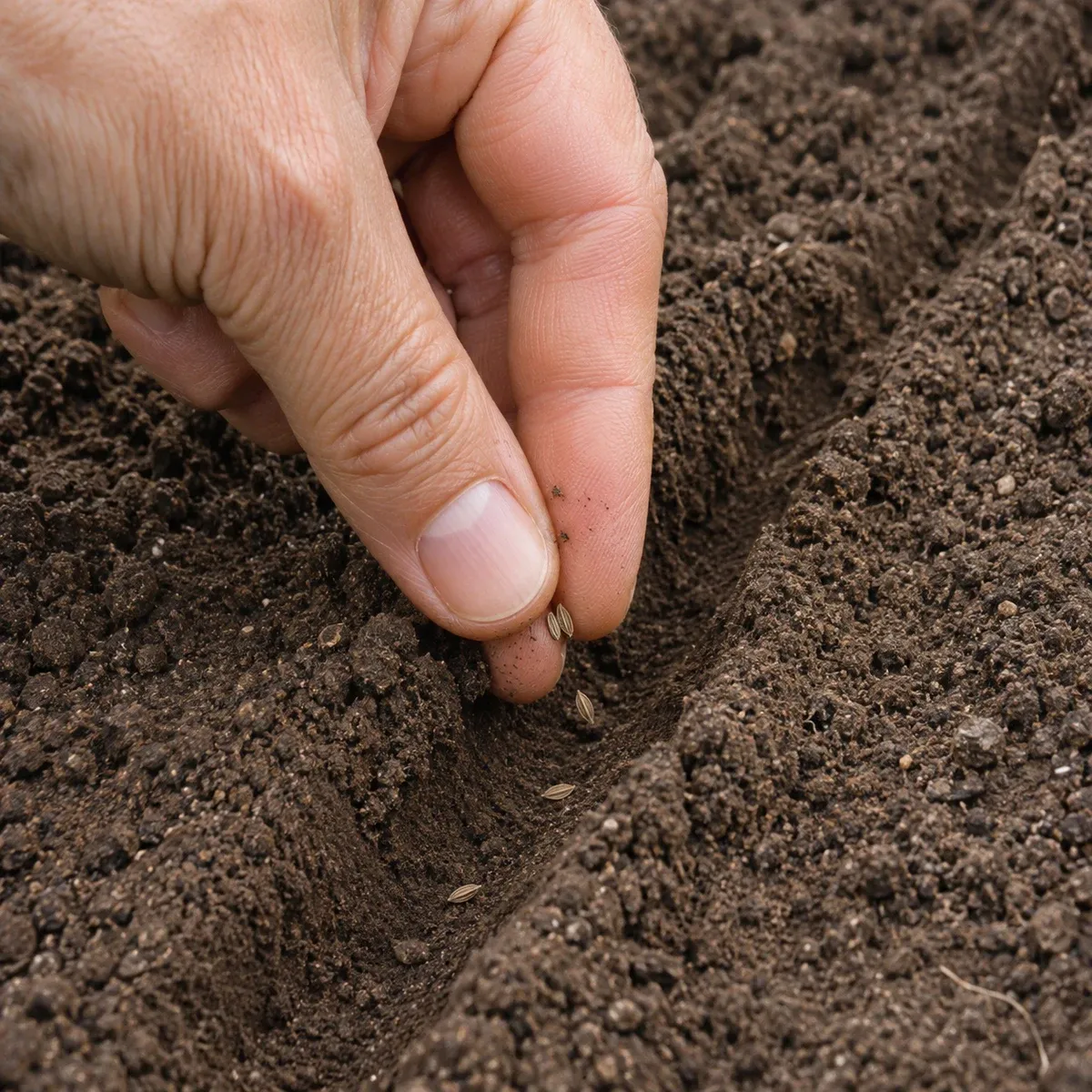
- Draw the furrow to the chosen depth and moisten its base.
- Distribute seeds sparingly, avoiding clumps.
- Cover with fine soil to maintain the intended depth.
- Place a label indicating the variety and date.
Moistening the furrow and sparse sowing follow the RHS method. The label helps locate the row while waiting; the sowing guide provides further organisational tips.
Maintaining moisture and monitoring emergence
The University of Maryland requires consistent moisture in the seedbed. Observe the sown area before watering: adjust watering to how much the soil has dried and how much rain has fallen, without turning this need into daily automatic watering.
After heavy rain or excessive watering, a crust may hinder seedling emergence. The University of Minnesota suggests a fine water spray to soften the surface. The aim is to re-moisten gently, without disturbing the row.
This university notes germination may take up to three weeks. Observe temperature, moisture, and initial emergence before deciding to resow. The seedlings first produce two narrow leaves; the later leaves are deeply divided. Recognising these leaves helps you monitor emergence before weeding.
If no seedlings emerge, or emergence is patchy
Refer to the label before deciding to restart: variety, date, and sowing depth. Note where seedlings have emerged and compare the soil surface there with the bare patches: has the soil stayed moist or dried out, has a crust formed after rain, or has watering displaced soil? Minnesota Extension describes how germination can be slow and a crust can block seedling emergence; these observations do not mean you should assume that all the seed in the packet is faulty.
If the surface has hardened, re-moisten gently as described above, without scraping around to find every seed. Continue observing the fine seedlings before weeding or reworking the row. If you decide to sow again, check the variety’s sowing window once more and prepare a small distinct section, labelled with the new date, rather than sowing indiscriminately over areas where seedlings have already emerged. The small successive sowings described by the RHS help you keep this new trial small.
Thinning according to the expected root size
The SNHF suggests a first thinning when plants have two or three leaves, leaving 2 to 3 cm between plants, then a second 10 to 15 days later, with a minimum of 3 to 4 cm.
This minimum does not suit all sizes: the RHS indicates 5 to 7.5 cm, and Minnesota Extension recommends more space for the largest varieties. Choose the final spacing based on the seed packet, rather than systematically keeping all emerged plants.
To remove excess plants while minimising disturbance to neighbouring roots, Maryland Extension recommends cutting seedlings rather than pulling them. Note the final spacing and how evenly seedlings emerged: these observations will help adjust the density of your next sowing.
The steps in pictures
Carrot: depth and spacing between rows
1 Cover the seed
Cross-section view · not to scale
The measurement runs from the surface down to the seed.
2 Space the sowing rows
Top view · example: half-long
Measure from one row to the next, perpendicular to the sowing rows.
Reference by carrot type
- Short
- 15 cm
- Half-long
- 20 cm example shown
- Long
- 25 cm
These distances are between the rows. The spacing between plants in the same row depends on the variety and thinning.
The SNHF indicates sowing at approximately 1 cm depth and rows spaced 15 cm apart for short varieties, 20 cm for half-long varieties, and 25 cm for long varieties. The distance between rows is measured perpendicular to the rows; it differs from the spacing between plants in a row.
Sow directly in the final position. After emergence, thin out according to the variety’s size and the packet instructions.
Based on SNHF, carrot sowing · RHS, direct sowing and thinning.
Key points for this crop
Practical guidance
- Method
- Direct sowing, no transplanting
- Depth
- Approximately 1 cm; check the packet
- Emergence
- Keep the seedbed consistently moist
- Thinning
- Adjust final spacing to the variety’s size
Sources and references
- CarrotSociété nationale d’horticulture de France (SNHF), Jean-Daniel Arnaud Accessed on 16 October 2026.
- How to grow carrotsRoyal Horticultural Society (RHS), in English Accessed on 16 October 2026.
- Growing Carrots in a Home GardenUniversity of Maryland Extension, in English Accessed on 16 October 2026.
- Growing carrots and parsnips in home gardensUniversity of Minnesota Extension, Marissa Schuh and Jill MacKenzie, in English Accessed on 16 October 2026.