
The vegetable garden notebook / Crops
Growing carrots: sowing, thinning and deciding when to harvest
A row of carrots is planned before opening the seed packet: what root shape can your soil accommodate? After sowing, caring for the seedlings and giving them enough space matter just as much as the sowing date.
Adapt this guidance to your garden’s climate and conditions.
Choosing carrots based on the soil
Identify a sunny, well-draining location. Long-rooted carrots suit deep, light soil with few stones, while shorter varieties are better suited when depth is limited, according to the RHS.
To compare seed packets, check the advertised shape:
- Nantes type: cylindrical root with a rounded tip.
- Chantenay type: shorter and broader root, better adapted to heavy and shallow soils than long, thin types. These distinctions are described by the University of Maryland.
- Small round varieties: an option for container growing. A long variety requires a deep container, notes the RHS.
Shape alone is not enough to choose a sowing date. Also keep the variety name and its sowing window: you can then link the result to what you actually grew.
Carrots in pots: what depth to plan for?
Choose the container based on the root length advertised for the variety. The RHS recommends small round varieties for standard pots; a long carrot requires a deep container. Measure the actual depth of potting compost available, excluding the empty rim of the pot. In a shallow container, opt for a short variety or an early harvest rather than waiting for a long mature root.
Sow directly into suitable potting compost, in a pot that allows excess water to drain. Maintain the required spacing after thinning. Regularly check moisture levels: containers dry out faster than open ground, notes the RHS. The pot alone does not protect against carrot fly: see how to cover the whole crop in the section dedicated to this pest.
When to sow carrots in open ground?
The SNHF provides March to July as a general window for open-ground sowing. Cross-reference this with the variety and your climate; it does not mean every garden is ready by March. Cultivation under cover follows different timings.
If the soil is waterlogged, wait until it becomes workable. Avoid trampling it while waiting: the RHS highlights the risk of worsening compaction. Instead, prepare your labels and the row locations.
Preparing and sowing a row
Sow directly where the carrots will grow. Transplanting can deform their roots. Before sowing, remove weeds and stones, break up clods, and rake the surface: these are the preparation steps recommended by the RHS. Avoid adding fresh manure just before sowing, as advised by the SNHF.
- Draw a shallow furrow. The SNHF indicates a sowing depth of 1 cm.
- Plan the rows. Its guidelines are 15 cm for short types, 20 cm for half-long types, and 25 cm for long varieties. For a different type or specific instructions, follow your variety’s recommendations. SNHF
- Moisten the bottom and distribute seeds sparingly. The RHS recommends a sparse sowing; cover to maintain the intended depth.
- Mark the row. Note the variety and date. Our sowing guide complements these initial steps.
Helping seedlings emerge without promising a date
Maintain consistent moisture in the sown area, following the University of Maryland’s advice. Check moisture before adding water: rain may have already dampened the row.
A crust formed after heavy rain or excessive watering can hinder seedling emergence. The University of Minnesota suggests gently rehydrating the surface with a fine spray. The seedlings first show two narrow leaves; the leaves that follow are finely divided. These observations help identify the row without disturbing it during the wait.
Germination can be slow, notes the RHS. Record when the first seedlings actually emerge, rather than relying on an expected date.
Thinning to allow roots to grow
The SNHF describes two stages: at two or three leaves, leave 2 to 3 cm between plants; then, 10 to 15 days later, achieve a minimum of 3 to 4 cm. This minimum is not the goal for all varieties: the RHS advises 5 to 7.5 cm, and Minnesota recommends more space for large roots.
Therefore, choose the final spacing based on the variety’s instructions. To remove excess plants without disturbing neighbours, you can cut them at soil level, a method suggested by Maryland.
Afterwards, weed regularly, disturbing only the soil surface and taking care not to damage the carrots. The University of Minnesota emphasises this shallow working depth. Preparing before sowing and maintaining an established row are two different tasks.
Why are my carrots forked?
A carrot split into multiple roots does not have a single cause. Vilmorin-Mikado cites stones, clods, and poorly decomposed manure among possible factors. Transplanting can also deform the taproot, notes the RHS. Refer to the preventive steps in preparing and sowing a row, without trying to correct an already formed root.
If multiple roots twist together, also check density: the University of California describes these deformations in overly dense sowings. Compare the result with the spacing maintained after thinning. Note whether the issue affects a few plants or an entire area, then examine the soil there before the next sowing.
Shape alone does not indicate disease or nematodes. California highlights that several causes produce similar symptoms; the University of Maryland specifies that attributing damage to nematodes requires analysis. If deformations recur despite suitable planting, keep photos and seek horticultural advice before considering treatment.
How to control carrot fly
Larvae burrow rusty-brown tunnels into roots; damaged foliage alone does not identify the fly. The RHS primarily recommends complete coverage with insect-proof mesh, combined with crop rotation: adults may emerge under the mesh if pupae overwinter in the plot’s soil.
- Choose mesh designed for carrot fly and cover the entire crop, including the top. The RHS considers this coverage more effective than a simple vertical barrier.
- Securely close the edges at ground level, repair any holes, and allow room for growth, as explained in its mesh guide. Opening to weed may let insects in; reseal after intervention.
- Sow sparsely to limit thinning: the scent of removed plants attracts female flies, according to the RHS.
- Also monitor moisture and plant health under the cover. The mesh does not replace watering or vigilance. RHS
Varieties described as less susceptible are not fully resistant. Mesh prevents future attacks; it does not repair an already tunnelled root. Prepare the next location with the crop rotation guide. Flight periods indicated for the UK do not constitute a guaranteed calendar for France.
Watering and deciding when to harvest
Once the crop is established, examine the soil to decide on watering: the University of California recommends visual and tactile assessment, seeking sufficient moisture in the root zone. The need cannot be deduced from the surface alone; no fixed volume or schedule suits all soils.
To harvest, gently expose the top of a root and observe its diameter, as suggested by the same source. Compare it to the cultivated type: the University of Maryland advises harvesting roots large enough for the intended use and leaving smaller ones to continue growing.
Pull out a few carrots to assess the result. In soil that grips the roots, loosen the area beside them with a fork before gently lifting: pulling only on the foliage may break the carrot. This technique is described by Minnesota.
A useful note: “First harvest from row A: variety, date, observed diameter, and spacing maintained after thinning.” Add whether seedling emergence was even or patchy. You will have concrete data to adjust the next trial.
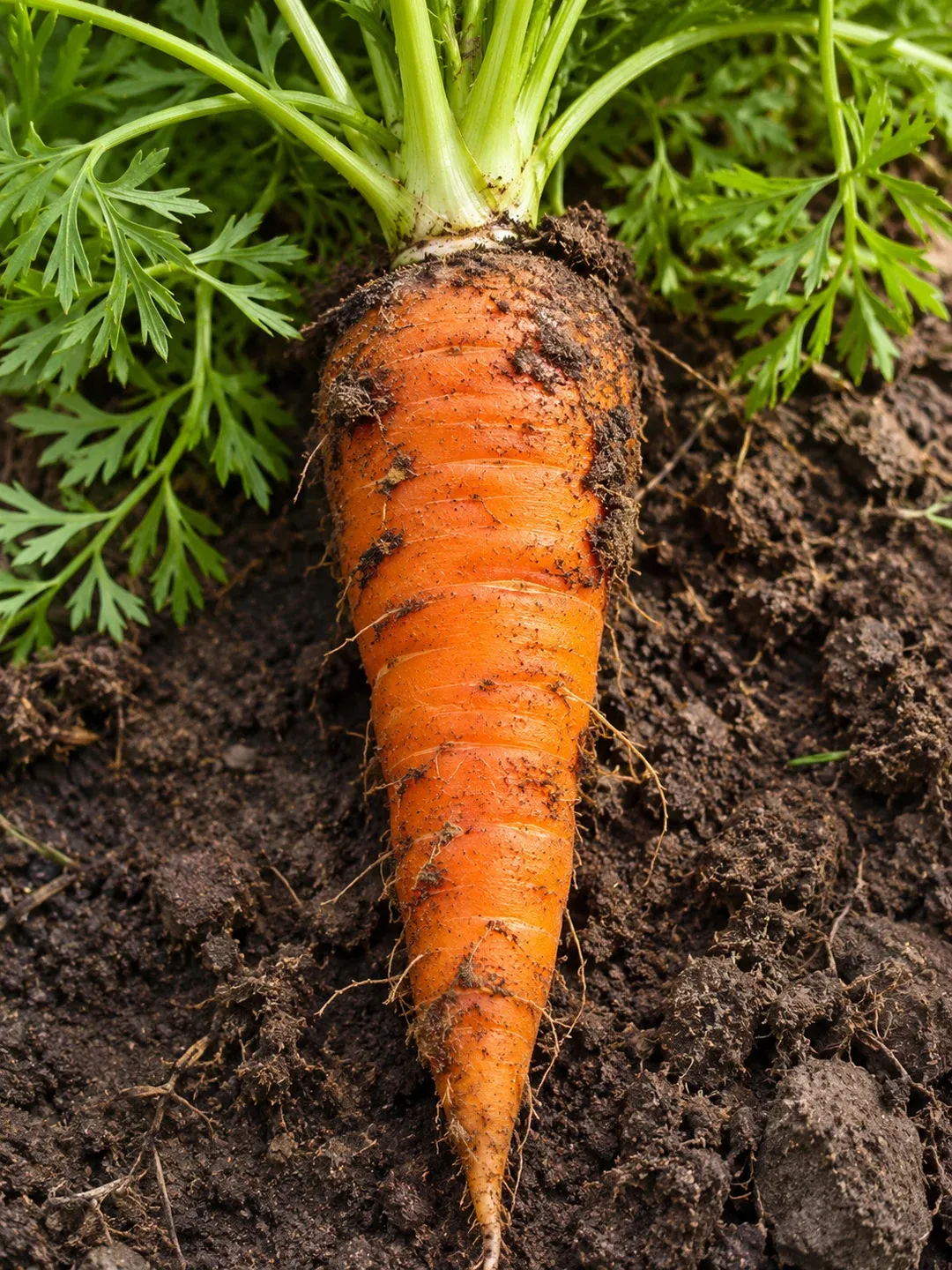
Why carrots flower
Carrot is a biennial plant: the root formed in the first year may produce a stalk and umbels in the second year if left in place. This is the cycle described by the SNHF. Keeping roots over winter does not mean they will simply continue to grow for culinary use.
Flowering in the first season is also possible. The RHS explains that prolonged cold early in the crop can trigger this bolting, which becomes visible later. Note the sowing date, variety, and cold spells to adjust the next trial, without assuming that a flower stalk alone is a sign of disease.
For roots intended for eating, decide when to harvest before the plants flower: the University of Florida notes that roots past their best stage become tough and woody. A plant kept to observe its flowers no longer serves the same purpose as a row intended for tender roots.
Leaving carrots in the ground over winter
This option applies to already developed roots, with a variety and timing suited to late harvest. It does not guarantee that sowing just before cold weather will provide carrots all winter. The SNHF reserves leaving carrots in the ground for regions with mild winters.
In well-draining soil, it advises cutting the foliage to 1 or 2 cm above the crown, then protecting the row with straw or dry leaves during cold weather. Mark the row to harvest roots as needed. If your soil remains waterlogged in winter, the RHS recommends lifting remaining carrots and storing them indoors.
Also choose to lift the carrots before hard frosts if leaving them in the ground is unsuitable for your climate. Check a few roots during storage and plan to finish the harvest before flowering growth resumes in spring. The vegetable storage guide complements the choice of storage after lifting.
Key points for this crop
Practical guidance
- Planting
- Direct sowing at the growing location
- Soil
- Well-draining, prepared according to root length
- Seedling emergence
- Monitor moisture on the sown surface
- Harvest
- Check the roots and the guidance for the variety
Sources and references
- CarrotSociété nationale d’horticulture de France (SNHF), fact sheet by Jean-Daniel Arnaud Accessed on 15 October 2026.
- How to grow carrotsRoyal Horticultural Society (RHS), in English Accessed on 15 October 2026.
- Growing carrots in a home gardenUniversity of Maryland Extension, in English Accessed on 15 October 2026.
- Growing carrots and parsnips in home gardensUniversity of Minnesota Extension, in English Accessed on 15 October 2026.
- Cultural tips for growing carrotUniversity of California, Statewide IPM Program, in English Accessed on 15 October 2026.
- Waterlogging and floodingRoyal Horticultural Society (RHS), in English Accessed on 15 October 2026.
- Carrot flyRoyal Horticultural Society (RHS), in English Accessed on 17 October 2026.
- Insect-proof meshRoyal Horticultural Society (RHS), in English Accessed on 17 October 2026.
- Forked carrotsVilmorin-Mikado France, professional seed supplier Accessed on 18 October 2026.
- Close Planting of CarrotsUniversity of California, Statewide IPM Program, in English Accessed on 18 October 2026.
- Root Knot Nematodes on VegetablesUniversity of Maryland Extension, in English Accessed on 18 October 2026.
- Bolting in vegetablesRoyal Horticultural Society, in English Accessed on 18 October 2026.
- Carrots — Gardening SolutionsUniversity of Florida, IFAS Extension, in English Accessed on 18 October 2026.