
The vegetable garden notebook / Techniques
Crop rotation: organising a small vegetable garden
Rotation involves growing different crops in succession in the same location. In a small vegetable garden, start by recording what actually grew in each plot: this record will be more useful than a four-year plan that is impossible to follow.
Adapt this guidance to your garden’s climate and conditions.
Practical steps
- Record
Name the plots and note all the crops that have succeeded one another there.
- Group
Identify botanical families and observed problems.
- Adapt
Choose the next locations based on the history, soil, and sun exposure.
- Update
Adjust the plan with the actual plantings carried out.
What is crop rotation for?
Avoiding repeatedly planting the same crops in the same location can help slow the build-up of certain pests and diseases associated with those crops. This is the principle outlined by Jardiner Autrement. Complement rotation with monitoring of diseases and soil requirements.
Three- or four-year cycles are organisational models. The RHS offers several approaches depending on the vegetables grown and reserves this method for gardens that are not too small.
Start with a plot history
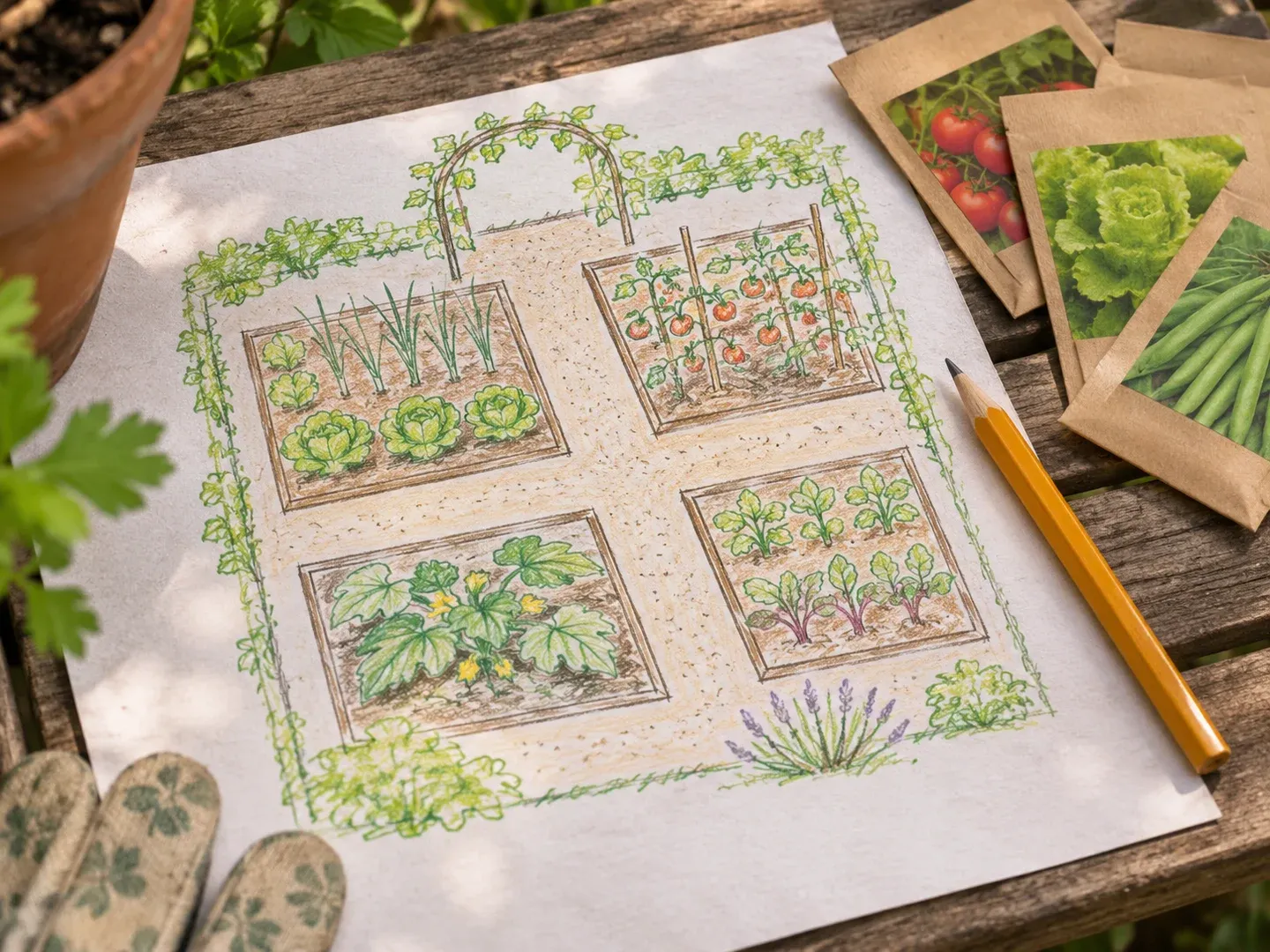
Draw the cultivated areas and give them stable names: “bed A”, “near the gate”, “north square”. Keep the same reference points from one season to the next, even if you modify the rows.
For each area, record:
- the vegetables grown and, if known, their variety;
- the planting dates and dates when each crop was cleared;
- short-term crops and green manures grown between crops;
- inputs applied and problems observed.
Do not reconstruct from memory a level of precision you do not have: “onions, year uncertain” is usable information. Also distinguish an observation, such as “soft bulbs”, from a confirmed diagnosis.
This is one practical way to keep your garden records. It complements the pre-season plan preparation recommended by the RHS. You can revisit it during the November vegetable garden review.
Look at families, not just the harvested part
Categories such as “leaf vegetables”, “root vegetables”, and “fruiting vegetables” do not correspond to botanical families. Planting a turnip after cabbage changes the harvest but keeps the same family.
| Family or group to identify | Examples useful in the vegetable garden |
|---|---|
| Brassicaceae | Cabbages, turnips, radishes: see the classification by Ephytia. |
| Fabaceae, also called legumes | Peas, broad beans, French beans: see Jardiner Autrement. |
| Solanaceae | Tomato, whose family is detailed by the SNHF, and potato, grouped by the RHS. |
| Genus Allium | Garlic, onion, shallot, and leek, grouped by the RHS. |
This list helps identify crop sequences with little diversity; it does not mean all members of a family have exactly the same diseases. Before planting garlic, check if the plot previously grew onions or leeks.
Create a plan that fits your garden
Proceed in this order:
- Mark permanently occupied locations. Asparagus and rhubarb remain outside annual rotation, as specified by the RHS.
- List what you really want to harvest. Do not add a crop just to fill a category in a diagram.
- Compare possible locations with the history. Look for a different family when growing conditions allow.
- Check the soil and sun exposure. A damp or shady area may make a move unsuitable: these constraints are noted by Jardiner Autrement.
With two small beds, you may not always be able to replicate a full cycle. Note the compromise made and monitor plant health. A limited rotation remains useful for organising trials, without guaranteeing protection against diseases. When sowing, update the plan with the crops actually planted, including unexpected replacements.
How do you organise a four-year rotation?
If you have four suitable zones, here is an example of organisation proposed by the RHS. It rotates four groups; it does not set sowing dates or fertilisation.
| Year | Zone A | Zone B | Zone C | Zone D |
|---|---|---|---|---|
| 1 | Legumes | Brassicaceae | Potatoes or tomatoes | Alliums and other root crops |
| 2 | Brassicaceae | Potatoes or tomatoes | Alliums and other root crops | Legumes |
| 3 | Potatoes or tomatoes | Alliums and other root crops | Legumes | Brassicaceae |
| 4 | Alliums and other root crops | Legumes | Brassicaceae | Potatoes or tomatoes |
The legumes here include peas, broad beans, and French beans; Brassicaceae include cabbages, turnips, and radishes. The practical group Alliums and other root crops combines garlic, onion, shallot, leek, carrot, and beetroot: it does not form a botanical family. Tomatoes and potatoes belong to the same group in this model. RHS, rotation groups
Record the species actually present, including intercrops. Keep perennials separate. If you lack space for a group, do not plant an unnecessary vegetable just to fill the slot. This diagram does not resolve persistent contamination: read below about the limits for white rot and club root.
Where should you record courgettes, lettuces, and sweetcorn?
The four-group model does not cover all vegetables. The RHS places Cucurbitaceae (courgette, squash, cucumber), salad crops (lettuce, witloof chicory and other chicories), and sweetcorn separately: it positions them where suitable, avoiding frequent replanting in the same spot. This does not reclassify them as root crops or crops without a history.
Add their names to the slot actually occupied and track their succession, even if they serve as an intercrop between two groups in the table. If a disease is identified, its host plants and persistence take priority over this organisational flexibility.
Example with only two zones
Suppose you want tomatoes, French beans, and lettuce. This year, note A: tomatoes and intercropped lettuce; B: French beans, with their actual dates. Next year, first check if tomatoes can move to B and French beans to A: sunlight, drainage, and support must still be suitable. Distribute lettuces where space and season allow, also recording them in the history.
This simple swap is not a four-year rotation: it quickly brings the same crops back to their former locations. If B is too shady or waterlogged for tomatoes, do not force the move; reduce the project, find another suitable location, or record the short interval before growing the crop there again and its limitations. In the presence of a confirmed persistent disease, a two-plot change does not constitute remediation. The site constraints from Jardiner Autrement and the RHS caution about very small gardens remain decisive.
Legumes do not guarantee fertiliser for the following year
Peas, broad beans, and French beans can use atmospheric nitrogen thanks to their association with bacteria. For the following crop, the benefit comes particularly from the plant parts that remain and decompose. Jardiner Autrement describes this gradual release; INRAE also distinguishes harvested seeds from residues left after harvest.
A row of French beans does not mean the plot has all the nitrogen needed for the next crop. Record what was harvested, removed, or left in place, without assuming that this preceding crop alone has saved a particular amount of fertiliser.
Green manures also count in the history. Mustard belongs to Brassicaceae: the RHS advises against following it with other Brassicaceae, particularly due to the risk of club root. A cover crop is not automatically a break for diseases of the relevant family.
When four years of waiting are not enough
Some diseases persist well beyond an ordinary rotation. According to the RHS, the survival structures responsible for onion white rot can remain in the soil for at least fifteen years, although they do not always persist that long. The factsheet considers rotation impractical as a means to resolve established contamination.
For club root in Brassicaceae, the RHS indicates possible contamination for up to twenty years. These durations are not guarantees of subsequently healthy soil.
If a disease is suspected, confirm the diagnosis before deciding on the return of the crop. In the presence of white rot, avoid transferring contaminated soil with tools or footwear to other areas, in accordance with the prevention factsheet. Keep this information in the history: it matters more than completing a rotation cycle.
The steps in pictures
A plan to keep a record of locations
Example (fictional) · One season: 2026

 RhubarbPermanent location, kept separate
Top view, not to scale.
- Season tracked
- 2026 fictional
- Cultivated species
- Carrot
- Botanical family
- Apiaceae (SNHF)
- Fictional observation
- “Some gaps in the row.”
An example note, without diagnosis or advice for the next crop.
Name the growing zones and record, for each, the species actually present, their families and any problems observed. Keep permanent crop locations separate. Then assess the options against the planting history, soil conditions and exposure.
Keep asparagus and rhubarb out of the annual crop rotation. Also record any observed diseases to inform the selection of subsequent crops.
Based on RHS, planning and permanent crops · Jardiner Autrement, site constraints.
Sources and references
- Crop rotation in the vegetable gardenJardiner Autrement, SNHF Accessed on 15 October 2026.
- Crop rotationRoyal Horticultural Society (RHS), in English Accessed on 15 October 2026.
- Brassicaceae (cabbages, etc.)INRAE, Ephytia, D. Blancard Accessed on 15 October 2026.
- TomatoSNHF, Jean-Marc Muller Accessed on 15 October 2026.
- Nitrogen-fixing plantsJardiner Autrement, SNHF Accessed on 15 October 2026.
- Making the most of legumes’ benefits in the fieldINRAE Accessed on 15 October 2026.
- Green manuresRoyal Horticultural Society (RHS), in English Accessed on 15 October 2026.
- Onion white rotRoyal Horticultural Society (RHS), in English Accessed on 15 October 2026.
- Club rootRoyal Horticultural Society (RHS), in English Accessed on 15 October 2026.
- Crop rotation — How to do a four-year rotationRoyal Horticultural Society (RHS), in English Accessed on 17 October 2026.