
The vegetable garden notebook / Crops
Sowing radishes: depth, spacing and small batches
When sowing radishes, keep two pieces of information separate: the shape of the root and the type of cultivation. These will help you choose the appropriate depth, spacing and season. For small radishes, also plan the next batch before filling the entire row.
Adapt this guidance to your garden’s climate and conditions.
Choose the type before the date
A small half-long radish is not a large winter radish: the shape alone does not determine the season. The SNHF distinguishes, in particular, forcing radishes, all-season radishes, large long-rooted radishes (radis-raves) and winter radishes. For daikons too, follow the variety’s instructions, as recommended by Minnesota.
In France, the SNHF provides these indicative windows: from mid-February under protection for forcing radishes; mid-March to the end of September for all-season radishes; June to August for summer, autumn and winter types. Check the seed packet and your garden’s conditions. For small radishes, the RHS advises avoiding hot, dry spells, which favour bolting.
Prepare the row and adjust the sowing
Sow directly in the intended location. Prepare loose, well-drained soil; long roots require sufficient soil depth. In stony or very heavy soil, Minnesota recommends shorter daikons.
The SNHF specifies a very light covering of soil for round radishes, compared to 1.5 to 3 cm for half-long and long radishes. The seed packet details the instructions for your variety. Do not confuse sowing depth with the soil depth required for the future root.
For spacing along the row, here are the RHS guidelines:
| Cultivated type | Between retained plants | Between rows |
|---|---|---|
| Small salad radishes | 2.5 to 5 cm | 15 cm |
| Large winter radishes and daikons | 15 to 20 cm depending on the variety | 15 cm using this method |
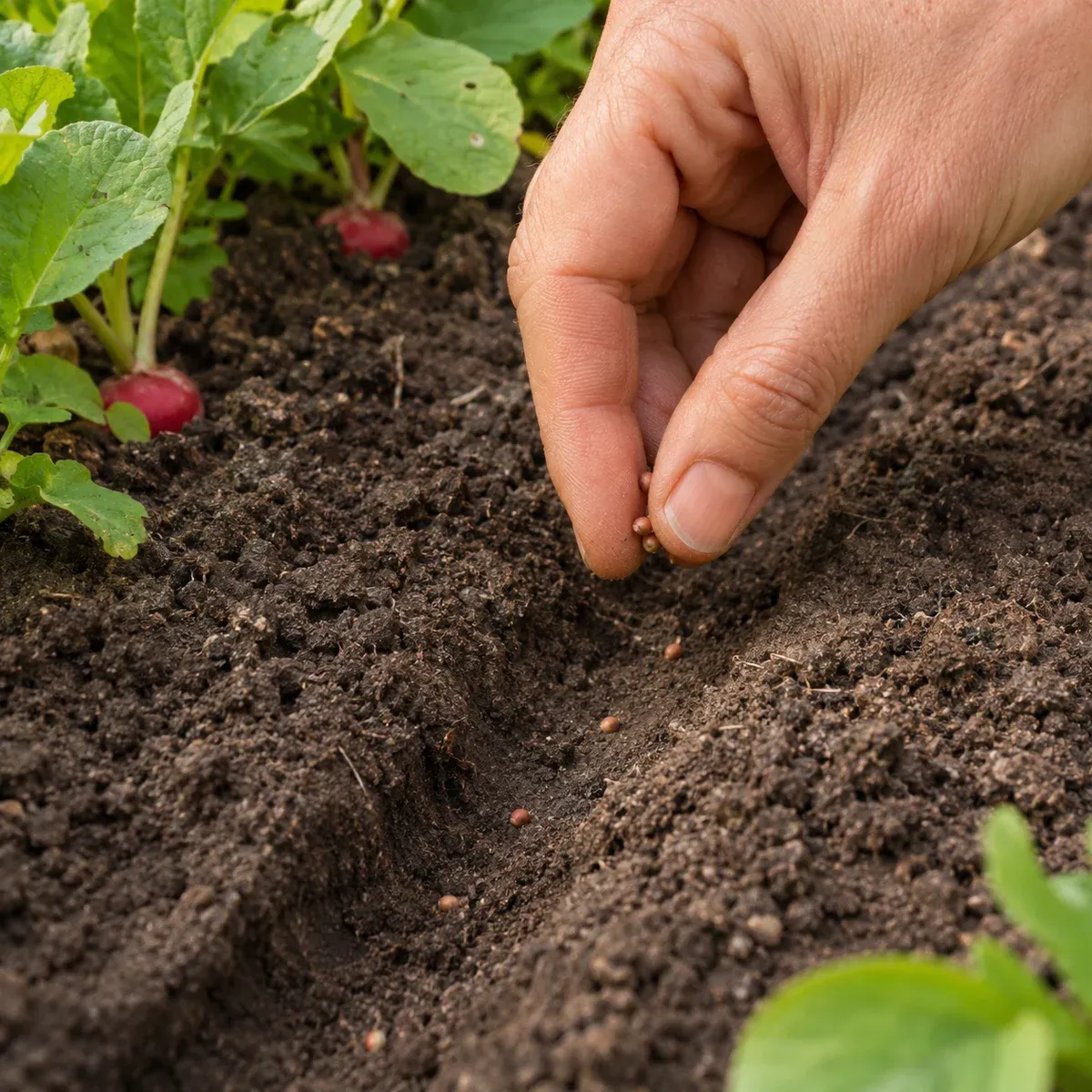
Place the seeds individually, aiming for this spacing. If several seedlings end up too close, remove the weakest soon after the seedlings emerge: the RHS recommends not waiting until competition hinders root development. A fully green row is not necessarily a sufficiently spaced row.
Monitor seedling emergence without waterlogging the soil
Keep the soil consistently moist, without saturating it, following Maryland. Check the row after heavy rain: Minnesota notes that a crust formed by rain or excessive watering can impede seedling emergence. A light sprinkling can soften it; more water does not necessarily mean better seedling emergence.
No seedlings or patchy emergence: what should you check?
The RHS notes that seedlings usually emerge in around 7 to 10 days; actual conditions may alter this guideline. Re-examine the label, the radish shape and the depth specified on the seed packet, then observe the surface: is it moist, dried out, saturated or hardened after rain? Compare the empty sections with the areas where seedlings have emerged, without digging up the entire row. The crust described by Minnesota justifies first checking and gently softening the surface.
If preparing a replacement batch, ensure the radish type is still within its suitable window and that the weather is appropriate: a new batch of small radishes during a hot, dry spell will not address the cause described by the RHS. Sow a small, distinct section with a new label, and keep the seedlings that have already emerged at their recommended spacing. This approach follows the logic of small batches, without imposing a fixed deadline for declaring a sowing unsuccessful.
Organise small batches
For small radishes consumed fresh, Maryland advises several sowings in small quantities. The RHS recommends reserving space for the next row and observing the growth rate before repeating.
Prepare a label for each batch with the variety and date, then note the length sown. At the first harvest, also record how much you actually ate: this helps you adjust the quantity for the next sowing. If a batch exceeds your needs, shorten the next row. These are organisational choices to adapt to your household, without any promised yield.
According to the RHS, weather changes can cause batches sown at different times to mature simultaneously. Therefore, reconsider each batch based on the season and the progress of previous ones.
Do not schedule a mandatory harvest on the eighteenth day. The SNHF classifies the variety ‘De 18 jours’ (‘18-day’) among all-season radishes, which typically take four to six weeks to grow. Observe the actual development; the radish fact sheet details harvest guidelines. The sowing guide covers common preparation and monitoring techniques.
Key points for this crop
Practical guidance
- Seed packet
- Identify the type, shape and recommended sowing period
- Spacing
- Allow more space for large radishes
- Seedling emergence
- Monitor moisture and surface crusting
- Small radishes
- Sow in several modest-sized batches
Sources and references
- RadishSociété nationale d’horticulture de France (SNHF), Jean-Daniel Arnaud Accessed on 16 October 2026.
- How to grow radishesRoyal Horticultural Society (RHS), in English Accessed on 16 October 2026.
- Growing radishes in home gardensUniversity of Minnesota Extension, Marissa Schuh and Jill MacKenzie, in English Accessed on 16 October 2026.
- Growing Radishes in a Home GardenUniversity of Maryland Extension, in English Accessed on 16 October 2026.
- Successional sowingRoyal Horticultural Society (RHS), in English Accessed on 16 October 2026.