
The vegetable garden notebook / Crops
Sowing radishes: selecting the type, depth, and harvest
Before sowing radishes, identify their type and shape. Small spring radishes and large winter radishes need different sowing schedules and spacing. Keep the seed packet to track your variety.
Adapt this guidance to your garden’s climate and conditions.
Which type of radish to sow, and when?
First, read the type indicated on the seed packet. The following guidelines come from the SNHF; check the specific instructions for your variety and local conditions before choosing your sowing date.
| Type | Period and method | Spacing between plants |
|---|---|---|
| Forcing | From mid-February under protection; also in October under a tunnel. | 2 to 3 cm |
| All-season | Mid-March to late September, in open ground. | 2 to 3 cm |
| Winter | June to August; the name does not refer to the sowing season. | 15 cm |
The SNHF recommends 10 to 20 cm between rows. These dimensions are general guidelines: retain the packet’s instructions for a specific variety.
For small radishes, the RHS advises against sowing during hot, dry spells, which encourage bolting. “All-season” therefore does not mean every week of the year is suitable. A break may be preferable during periods when watering is difficult.
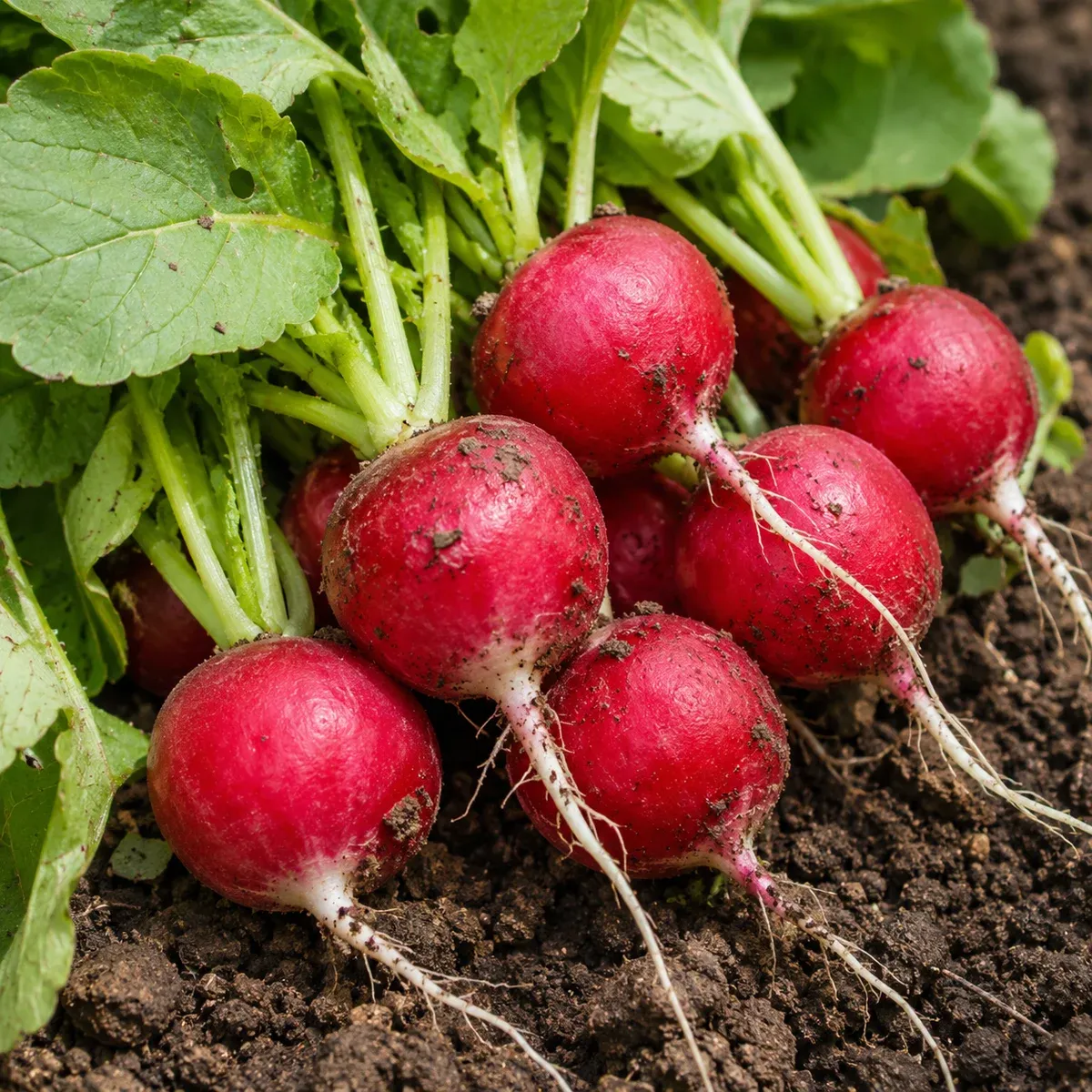
Preparing a suitable spot for the root
The RHS advises full sun, with light shade possible in summer for small radishes. Prepare a fine, weed-free surface, free of stones; long varieties require deep soil.
The University of Minnesota emphasises well-draining, non-compacted soil. For daikon, it recommends a shorter variety if the ground is stony or very heavy. Do not choose based on colour alone: also consider the expected root length.
Before opening the packet, mark the row and prepare a label with the variety and date. Our sowing guide covers preparation and follow-up steps.
Radishes in pots: choose based on root length
For small radishes with short roots, the RHS describes a container at least 30 cm wide and deep, filled with peat-free potting compost. These dimensions apply to this method; they do not define a universal volume for all radishes.
A long winter radish or daikon requires more usable depth: the same source notes that some roots exceed 30 cm. Compare your variety’s expected root length with the actual depth of growing medium available below the seeds. If the container is unsuitable, choose a shorter variety or open ground. Maintain the spacing appropriate for the radish type, then thin once the seedlings have emerged; pots do not allow indefinite crowding.
Monitor potting compost dryness closely: radishes in containers are more exposed to it, according to the RHS. Check its moisture before watering, aiming for consistent growth without saturation.
What changes with sowing under cover?
Cover enables early sowing of forcing radishes described by the SNHF, without turning all varieties into winter crops. Choose the appropriate type and check the soil even when it rains outside: verify its moisture before watering. Heat and drought can still cause poor root development in small radishes, even under protection. RHS
At what depth should radishes be sown?
The SNHF distinguishes near-surface sowing for round radishes and 1.5 to 3 cm for semi-long and long varieties. Follow the packet’s instructions to determine how much soil to cover your variety’s seeds with: a single depth does not suit all radishes.
Distribute seeds evenly, avoiding clumps. Once the seedlings have emerged, if they are too crowded, remove the weakest to restore the chosen spacing. The RHS recommends early thinning: leaving all plants in place may prevent roots from swelling properly.
For small radishes, plan several modest sowings rather than one long row. This succession principle, described by the University of Maryland, spreads out harvests. Note the quantity sown and what you actually consume before deciding on the next sowing; no fixed interval is necessary for this record.
Water according to soil conditions, without a fixed quota
Aim for consistent moisture without saturating the soil, following the University of Maryland. Before watering, observe the soil and check moisture below the surface near the row. Minnesota suggests using a small trowel to see how deep the soil is moist: surface appearance alone does not describe the entire root zone.
Adjust watering based on this observation, rainfall, and drying conditions. Water stress can make roots tough; moisture fluctuations may cause cracking, according to Minnesota. These are risks to minimise, without assuming an identical watering schedule will suit every soil.
If you see abundant foliage but little root, also check plant density. Lack of space is among the causes described by this university; this symptom alone does not mean fertiliser is needed.
Leaves with holes or roots with tunnels: separate observations
The RHS identifies flea beetles for small leaf holes and cabbage root fly for tunnels in roots, particularly in winter and oriental types that remain in the ground longer. A holed leaf does not prove a root is infested. Look for pests and inspect the harvested part before acting.
Our pest guide for cabbages and other Brassicaceae distinguishes these signs on radishes and explains prevention based on the target. Practices for transplanted cabbages are not all suitable for a row of sown radishes.
When to harvest radishes?
For small spring radishes, observe the swollen part appearing at soil level. The University of Maryland suggests approximately 2.5 cm in diameter, depending on the cultivar, as a harvest guideline. This diameter is not a universal target for elongated or large winter radishes.
Harvest one radish first to check its size and texture, then pick the others as they mature. Do not systematically wait for them to grow larger: over-mature small radishes may become fibrous and stronger in flavour, as noted by Minnesota.
For winter radishes, the SNHF places the start of harvests in November after a summer sowing. Verify your variety’s expected development, without applying the small size of spring radishes.
Is ‘De 18 jours’ (‘18-day’) radish always ready to harvest in 18 days?
No: the SNHF classifies this variety among all-season radishes, which take around four to six weeks from sowing to harvest. This guideline remains indicative. Keep the sowing date for comparisons, but observe the root before harvesting.
Can radishes be used to mark another sowing?
The RHS describes this use with fast-growing small radishes, particularly on a parsnip row: they must be harvested before interfering with the main crop. Large winter radishes are not interchangeable with these temporary markers. For a first trial, labels are also sufficient to locate your rows.
What to note for the next sowing?
Record the variety, date, chosen spacing, and first observed harvest. Add a specific detail: “plants too crowded”, “soil dry below the surface”, or “first root still thin”. These notes will help you choose the next step without turning a single trial into a general rule.
Key points for this crop
Practical guidance
- Selection
- Type and variety before sowing date
- Depth
- Adapt to round or elongated shape
- Water
- Consistent moisture, without saturation
- Harvest
- Observe the root rather than counting days
Sources and references
- RadishSociété nationale d’horticulture de France (SNHF), Jean-Daniel Arnaud Accessed on 15 October 2026.
- How to grow radishesRoyal Horticultural Society (RHS), in English Accessed on 15 October 2026.
- Growing radishes in home gardensUniversity of Minnesota Extension, Marissa Schuh and Jill MacKenzie, in English Accessed on 15 October 2026.
- Growing Radishes in a Home GardenUniversity of Maryland Extension, in English Accessed on 15 October 2026.