
The vegetable garden notebook / Techniques
Cabbage Pests: Observing Damage and Choosing Prevention
Holes in leaves are not enough to identify a pest. On broccoli, cauliflower, kale, cabbage, radish, or rocket, start with the affected part, the crop stage, and the observed animals before selecting an action.
Adapt this guidance to your garden’s climate and conditions.
Practical steps
- Observe
Examine leaves, undersides, heart, and base; note the crop stage.
- Distinguish
Look for small jumping beetles, caterpillars, slug trails, or root damage.
- Prevent
Fit netting suited to the target pest before the adults arrive.
- Recheck
Monitor new leaves and root condition, even under protection.
Observe leaves, stem base, and roots
Start by noting the crop and its stage: nearly defoliated radish seedlings and a few holes in the large leaves of established broccoli do not present the same issue. On kale and rocket, the leaves are the harvest; on cauliflower and broccoli, also inspect the harvested part and its surroundings. Kale does not need to form a head.
Examine both sides of the leaves, the folds, the heart, and the base of the stem, called the collar. A wilting plant also requires checking moisture and, if it is declining, the roots. Multiple causes may coexist; a hole or colour alone does not prove the identity of the culprit.
The following guidance applies to headed cabbages, broccoli, cauliflowers, and kale, as well as radishes and rocket where the pest or disease discussed affects them. Begin by observing the damage and searching for the responsible animal to choose the appropriate prevention.
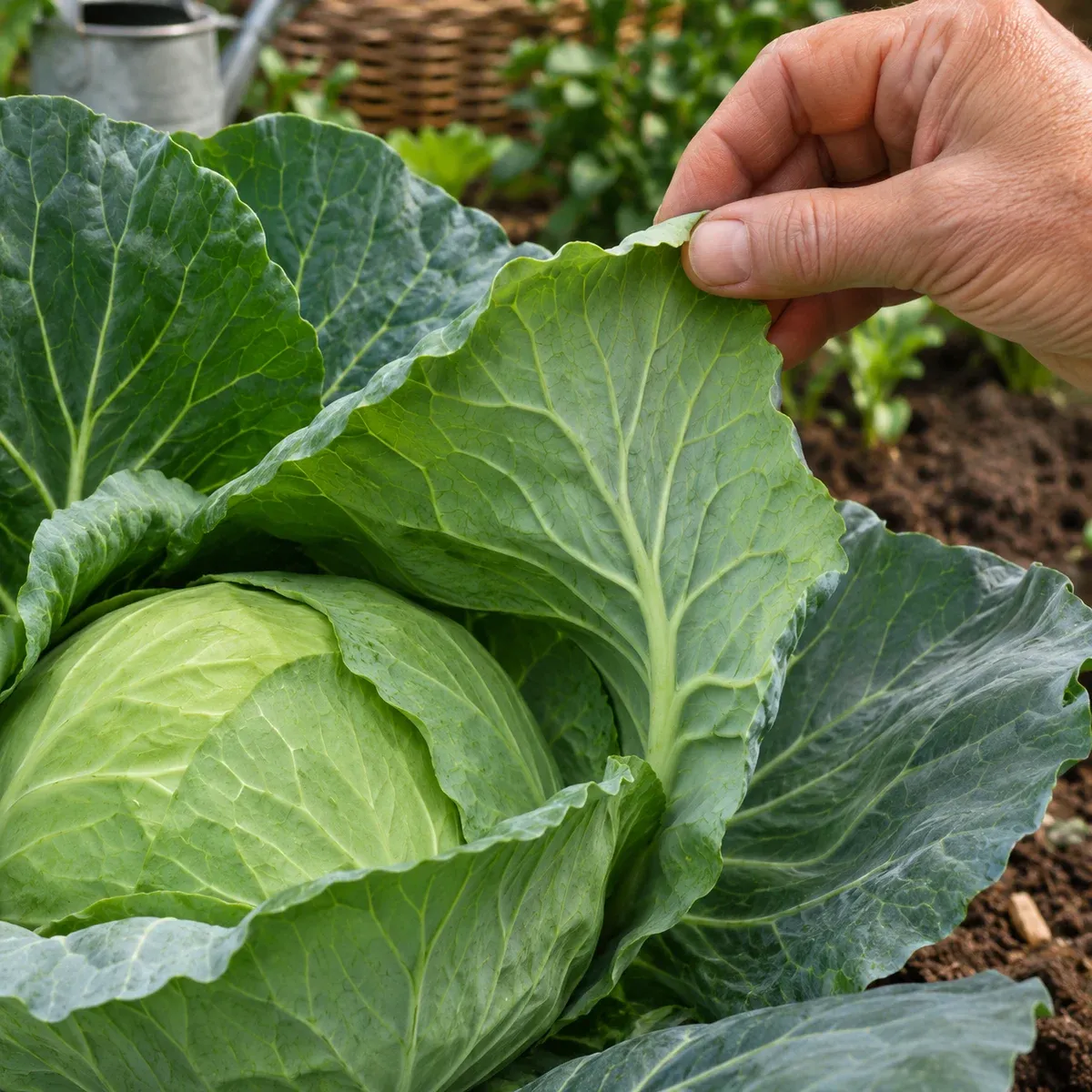
Flea beetles and other causes of holes
Numerous small holes and jumping insects: look for flea beetles
Flea beetles of the Brassicaceae are small beetles that can jump when the leaf is disturbed. Round perforations, sometimes superficial at first, associated with these insects form a body of evidence. Young seedlings are particularly vulnerable, especially radishes and rocket, which the RHS lists among their hosts.
On established cabbage, a few outer leaves with holes may be tolerable. On seedlings with little green surface remaining, the priority is to protect new growth. Inspect before covering and choose a mesh suitable for small insects; netting designed only against butterflies may allow flea beetles to pass through.
Leaves eaten, eggs, or droppings: look for caterpillars
Turn over the leaves and check the folds: caterpillars of cabbage white butterflies and other species may be accompanied by eggs and droppings. Some remain mainly on the outer leaves; others penetrate the heart of the cabbages. The RHS describes these differences: a white butterfly seen in the garden does not, on its own, explain all the damage.
Regularly inspect plants and manually remove eggs and caterpillars identified as responsible, when necessary. Prevent new egg-laying with netting installed before adult insects can reach the plants. Keep it away from contact with leaves, as egg-laying through the cover remains possible. Netting does not remove caterpillars already present.
Irregular holes and slime: observe at dusk
Slugs and snails can rasp young leaves and seedlings. Look for the animals on mild, damp evenings, as well as slime trails; their absence during the day does not rule them out. The RHS notes that only certain species consume living plants.
Prioritise protecting vulnerable seedlings and young plants. Selectively removing the animals you find lets you act without assuming that slugs caused every hole. Insect-proof netting is not a sufficient response: slugs may already be underneath, where humidity favours them. RHS, netting
Wilting: distinguish root fly and club root
Roots gnawed or tunnelled: look for fly larvae
The cabbage root fly, Delia radicum, produces legless whitish larvae that consume roots. Transplanted young plants may make little growth, wilt, then die. The RHS also describes tunnels in the harvested roots of radishes and turnips. Do not confuse these underground larvae with a caterpillar eating the leaves.
Prevention focuses on stopping egg-laying at the base of the plants: suitable cover from sowing or planting, or a collar designed for this purpose around transplanted cabbages. A collar does not protect leaves against caterpillars and flea beetles. Move the crop: adults may emerge from pupae that have overwintered in the soil, even inside the netting if Brassicaceae occupy the bed again.
Swollen and deformed roots: consider club root
Club root is a disease, caused by Plasmodiophora brassicae, not an insect. Look for swollen, deformed roots, pronounced wilting on hot days and patches of declining plants. INRAE, RHS
Confirm the cause if roots appear abnormal. In cases of club root, netting does not sanitise the soil. Avoid transferring soil from the affected area on tools, shoes, or new plants, and seek healthy planting material. Persistence in the soil can be very long: a typical rotation does not guarantee elimination of the disease. Lime application should not be decided based on wilting alone and does not replace diagnosis. RHS
Damage to radishes and rocket: also check the harvested part
For radishes, separate observations: small holes in leaves with jumping beetles, tunnelled roots with larvae, or abnormally swollen roots guide different investigations. A leaf with holes does not prove that the root will be infested with maggots. The RHS pages on flea beetles, root fly, and club root each document this crop.
On rocket, start by looking for flea beetles and slugs on the leaves. Do not conclude that every root problem discussed for cabbage applies to every damaged rocket leaf. Monitor the appearance of new damage after your intervention: old holes do not close up.
Choose and monitor netting according to the target
The RHS gives 1.3 to 1.4 mm as a benchmark against cabbage root fly, butterflies, and some other insects; this mesh is unreliable against flea beetles. A mesh of 0.8 mm specifically targets these small beetles. Always verify the targets and installation instructions for the chosen product.
- Inspect plants before covering and allow enough room for their growth.
- Seal the edges and ends; restore the seal after each access.
- Check leaves under cover, openings, and soil moisture.
- In hot weather, monitor overheating: fine meshes can increase temperature and humidity.
Cabbages, radishes, and rocket harvested before flowering do not require pollinator access to produce their leaves or roots. If you keep plants for seeds and allow flowering, reassess the cover to permit this access. The protective netting guide details installation and monitoring.
In crop rotation, group Brassicaceae together: switching from radish to broccoli or from cauliflower to kale does not change the family. Rotation complements exclusion against root fly; it does not block access to butterflies and flea beetles from elsewhere and does not guarantee elimination of club root from affected soil.
Sources and references
- Flea beetles on brassicas and allied plantsRoyal Horticultural Society, in English Accessed on 18 October 2026.
- Cabbage caterpillarsRoyal Horticultural Society, in English Accessed on 18 October 2026.
- Slugs and snailsRoyal Horticultural Society, in English Accessed on 18 October 2026.
- Cabbage root flyRoyal Horticultural Society, in English Accessed on 18 October 2026.
- Club root — symptoms and damageINRAE, Ephytia VigiJardin, modified on 7 November 2019 Accessed on 18 October 2026.
- Club rootRoyal Horticultural Society, in English Accessed on 18 October 2026.
- Insect-proof meshRoyal Horticultural Society, in English Accessed on 18 October 2026.