
The vegetable garden notebook / Techniques
Protective Netting in the Vegetable Garden: Choosing Netting for the Pest and Fitting It Properly
Netting provides protection through exclusion: it must match the target pest and form a continuous barrier. Selection begins with the crop, the cause of damage, and the vulnerable growth stage.
Adapt this guidance to your garden’s climate and conditions.
Practical steps
- Target
Identify the pest and vulnerable growth stage before selecting the mesh size.
- Install
Cover the crop with allowance for growth and secure all edges.
- Monitor
Check for gaps, leaf contact, water, and heat.
- Adapt
Enable pollination for relevant crops and remove unnecessary protection.
Identifying the Cause of Damage
Netting designed to exclude butterflies may not stop smaller insects. Look for the culprit on the plant and beneath the leaves; a leaf with holes does not, on its own, identify the species. Note the crop, growth stage, and observed pest before selecting the material.
The RHS specifies a mesh size of 1.3 to 1.4 mm for several flies, including the carrot fly, and a mesh size of 0.8 mm for smaller insects, such as flea beetles. These are selection guidelines: verify the stated target and the manufacturer’s instructions. Standard mesh is not reliable against all small insects; finer mesh may also increase heat and humidity.
For carrots, protection aims to prevent the fly from accessing the crop. It will not repair a root that is already tunnelled.
Netting, Fleece, or Cloche: Choosing the Right Function
| Protection | Usage to verify | Main limitation |
|---|---|---|
| Insect-proof netting | Keep out pests that the chosen mesh is designed to block | Minimal thermal gain; not equivalent to fleece for frost protection |
| Horticultural fleece | Provide partial cold protection depending on quality | Heat and humidity must be monitored; frost-free conditions not guaranteed |
| Cloche or small tunnel | Shelter a crop with a cover chosen for this purpose | The support does not define the protection: material, anchoring, and ventilation matter |
The RHS guide to fleece notes that its protection depends on the material and solar heat gain. The University of Maryland also distinguishes between fleece, netting, and shading on the same structure. To prepare for a cold spell, consult winter tasks.
Installing a Continuous Barrier Without Crushing Vegetables
Install protection at the start of the vulnerable growth stage, after inspecting the plants. A cover may enclose an insect already present or a pest emerging from the soil: also follow crop rotation. University of Maryland
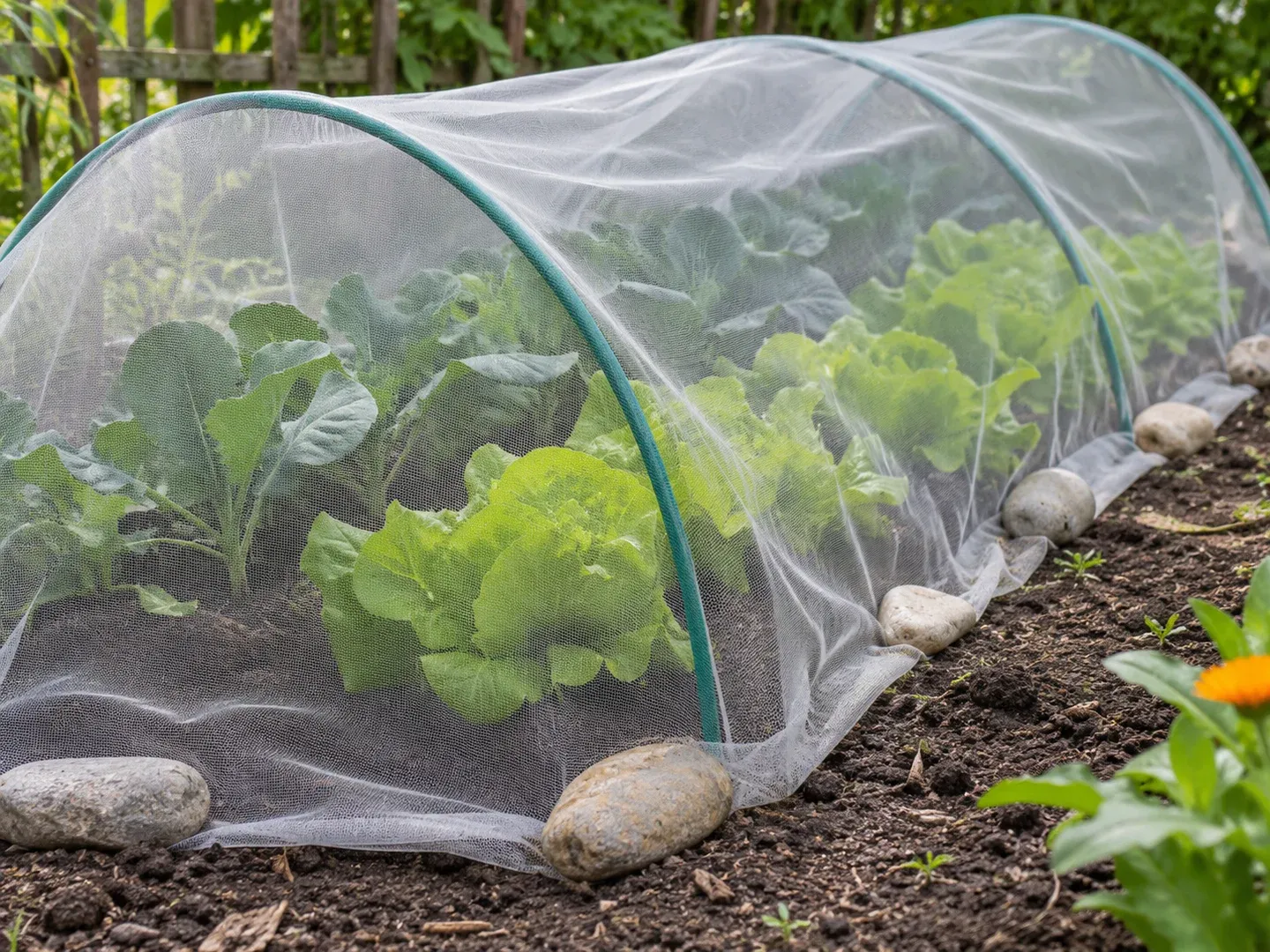
- Choose a piece large enough to cover the top, sides, and ends.
- Allow space for growth, using suitable supports if necessary.
- Secure the edges at ground level, with soil or continuous anchoring appropriate to the system.
- After each opening, inspect the plants and re-establish the seal.
Keep the netting away from the foliage: some insects can lay eggs through it if it touches the leaves. Avoid stretching it tightly over hoops, as this widens the mesh. The surface should be taut without sagging, with sufficient volume for the crop. RHS
Under Cover: Water, Heat, and Flowering
Lift a corner occasionally to check the soil, young leaves, and competing weeds. Rain passing through a cover does not prove that the roots have enough water. The University of Maryland recommends monitoring irrigation and plants under cover; covers can also trap excessive heat. Check particularly after a hot day or wind.
For strawberries and courgettes, which rely on insects for pollination, remove the cover during flowering to allow access to the blooms. Opening also allows pests to return: this decision depends on the crop and its growth stage, not a common date for the entire vegetable garden. Leafy vegetables do not all require this during their production. RHS, University of Maryland
Birds and Small Mammals: Avoiding Netting as a Trap
If pigeons are indeed responsible for the damage, netting supported on a frame can protect young crops. Keep the netting taut, check for holes, and regularly ensure no animal is trapped: loose netting can ensnare or injure wildlife. Remove it as soon as it is no longer needed. RHS, pigeons
For nibbled crops or seeds and seedlings that have disappeared, do not immediately assume a small mammal is to blame. Insect-proof netting is not universal protection against all animals. Confirm the target before modifying the installation.
Before storing the material, identify and repair any openings, then keep it safe from damage. Recheck it before the next installation: its presence over a row does not prove the barrier is still intact. RHS, University of Maryland
Sources and references
- Insect-proof meshRoyal Horticultural Society, in English Accessed on 18 October 2026.
- Vegetable Garden Weather and Pest ProtectionUniversity of Maryland Extension, in English Accessed on 18 October 2026.
- Fleece and crop coversRoyal Horticultural Society, in English Accessed on 18 October 2026.
- PigeonsRoyal Horticultural Society, in English Accessed on 18 October 2026.