
The vegetable garden notebook / Vegetable garden calendar
The vegetable garden in June: what to sow, plant and harvest?
In June, you can still start new crops while tending to those from spring. Choose your next sowings based on the variety, soil temperature and your ability to monitor moisture levels.
Adapt this guidance to your garden’s climate and conditions.
This guide uses French examples and seasonal references. Adjust them to your garden’s climate and local conditions.
Three priorities this month
- Select a few suitable sowings
Check the variety, soil temperature and whether you can monitor the sowing until seedlings emerge.
- Care for established crops
Check moisture before watering, taking into account each plant’s growth stage.
- Harvest at the right stage
Observe vegetables already formed without waiting for a date common to all gardens.
Choose tasks according to your garden
Before filling an empty bed, check local forecasts and assess its condition. A still-cold soil, a very dry period or plants recently moved from a greenhouse require different decisions.
Start with the crops already in place: which are emerging, establishing after planting, flowering or bearing fruit? The RHS distinguishes these stages to guide watering. Reserve an area for new sowings where you can monitor moisture levels.
What to sow and plant in June?
| Crop | Possible task | Condition to check |
|---|---|---|
| French bean | Sow in place | Warmed soil: the SNHF indicates 15 to 18 °C in the ground. Choose between a dwarf type and a climbing type, which requires support. SNHF |
| Carrot | Sow in open ground | June falls within the indicative window of March to July. Choose a variety suited to soil depth and desired harvest. SNHF |
| Summer or autumn radish | Start a season-appropriate sowing | The June to August window applies to these types: read the packet, keep the soil moist and do not confuse them with forcing radishes. SNHF |
| Potted tomato | Plant out a young plant that has been hardened off | No more risk of frost, sunny location and earliness of the chosen variety taken into account. SNHF |
| Courgette in a pot | Plant in the final location | After the risk of frost, in full sun, in loose, humus-rich soil, with enough space for the variety. SNHF |
For French beans, the SNHF places the first sowings in April in the regions of the Midi and South-West where the growing season starts early. This reference does not mean all gardens should start at the same time: in June, too, sufficiently warmed soil is what matters. Our French bean guide details the choice between dwarf and climbing types.
If tomatoes or courgettes have been raised indoors or under glass, gradually acclimatise them to outdoor conditions before planting. The RHS recommends a step-by-step transition, starting in a sheltered situation. Acclimatisation does not make these plants frost-resistant. It remains useful even when planting occurs later than planned.
Help seedlings emerge before sowing more rows
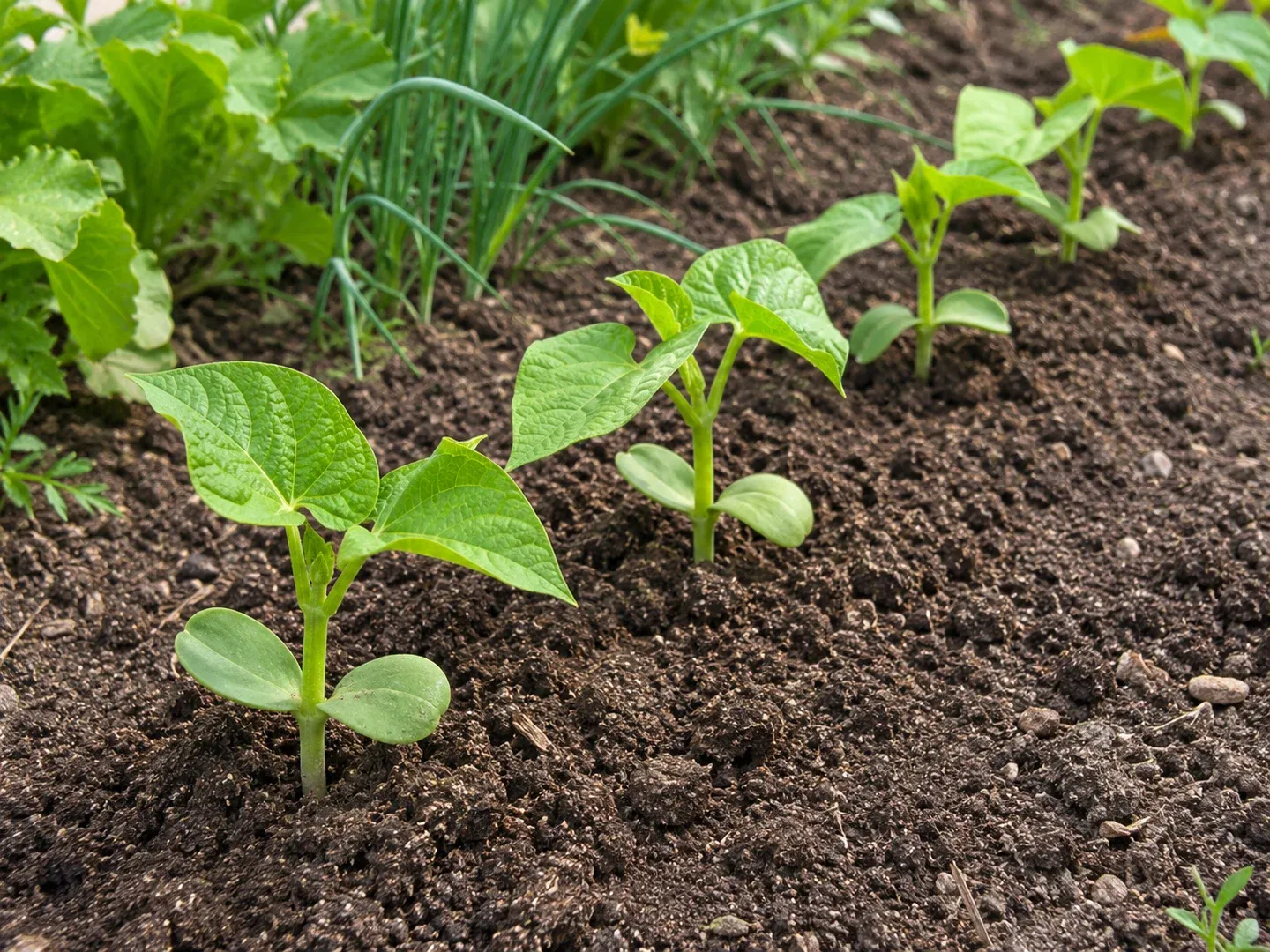
Freshly sown seeds and young plants require consistent moisture, according to the RHS. Therefore, check sowing rows separately from well-rooted crops. A schedule of infrequent watering applied indiscriminately to the entire plot does not address these different situations.
To prepare the soil and distribute seeds, consult the sowing guide. If you cannot ensure this monitoring during a hot period, reduce the new sowing or postpone it within the window compatible with your variety. It is not necessary to fill all available space immediately.
Water based on soil conditions, not a calendar
Scrape back a little soil and check the moisture below the surface before watering. Jardiner Autrement also recommends verifying the result after watering: a wet surface does not prove the soil is moist deeper down. Apply water at the base, without saturating an area that is still damp.
Sandy, free-draining soil may require smaller, more frequent applications than clay soil; observation remains key. Regarding crops, the RHS highlights the moisture needs of courgettes until harvest and the regularity of watering for tomatoes during flowering and fruiting. This does not set a volume per plant or a daily frequency.
Around established crops, mulch applied after rain or watering can help retain moisture. Continue to check the soil: the cover does not replace monitoring. The watering guide distinguishes more precisely between sowings, open ground and containers.
A wilted leaf is not conclusive. The University of Maryland describes temporary wilting in heat or wind while the soil remains moist. Poor drainage can also cause this sign. Check the soil and the plant’s progress when the heat subsides; if the problem persists, investigate the cause instead of automatically adding water.
Harvest what has reached the right stage
June harvests depend on what was sown or planted earlier. Early carrot varieties grown as a forced crop may yield roots this month, according to the SNHF; this is not the schedule for a sowing done now.
Monitor small salad radishes and pick them when formed, without leaving them unnecessarily: their quality declines if they become hollow. This does not mean summer or autumn radishes will be ready as quickly: their growing period is longer. The radish fact sheet clearly distinguishes these groups.
If your courgettes are already producing, harvest young fruits as they develop, as advised by the SNHF. Do not treat the absence of a harvest from a young plant planted in June as a delay you need to correct: compare its progress to its planting date and variety, not to another garden’s basket.
Sources and references
- French beansSociété nationale d’horticulture de France (SNHF), Jean-Daniel Arnaud Accessed on 16 October 2026.
- CarrotSNHF, Jean-Daniel Arnaud Accessed on 16 October 2026.
- RadishSNHF, Jean-Daniel Arnaud Accessed on 16 October 2026.
- TomatoSNHF, Jean-Marc Muller Accessed on 16 October 2026.
- CourgetteSNHF, Jean-Marc Muller Accessed on 16 October 2026.
- Hardening off tender plantsRoyal Horticultural Society (RHS), in English Accessed on 16 October 2026.
- Water-efficient irrigationJardiner Autrement, a programme run by the SNHF Accessed on 16 October 2026.
- Watering vegetables and fruitRHS, in English Accessed on 16 October 2026.
- Wilting of Vegetable PlantsUniversity of Maryland Extension, in English Accessed on 16 October 2026.