
The vegetable garden notebook / Techniques
Vegetable garden plan: designing your first manageable garden
A first vegetable garden plan helps you confirm that you can reach, water and monitor your crops. Start with the space you can actually use, then add a few vegetables you want to grow.
Adapt this guidance to your garden’s climate and conditions.
Practical steps
- Observe
Identify sunlight, soil, water source and access points.
- Draw
Position pathways before allocating growing areas.
- Choose
Select a few suitable crops and allocate them enough space.
- Record
Keep the dated plan and the history of each area.
Start with the location
Before drawing rows, sketch the plot with its boundaries, trees, walls and access to the water source. Note where the sun reaches in the morning and afternoon. Date this observation: an autumn survey alone does not describe the entire growing season.
Most vegetables prefer a sunny location. Some, such as lettuce or spinach, tolerate more shade, while vegetables grown for their fruit generally perform less well in shade. The RHS also advises a spot sheltered from strong winds and away from large trees and hedges, whose roots compete with vegetables for water and nutrients.
On your sketch, mark areas where water remains on the surface after rain. Soil that drains excess water and a watering point that is easily accessible are among the criteria used by the University of Maryland. Check the actual path of the hose or watering can to the crops.
Draw pathways before the beds
A bed here refers to a cultivated area between pathways; it does not necessarily have a wooden frame. Allocate space for pathways first, then measure the remaining area. The aim is to be able to work from the edges without stepping among the plants: pathways thus limit soil compaction in cultivated areas, as explained by the University of Maryland.
Test your design on the ground with temporary markers. Can you comfortably reach the centre? Pass through with your equipment? Crouch without encroaching on the crops? Adjust widths to these movements and the people who will garden. A standard measurement does not replace this trial.
A raised bed is not mandatory. If you choose one, factor in its cost and maintenance. Its soil can dry out more quickly, especially in hot, dry weather; it then requires more monitoring and watering. This limitation is highlighted in the same factsheet.
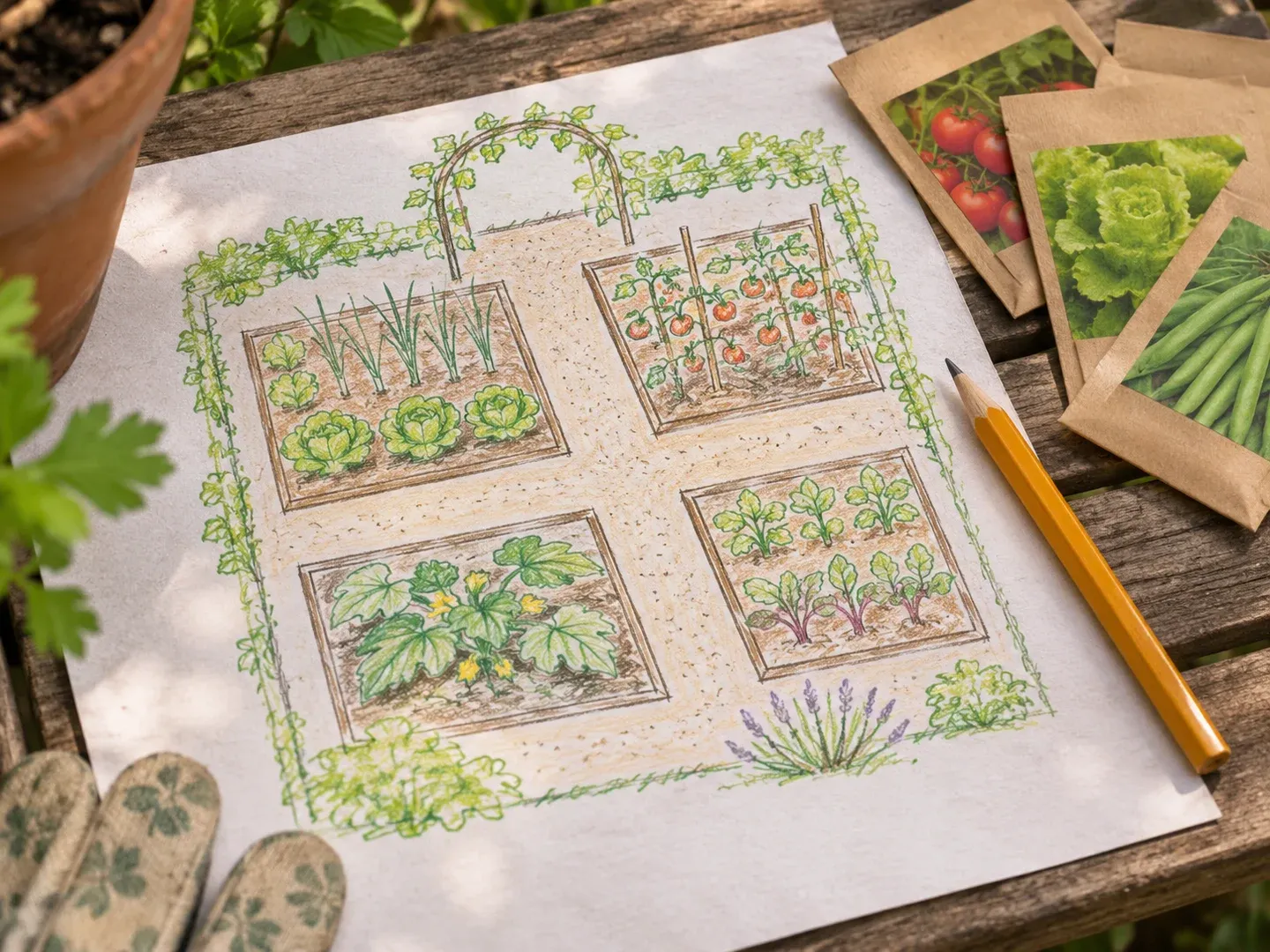
What size for a first vegetable garden?
Start with a single small area that you can reach and monitor, then expand after your first review. The University of Maryland advises starting small and scaling the garden to the resources available. There is no set area that automatically feeds one, two or four people.
To make the choice concrete, mark out a test rectangle on the ground. A rectangle of 2 m by 1 m represents 2 m² of cultivated area: this is an example of calculation and organisation, not a recommended size for everyone. Check that you can reach the centre from the edges, add pathways around it, then draw the plants at their mature spacing. If this already seems difficult to water or maintain, reduce the trial.
How many plants should you plan to grow for your household?
Start with the vegetables you actually consume and the period when you want to harvest them. The RHS recommends considering useful quantities and avoiding surpluses that cannot be stored.
- Note, for one or two crops, what you consume and the desired harvest period, without promising self-sufficiency.
- Transfer the spacing requirements of the variety to the available area. The spacing tool counts theoretical planting positions; it does not predict plant survival or yield.
- After the trial, note what was harvested and eaten, along with the number of plants and duration. Then adjust the next batch to your consumption and what you can manage.
A past yield can serve as a hypothesis for preparing the next season: the University of Maryland reminds us of variability and possible failures. A fixed list of plants “for four people” would overlook differences in varieties, seasons and usage.
Choose a few crops you can manage
List the vegetables you like to eat, then reduce the list based on the space and care you can provide. The RHS recommends considering the time available, the quantities actually consumed and the periods when tasks are concentrated.
For each selected crop, add to the plan:
- the species and variety name;
- the sowing or planting period suitable for your region;
- the spacing to maintain and the space needed for the mature plant;
- any equipment or tasks to plan for.
The SNHF notes that the choice must suit the soil, region and period, and that seed packets provide useful information. Transfer their spacing requirements to your drawing. To move from plan to seed, consult our sowing guide.
For a first trial, you might consider lettuces or dwarf French beans, cited among beginner-friendly crops by the University of Maryland. Their inclusion in this list does not exempt you from checking the variety and season for your location. For garlic, our growing factsheet helps verify conditions before allocating space.
An example plan to adapt
Take a single bed of 2 m by 1 m, accessible from both long sides, for head lettuces whose variety suits the season. The RHS suggests approximately 30 cm between large head lettuces; check the seed packet before adopting this assumption. This plan illustrates setting out plants, rather than sowing densely and thinning later. RHS, lettuce
          cultivated length: 2 m
          access from this pathway
      ┌──────────────────────────────┐
      │  L    L    L    L    L    L   │ ← row 35 cm from the edge
 1 m  │                              │
      │  L    L    L    L    L    L   │ ← row 65 cm from the same edge
      └──────────────────────────────┘
          access from this pathway
          then path to the water source
L = centre of a plant. The drawing is indicative; positions are measured on the ground. On each row, place the centres at 25, 55, 85, 115, 145 and 175 cm from the short side: there are five intervals of 30 cm, i.e., 150 cm between the first and last plant, with 25 cm of margin at each end. The two rows are 30 cm apart. This gives 6 places × 2 rows = 12 theoretical places, without predicting establishment or harvests.
Pathways are added to these 2 m² of cultivated area. Test their width with your equipment and gardening style; they are not counted as available spaces for a plant. The advice to draw to scale aims precisely to avoid overcrowding. RHS, plan
If your seed packet requires 40 cm, redraw rather than crowding the same twelve plants: in this calculation example, five centres at 20, 60, 100, 140 and 180 cm, on two rows at 30 and 70 cm from the edge, give ten places. The 40 cm spacing is an arithmetic assumption, not a recommendation for all lettuces. If access is no longer possible, reduce the bed or the number of crops further; do not reclaim the pathway to keep the initial number.
Add north and shade to your version. A tall crop or support may alter the light for lower crops; place them on the sketch before purchasing, following the Maryland layout principles.
Add the history, even if incomplete
Label the areas A, B or C and note what grew there previously, with the year and any observed problems. If unknown, write “previous crop unknown”. This record will be the starting point for future plans.
Rotation involves moving groups of annual crops from one area to another to limit the build-up of certain pests and diseases associated with their hosts. The RHS groups garlic, onion, shallot and leek together, for example: moving from one to another in the same place does not change the group. It also notes that a full rotation scheme is poorly suited to very small vegetable gardens.
Check the plan before purchasing
Review your drawing by following the path of a garden visit: entering, reaching each area, watering, observing and harvesting. Also note periods when you will be away and who can monitor the crops. If the organisation seems too demanding, reduce the project before ordering seeds.
Keep the dated plan, then annotate it throughout the season: actual planting, relocation, insufficient space, obstructed pathway. To prepare this work in autumn, the November calendar helps distinguish useful observations from tasks to undertake based on current conditions.
A plot record sheet to reuse
To compare locations and share your observations, copy a sheet for each bed or container. This is a monitoring tool proposed here: the criteria for sunlight, wind, water and access come from the location principles of the RHS and the University of Maryland. A single measurement does not define the garden’s climate.
| Detail to record | What you record |
|---|---|
| Precise location and date | Bed A, pot near the wall, centre of the row; date and time of the observation. |
| Light | Hours of direct sunlight observed, obstacle causing shade, season and whether foliage is present. |
| Soil and water | Observed condition below the surface, after rain or watering; area remaining damp or drying quickly. |
| Wind | Exposed or sheltered area and observed effect on plants, without estimating wind speed. |
| Night | Minimum recorded if you have a thermometer; device location and local forecast consulted. |
| Crop | Species, variety, growth stage, work done and actual result. |
| Decision to review | Wait, reduce the trial, move a pot or compare another area; date of next check. |
Keep observations and assumptions separate. “Soil damp below the surface this morning” describes an observation; “this entire area never needs water” would be a generalisation. Repeat the observations in spring and summer before comparing results.
You can cross-reference this sheet with growing in shade, clay soils and the Île-de-France example. These records do not remove the need to consider the crop’s requirements or the current season’s forecasts.
Sources and references
- Positioning vegetablesRoyal Horticultural Society (RHS), in English Accessed on 15 October 2026.
- Planning a Vegetable GardenUniversity of Maryland Extension, in English Accessed on 15 October 2026.
- Growing Vegetables in Raised BedsUniversity of Maryland Extension, in English Accessed on 15 October 2026.
- Planning a vegetable gardenRoyal Horticultural Society (RHS), in English Accessed on 15 October 2026.
- Seed and sowing: successful sowing, key principlesSociété Nationale d’Horticulture de France, Dominique Daviot and Philippe Monchaux Accessed on 15 October 2026.
- Crop rotationRoyal Horticultural Society (RHS), in English Accessed on 15 October 2026.
- Planning a Vegetable Garden — Beginner tipsUniversity of Maryland Extension, Jon Traunfeld, in English Accessed on 17 October 2026.
- Planning a vegetable garden — Make the most of spaceRoyal Horticultural Society (RHS), in English Accessed on 17 October 2026.
- How to grow lettuces — PlantingRoyal Horticultural Society, in English Accessed on 8 November 2026.