
The vegetable garden notebook / Crops
Growing corn salad: sowing, watering and winter harvests
Corn salad fills a row vacated in late summer, provided the seedlings emerge successfully. Select your variety according to the season, then monitor the moisture of the seedbed closely.
Adapt this guidance to your garden’s climate and conditions.
When to sow corn salad?
The SNHF sets the common period from mid-July to autumn; Sainte Marthe suggests July to October. In metropolitan France, adjust this guideline according to the seed packet and garden temperatures: corn salad does not tolerate high heat well. The September calendar helps organise row succession.
For winter, the SNHF notably mentions ‘Verte de Cambrai’ and ‘Coquille de Louviers’, which are more cold-resistant. A large-seeded, earlier variety does not necessarily serve the same purpose. Verify the stated period for the purchased variety.
How can you sow successfully and help seedlings emerge?
Keep the soil firm: a light raking is sufficient, without ploughing or systematic fertilisation. Sow thinly, cover lightly with fine soil, then firm down with a rake. The surface must remain moist during germination and establishment. A crate can provide temporary shade if heat dries the row. SNHF
For a row that is easy to maintain, Sainte Marthe recommends 5 mm depth, 20 cm between rows, then 5 cm between plants after thinning. These are its cultivation guidelines, to be adapted to varietal instructions. Water gently after sowing. Sainte Marthe
Record the date, variety, and the parts of the row where seedlings emerge; these observations will help compare two sowings without attributing all failures to seed quality. Common practices are detailed in the sowing guide.
No seedlings emerging: wait or start again?
Sainte Marthe indicates 18 °C for germination and a benchmark of 12 days for emergence. These figures are guidelines, not a guarantee of success or a deadline for giving up on the sowing. The SNHF warns that germination and establishment can take a long time; keep the soil moist throughout. Sainte Marthe · SNHF
Before resowing, check the date and variety of the batch, then the conditions of the row: has the weather been very hot since sowing, has the thin covering of soil dried out, or has it stayed too wet? The soil must remain firm but not become waterlogged. If conditions are cool and regularly moist and a few seedlings appear, keep watching rather than sowing a new batch over the existing seeds. SNHF
If the row has been exposed to very hot weather or has dried out, first adjust the shade and how you monitor watering, then try a small, separate sowing labelled with its date when the variety and season allow. This will help compare conditions; it does not alone prove that the first batch was poor. The guide to seeds that do not germinate provides broader checks.
Should corn salad be watered or fertilised?
Monitor the surface closely until the seedlings emerge, then soil moisture during hot, dry periods. Sainte Marthe advises moderate watering; no fixed daily schedule suits all soils. Weed before small rosettes are overrun. Sainte Marthe
The soil must remain moist without excess: the SNHF highlights a risk of damping-off during establishment if moisture is too high. Its factsheet does not recommend fertilisation for this undemanding crop. SNHF
Is corn salad frost-resistant?
It is cold-resistant, with varietal differences. In severe frost, fleece can protect plants. Sainte Marthe advises temporarily lifting the covers on milder days. SNHF · Sainte Marthe
When and how to harvest corn salad?
Harvest well-formed rosettes as needed, cutting at the base. The approximately 60-day period cited by Sainte Marthe corresponds to favourable conditions; a late sowing that overwinters may develop more slowly. Sainte Marthe
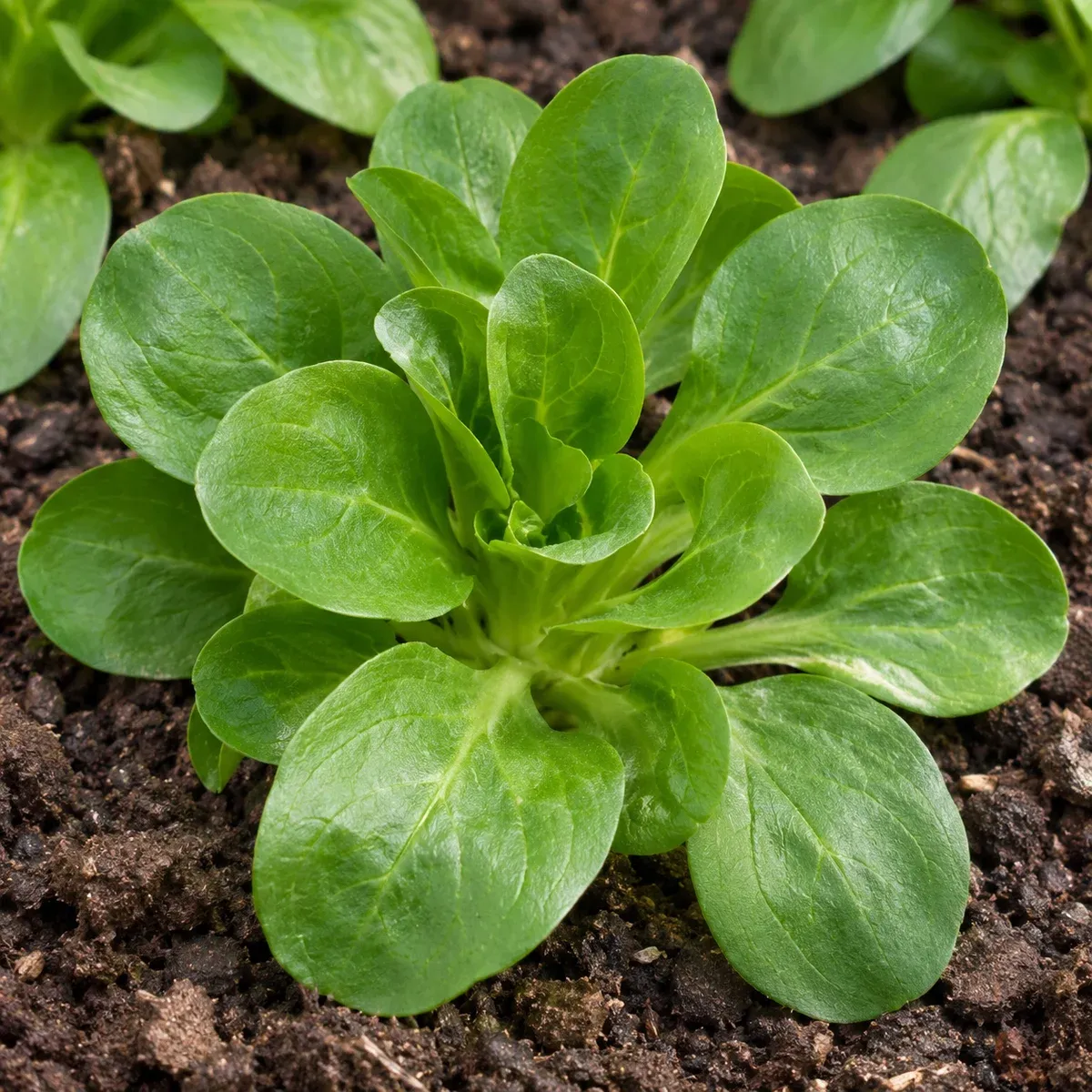
Can corn salad be grown in pots?
Yes, the SNHF mentions growing it on a terrace. Use a container with drainage holes. Sainte Marthe recommends sowing thinly, firming the growing medium and keeping it moist. Check it before each watering. SNHF · Sainte Marthe
A white coating or spots on established rosettes
Damping-off of young seedlings does not explain all later damage. The SNHF factsheet on corn salad powdery mildew describes powdery white spots that may spread across both sides of the leaves, followed by yellowing and stunted growth. It distinguishes these from initially greyish then brown spots that may suggest downy mildew. Examine both sides and the progression; colour alone does not confirm the cause.
Thin overly dense sowings, keep the base clear, and ventilate protected crops. Good drainage also matters. If powdery mildew is identified, the SNHF advises removing affected parts or the entire plant; do not replace this identification with a remedy applied to all white foliage. SNHF
When corn salad leaves the rosette stage to flower
The RHS describes an annual that later forms upright stems and small blue-white flowers in spring. This benchmark helps monitor plants that have overwintered; it does not set the same date for all varieties and gardens.
If your goal remains harvesting rosettes, pick them once the rosettes have formed, as described above, before allowing the bed to progress to flowering. Keeping a few plants for their seeds is another choice, to be prepared with the seed harvesting guide. Note this stage change to organise the space for the next crop.
Key points for this crop
Practical guidance
- Species
- Valerianella locusta, also known as lamb’s lettuce
- Common sowing period
- From mid-July to autumn, depending on variety and garden temperatures
- Soil
- Firm, moist, with no standing water
- Harvest
- Well-formed rosettes, typically from autumn to spring
Sources and references
- Corn saladFrench National Horticultural Society Accessed on 17 October 2026.
- Growing corn salad successfullyLa Ferme de Sainte Marthe Accessed on 17 October 2026.
- Corn salad — powdery mildewJardiner Autrement, French National Horticultural Society Accessed on 18 October 2026.
- Valerianella locustaRoyal Horticultural Society (RHS), in English Accessed on 18 October 2026.