
The vegetable garden notebook / Crops
Growing raspberries: planting, pruning and harvesting
Before planting a raspberry, identify its fruiting type. A pruning cut can help prepare the next crop, or remove the canes that would have borne it.
Adapt this guidance to your garden’s climate and conditions.
Summer-fruiting or autumn-fruiting: which to choose?
A summer-fruiting raspberry produces its crop in summer on canes that grew the previous year; an autumn-fruiting raspberry first fruits in late season on new canes, then may produce again on their lower sections the following summer. These are the two cycles described by Iowa. The choice therefore determines which canes to keep, not just the picking month.
Also compare vigour and mature size. An autumn-fruiting variety is not automatically dwarf: for a container, look for an explicitly compact cultivar, such as ‘Ruby Beauty’ cited by the RHS. Check the maturity period suited to your climate rather than choosing solely by colour. Raspberry plants are self-fertile: a second cultivar is not necessary for fruiting. RHS
When and where to plant a raspberry?
The SNHF recommends autumn planting in well-draining, moisture-retentive soil. Avoid waterlogging. In warm locations, it advises a position sheltered from intense sun; the full-sun recommendation from the RHS applies to the cooler British climate. Choose according to your climate, without confusing moist soil with waterlogged soil.
Prepare the support before planting. For a row of raspberries, the SNHF specifies 50 cm along the row and 1.50 m between rows; adjust spacing according to the expected vigour. Do not plant in frozen or waterlogged soil. The RHS advises planting at the previous soil level, without burying the plant deeply.
Replacing an old raspberry row
Before renewing raspberries, note the previous location and their health status. The RHS recommends a different area to avoid difficulties with establishment and health linked to replanting. Allow access and contain suckers: this long-lived row does not follow an annual rotation.
Watering, mulching and maintenance
Water at planting, then monitor the soil, particularly during establishment and fruit swelling in dry weather. Container needs differ from those in open ground: the RHS advises keeping the substrate moist during growth.
Mulching helps retain moisture. Leave space around the stems; avoid deep cultivation near the shallow roots. RHS, SNHF
How to prune according to raspberry type?
- Summer-fruiting: after harvest, cut to ground level the canes that have just fruited and retain vigorous young canes for the following year. SNHF
- Autumn-fruiting variety managed for a single autumn crop: the RHS suggests cutting canes to the ground in late winter. This method forgoes the summer harvest that retained canes could provide. RHS
Keeping two harvests on an autumn-fruiting raspberry
In late winter, retain a few strong canes that have already fruited at their tips, provided the plant is established and vigorous. Remove only the upper section that has already fruited; the lower part may produce the following summer. After this summer harvest, cut these old canes to the ground while preserving new canes, which will bear the late-season crop. Iowa explains how the upper and lower sections fruit in turn; the RHS reserves this method for well-established plants. It extends the picking season.
Tie retained canes and new shoots separately to distinguish them. With a summer-fruiting type, cutting all canes in winter would remove the wood for the next harvest. Iowa
If the type is unknown, retrieve the label or observe for a season before cutting everything back. Long-cane plants sold for quick production also require specific pruning instructions at planting.
Removing or replanting suckers
New shoots from the roots may spread beyond the intended row: remove those that encroach. For propagation, the RHS suggests lifting and replanting suckers during dormancy, only from recently purchased plants certified virus-free. A seemingly vigorous sucker from an old, diseased hedge is not healthy material.
Few fruits, spotted leaves or canes drying out: what to check?
Start with the type, planting date and pruning carried out. A newly planted summer-fruiting raspberry may not crop until its second summer; cutting its young canes removes a future harvest. Make these checks before assuming poor pollination. Next, verify soil moisture and the plant’s condition. RHS, Iowa
- Canes declining before harvest ends: look for a browned or split base and wilting leaves on the same cane. This may indicate cane disease; it differs from the expected ageing of a cane after its cycle. Photograph the base and leaves before seeking advice. RHS, cane decline
- Spotted leaves: also check the underside. Small orange pustules in summer suggest rust; yellowing alone is insufficient. Mottling and gradual loss of vigour may also accompany viruses, though some mites produce similar symptoms. Suspend sucker propagation and seek confirmation of the cause. RHS, rust, RHS, viruses
- Damaged fruit: a grey fuzzy coating is associated with botrytis, while dry patches near where the fruit attaches with a larva inside may indicate raspberry beetle, Byturus tomentosus. Open an affected fruit and note the timing; neither a larva nor a spot justifies random treatment. Remove mouldy fruit from the harvest. Minnesota, RHS, raspberry beetle
When to harvest raspberries?
Pick ripe fruit that detaches easily, without crushing. The period depends on type and variety; harvest regularly as they are fragile. The SNHF notes grey mould on ripe fruit in damp weather. Damaged fruit needs to be examined: damage alone does not identify one particular disease.
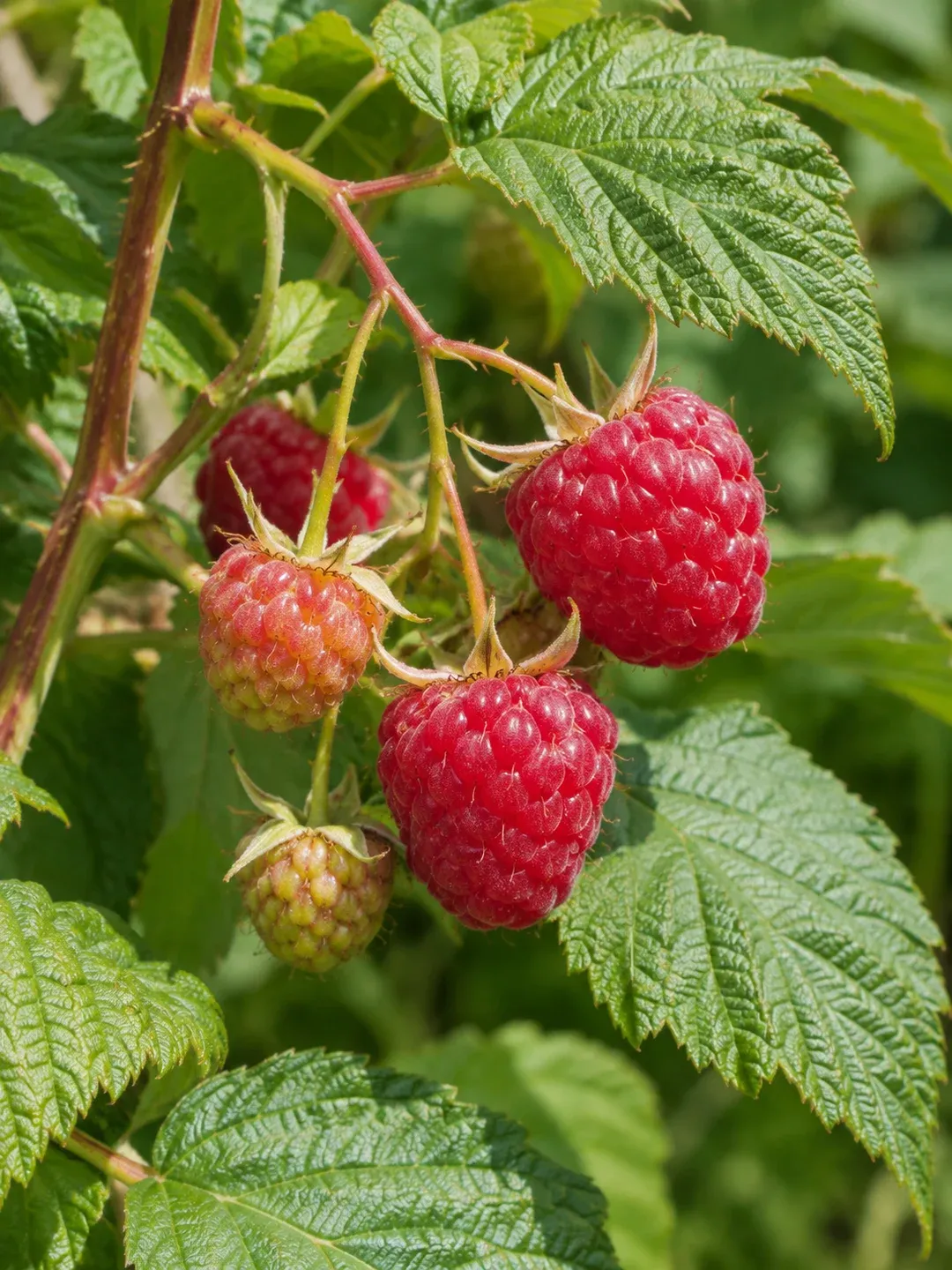
Can you grow raspberries in containers?
Yes, with a suitable compact variety and a well-draining container. The RHS recommends at least 40 cm width and 30 cm depth: these are minimum guidelines for such varieties, not for all raspberries. Provide support and regular monitoring of water and nutrition.
Key points for this crop
Practical guidance
- Plant
- Rubus idaeus, a fruiting shrub that produces new canes each year
- Soil
- Well-draining yet moisture-retentive, without waterlogging
- Planting
- Best in autumn, avoiding frost and waterlogged soil
- Pruning
- According to whether the variety is summer-fruiting or autumn-fruiting
Sources and references
- RaspberryFrench National Horticultural Society Accessed on 17 October 2026.
- How to grow raspberriesRoyal Horticultural Society, in English Accessed on 17 October 2026.
- How to Prune RaspberriesIowa State University Extension and Outreach, Aaron Steil and Richard Jauron, in English Accessed on 18 October 2026.
- Raspberry cane blightRoyal Horticultural Society, in English Accessed on 18 October 2026.
- Raspberry rustRoyal Horticultural Society, in English Accessed on 18 October 2026.
- Raspberry virusesRoyal Horticultural Society, in English Accessed on 18 October 2026.
- Raspberry beetleRoyal Horticultural Society, in English Accessed on 18 October 2026.
- Raspberry diseasesUniversity of Minnesota Extension, in English Accessed on 18 October 2026.