
The vegetable garden notebook / Crops
Planting shallots: grey or pink, care and harvest
For shallots, the first decision is the type of bulb purchased. An autumn-planted grey shallot and a Jersey-type shallot do not automatically follow the same schedule.
Adapt this guidance to your garden’s climate and conditions.
When to plant grey or pink shallots?
The French guide from SEMAE, section “How to grow shallots”, recommends October to December for grey shallots and February to April for Jersey-type shallots. These are guidelines: check the variety and the period indicated on the packaging, then assess the soil condition. Frozen or waterlogged soil is unsuitable.
Grey shallots, particularly ‘Griselle’, belong to Allium oschaninii; other types listed by the SNHF fall under Allium cepa, Aggregatum Group. The echalion is another type of onion: the commercial name alone is not enough to identify it. SNHF
Refer to the tasks for February or October depending on your choice.
How to plant the bulbs?
Choose bulbs sold for planting; the SNHF recommends certified planting stock for plant health. Plant them in full sun, in well-drained soil. If the soil remains too wet, a mound or raised bed may help, though this will not make every site suitable for winter planting. SNHF · SEMAE
SEMAE recommends 15 to 20 cm between bulbs, at least 25 cm between rows. Place the base in the soil, point upwards, and bury approximately two-thirds of the bulb. Do not cover it deeply like a sown seed. SEMAE
Label the type, variety, and date; record the location in your crop rotation plan.
Should you water and add fertiliser?
The SNHF describes shallots as a crop with modest nutrient needs that benefits from feeding given to previous crops, and advises against adding organic matter just before planting. Weed carefully around the bulbs. SNHF
During prolonged drought, monitor bulb formation closely and water if necessary. Waterlogging encourages problems; do not water automatically every day. SEMAE · SNHF
When to harvest shallots for storage?
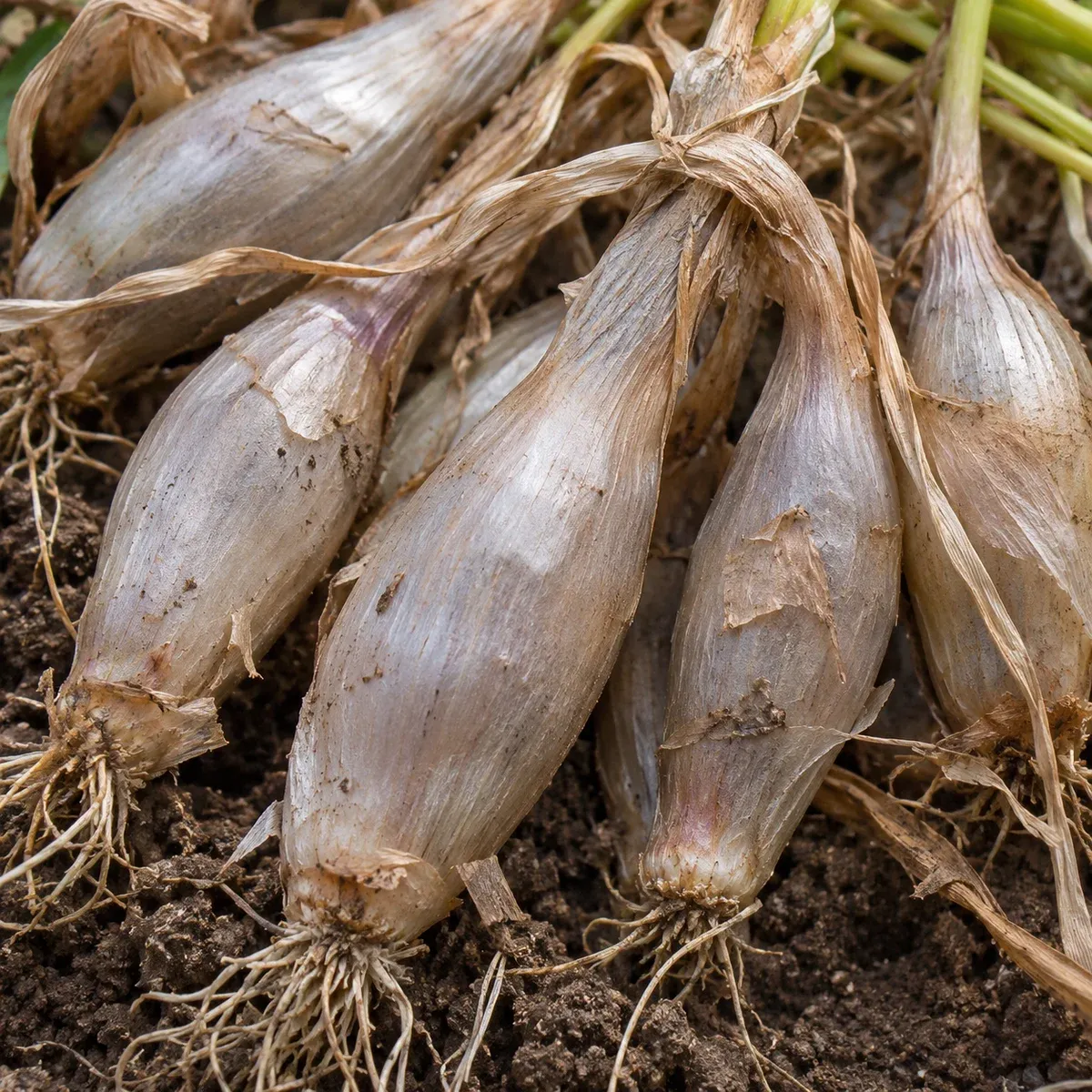
For bulbs to dry and store, wait until maturity: the foliage yellows and dries out. The SNHF suggests lifting the clumps when the leaves are half to two-thirds dry, in dry weather. Handle the clumps gently to avoid damaging the bulbs. SNHF · RHS
Then dry the shallots thoroughly, spaced out and well-ventilated; bring them under cover in a ventilated area if the weather is damp. Store only healthy, undamaged bulbs in a dry, ventilated place. Storage duration depends on the type and drying process. RHS
Can you plant shallots in pots?
Yes. The RHS advises a container at least 30 cm wide and deep, with drainage, and the same planting distances. Monitor moisture levels more frequently than in open ground. RHS
Leaves dying back or soft bulbs: where should you look?
Waterlogged soil or poor drying encourages rot, but a soft bulb alone does not identify the cause. Check drainage and the condition of the batch before considering treatment. RHS
Distinguish between issues appearing during cultivation and those revealed in stored batches:
- Lines of white spots, tunnels, larvae, or small brown pupae in the tissues: Allium leaf miner may affect shallots. Deformed leaves alone are not sufficient for identification. The leaf miner or leek moth guide helps compare observations without attributing all damage to the same insect.
- Yellowed leaves with white then purplish downy growth in damp weather: Allium downy mildew is a possibility for shallots. Examine both sides of the leaves and the progression; yellowing alone does not confirm it. Avoid overcrowded rows and maintain air circulation.
- Rotted roots and bulb base, white fungal growth, and tiny black grain-like structures: these signs match the description of white rot. Have the cause confirmed and avoid transferring suspect soil on tools or footwear. A simple rotation of a few years does not guarantee its elimination; the rotation guide explains this limitation.
- Stored shallots softening from the neck, with grey mould: neck rot may appear after an apparently healthy crop. Regularly inspect the batch and remove deteriorating bulbs; maintain the drying and ventilation described above.
Note the stage and photograph leaves, roots, or bulbs as appropriate. Do not replant soft or mouldy bulbs, as the RHS notes.
What to do with a shallot that starts to flower?
For a bulb harvest, the RHS advises removing the flower stalk as soon as it appears: flowering diverts resources from bulb growth. At harvest, identify bulbs that attempted to flower and use them first, as they store less well. Cutting off the flower stalk does not guarantee that the bulbs will store well.
Key points for this crop
Practical guidance
- Types
- Grey shallot and Jersey-type shallot: distinct schedules
- Exposure
- In full sun
- Soil
- Well-drained, no waterlogging
- Harvest for storage
- Foliage that yellows and dries out
Sources and references
- ShallotFrench National Horticultural Society Accessed on 17 October 2026.
- Growing shallots in the vegetable garden is very simple!SEMAE, September 2025 edition Accessed on 17 October 2026.
- How to grow shallotsRoyal Horticultural Society, in English Accessed on 17 October 2026.
- Onion downy mildewRoyal Horticultural Society (RHS), in English Accessed on 18 October 2026.
- Onion white rotRoyal Horticultural Society (RHS), in English Accessed on 18 October 2026.
- Onion neck rotRoyal Horticultural Society (RHS), in English Accessed on 18 October 2026.
- Allium leaf minerRoyal Horticultural Society (RHS), in English Accessed on 18 October 2026.