
The vegetable garden notebook / Crops
Planting and Growing Onions: From Sowing to Storage
To grow onions, start by deciding what you want to harvest: young onions for fresh eating or bulbs for storage. The variety, your region, and the starting method will then guide the planting process.
Adapt this guidance to your garden’s climate and conditions.
Seeds, sets or transplants: which to choose?
These three starting methods require different techniques:
- Seeds allow for sowing directly in the ground or in containers.
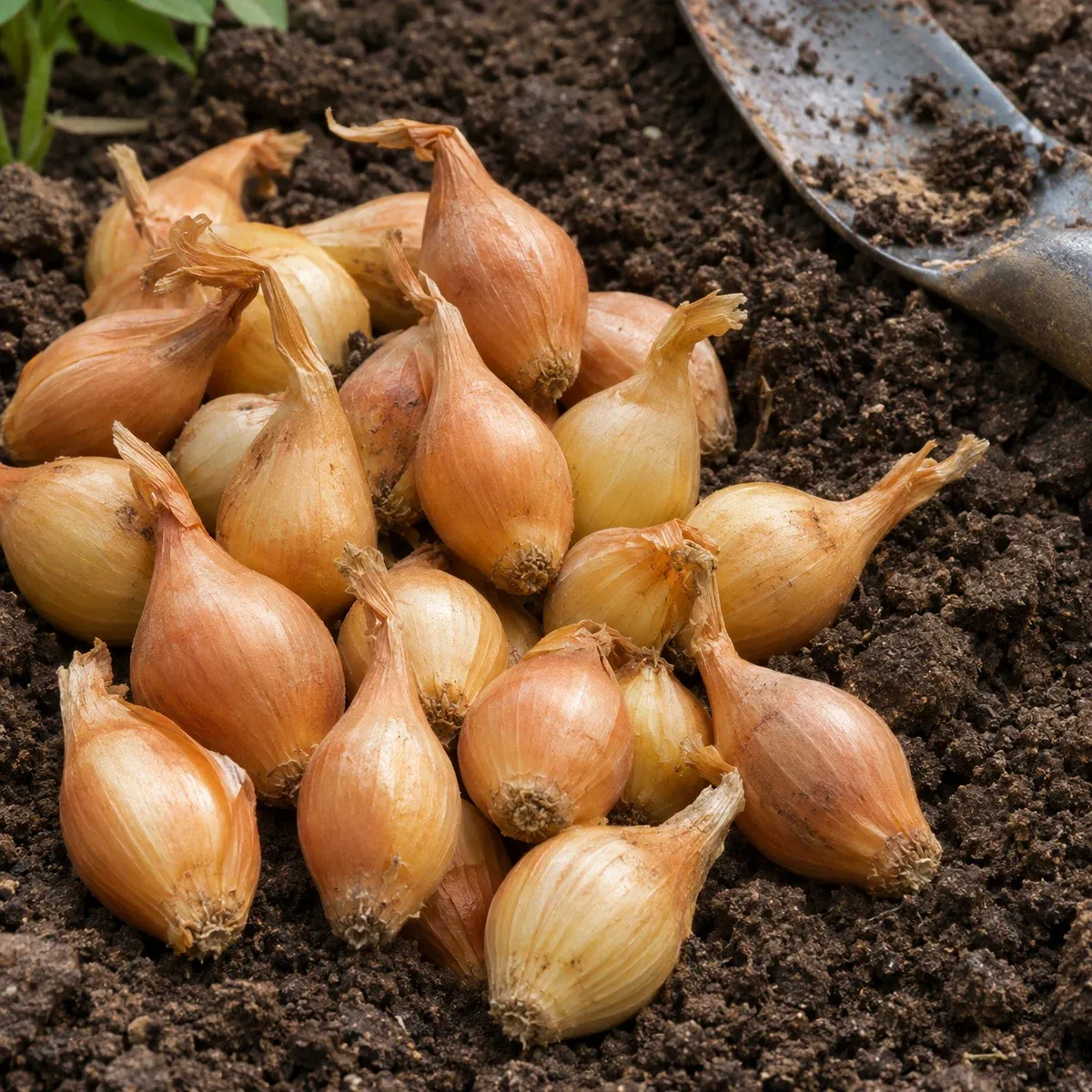
- Sets are small bulbs to plant.
- Transplants are young onions already developed, ready to be planted in the garden.
University of Minnesota Extension presents these three options. Be sure to identify what you are purchasing: a packet of seeds and a net of sets are not managed in the same way. To start from seeds, also consult the sowing guide.
Choosing a variety suited to your region
Bulb formation depends notably on day length and temperature. Varieties do not all have the same requirements: the categories “short-day” and “long-day” describe this response to light. The MAPAQ emphasises the importance of local varietal choice.
Therefore, check the region and season recommended by the supplier, as well as the intended use: fresh or storage. Colour alone does not replace this information. Keep the full variety name; it will be essential for comparing two harvests or finding an onion that stores well in your conditions.
When to plant onions?
The SNHF distinguishes between spring planting for a summer harvest and autumn planting for a harvest the following spring. These are seasonal guidelines: the choice depends on the planting material and local conditions.
For a crop that overwinters outdoors, choose a variety explicitly intended for this method. Avoid autumn planting of sets in heavy soil that becomes waterlogged: the RHS highlights a risk of rot. Therefore, do not choose the planting date before considering the location.
Preparing the plot and planting onions
Choose a sunny site and well-draining soil. The SNHF advises waiting three to five years after growing garlic, shallots, leeks, or onions on the same plot. Also, review the requirements for garlic to organise these crops in your vegetable garden plan.
For individually planted onions, 15 cm in the row and 30 cm between rows is a guideline within the ranges provided by the SNHF. Adjust according to varietal instructions.
In all cases, start by removing competing weeds and preparing loose soil, then follow the steps for your starting material.
Starting from seeds
Sainte Marthe provides an example of direct sowing from February to April, or sowing in a nursery bed, seed tray, or planter from August to September, with a variety suited to this method. Their guideline is 1 cm depth, 15 to 26 °C for germination, and an indicative emergence time of 9 to 20 days. These temperatures refer to germination, not a constant air temperature throughout the growing period. The seed packet, variety, and region remain decisive. Sainte Marthe
After emergence, monitor weeds particularly closely. The same source recommends a first thinning at the four- or five-leaf stage, followed by a second thinning later to create the final spacing. Distinguish this thinning from transplanting: the first removes plants from a row, while the second moves young onions to their final location. Sainte Marthe
Starting from sets
Place the tip upwards, just visible at the surface, at the distances specified for the variety. You are starting with a small bulb: there is no seed germination stage to wait for, nor a sowing depth to apply. RHS
Starting from transplants
Harden off transplants grown indoors before planting them outside; ensure they are suitable for the planting season. Keep in mind the difference between autumn planting intended to overwinter and spring planting. The number of days since sowing alone does not replace this varietal and climatic choice. RHS · SNHF
Label each row with the variety and starting method. Record the sowing date and transplanting date separately: these are two distinct steps.
Onions in pots: young onions or mature bulbs?
To grow onions to mature bulb size, the RHS recommends a container at least 45 cm wide and deep, in full sun, with a loam-based potting compost without peat. Plant the sets with the tip just visible, spaced 10 to 15 cm apart. A seed tray or starter pot is not this final container.
Next, decide on your harvest: Iowa State University Extension distinguishes between common onions harvested young for fresh use and bulbs left to mature for storage. Harvesting young onions frees up space; a storage bulb requires the appropriate variety, space, and drying process described below. Welsh onion, Allium fistulosum, does not form the same bulb: check the species on the packet.
Monitor substrate moisture during growth; onion roots are shallow. University of Minnesota Extension links stopping watering to bulb development and foliage beginning to fall over. Adjust this monitoring to the growth stage of the onions in the pot, without applying a fixed weekly water quantity.
Watering and monitoring during growth
Avoid automatic watering rules. The SNHF draws attention to bulb formation and prolonged droughts. Observe your soil’s moisture before intervening. When bulbs have reached their final size and foliage begins to fall over, stop watering, according to University of Minnesota Extension.
Weed regularly to maintain space between plants. Jardiner Autrement also recommends avoiding wetting the foliage. Elongated spots and a purplish mould may accompany downy mildew: examine symptoms before concluding that dying foliage simply indicates a harvest is ready.
Onions bolting to flower: which harvest to keep?
The flower stalk bears buds and then flowers; it is distinct from ordinary leaves. Iowa State University Extension links bolting to unfavourable conditions, including cold, and highlights the increased risk with large sets. For the case of a kitchen bulb that has already sprouted, consult the sprouted onion guide.
The RHS advises removing the flower stalk as soon as it forms to limit investment in flowers. This does not restore the bulb’s good storage potential. Iowa State University Extension recommends harvesting plants at the first signs of bolting and using them quickly: identify and harvest them for cooking, without mixing them with the batch intended for storage. Do not wait for all the foliage in the row to fall over for these plants.
Harvesting and storing onions
Young onions can be harvested for quick consumption, the SNHF reminds us. For storage, wait for signs of maturity: foliage falls over and dries gradually. Do not bend them intentionally to speed up this process; the RHS advises against this practice.
Lift bulbs gently. Dry them in a warm, dry, well-ventilated place; outdoors, dry weather is necessary. Wait until the outer skins are dry and the neck is tight before storing. Then store in a cool, dry, frost-free place, as indicated by University of Minnesota Extension.
Reserve healthy, mature bulbs for storage. Their storage life also depends on the variety, the MAPAQ notes: a harvest does not automatically keep all winter. Record the storage date and regularly check your batch; these observations will usefully complement your gardening notebook.
Key points for this crop
Practical guidance
- Exposure
- Full sun
- Soil
- Well-draining, no waterlogging
- Individual planting
- Spacing: 15 cm in the row, 30 cm between rows
- Storage
- Depends on variety, maturity, and drying
Sources and references
- OnionFrench National Horticultural Society (SNHF) Accessed on 15 October 2026.
- How to grow onionsRoyal Horticultural Society (RHS), in English Accessed on 15 October 2026.
- Onion physiology: understanding the plant to grow it wellMario Leblanc, agronomist, MAPAQ – Montérégie, via Agri-Réseau Accessed on 15 October 2026.
- Growing onions in home gardensUniversity of Minnesota Extension, in English Accessed on 15 October 2026.
- Onion – Downy mildewJardiner Autrement Accessed on 15 October 2026.
- All About OnionsIowa State University Extension and Outreach, Aaron Steil, in English Accessed on 18 October 2026.
- Growing onions successfullyLa Ferme de Sainte Marthe, French seed supplier Accessed on 8 November 2026.