
The vegetable garden notebook / Crops
Red, white or yellow onion: which variety should you choose?
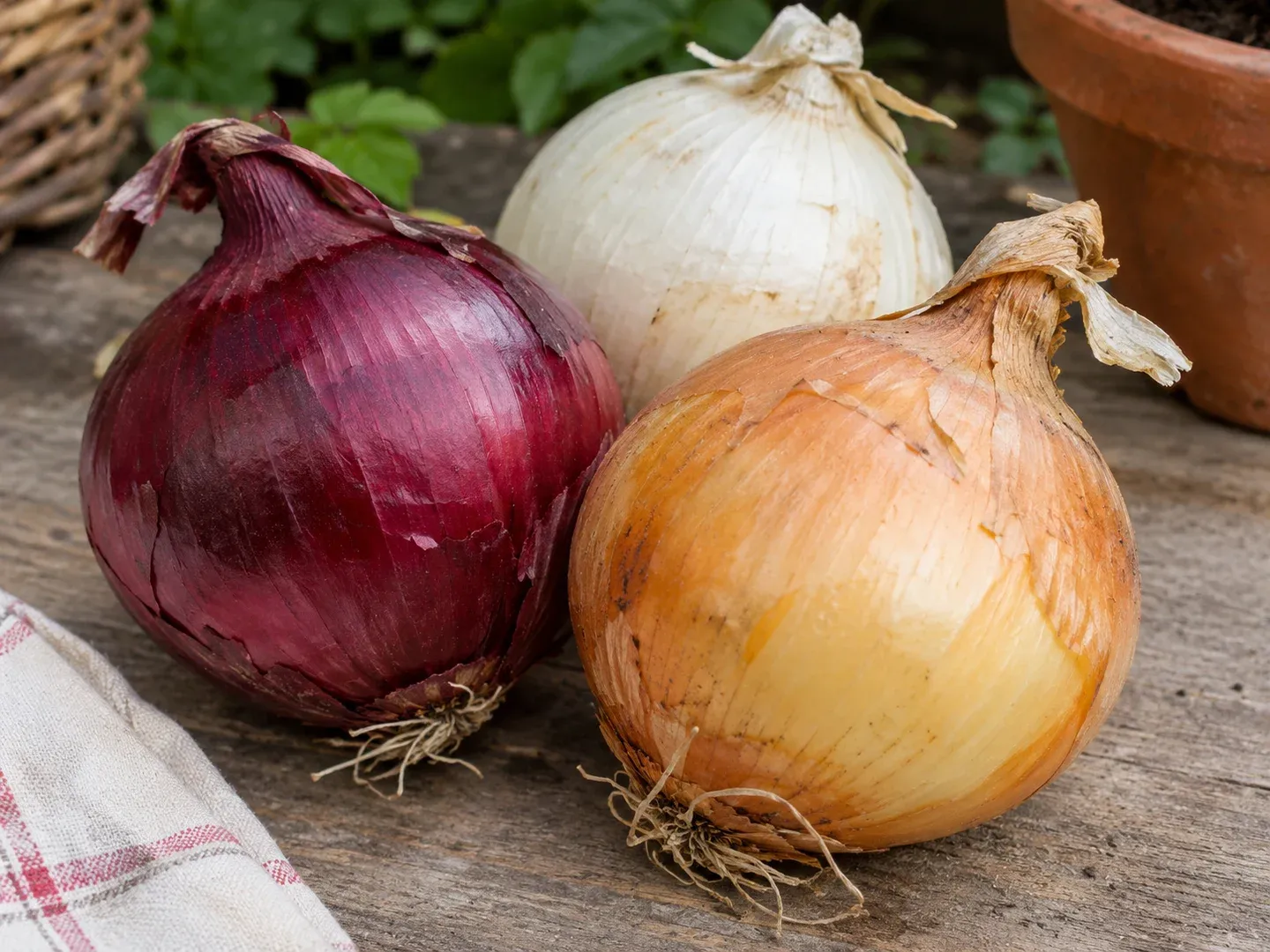
To eat your onions young, look for a variety intended for fresh use. To build up a store, choose a storage variety suited to your region. Red, white or yellow comes next: colour alone is not enough to predict flavour, harvest or storage.
Adapt this guidance to your garden’s climate and conditions.
Choose the use before the colour
For a fresh harvest, look for a variety advertised for this purpose. White onions are especially common for harvesting in bunches or using fresh, but other colours are also suitable: the Semences d’Ici dossier clearly distinguishes use from colour.
To store bulbs, look for an explicitly stated suitability for storage. The same dossier distinguishes the onion harvested young with its green leaves from the storage bulb, harvested at maturity and then dried. A young fresh onion is therefore not a bulb ready to join the dry store.
The names below are examples classified by the SNHF, not a performance ranking.
| Colour | Examples of varieties | Check before choosing |
|---|---|---|
| White | ‘Hâtif de Paris’, ‘De Vaugirard’ | Fresh use, expected harvest stage and period. |
| Yellow | ‘Jaune paille des vertus’, ‘Sturon’ | Suitability for storage, earliness and planting season. |
| Red | ‘Rouge de Brunswick’, ‘Bronzé d’Amposta’ | Advertised flavour and purpose: fresh or storage. |
These checks remain useful for all three colours. Keep the full name of the variety: “red onion” is too broad to compare two harvests.
Is a red onion always mild?
No. The RHS describes variable flavours depending on the variety and presents ‘Red Baron’ in particular as a red onion with a strong flavour and good storage suitability. This British example shows the limits of the shortcut “red = mild and to be eaten immediately”; it does not provide a French growing calendar.
If you are looking for an onion to eat raw, read the flavour description and try a small quantity before dedicating an entire bed to it. Colour does not replace this information or your personal preference.
Earliness and harvesting young: two different things
Earliness is a characteristic of the variety, treated separately from colour in Semences d’Ici. Harvesting a young onion to eat it quickly is, however, a choice of harvest stage described by the SNHF.
To compare two options, therefore, check what is advertised: young onion in a bunch or mature bulb. Also note the starting method—seeds, onion sets or young plants—and the season recommended locally. A mention of “early” is not enough to set the sowing or planting date. The onion growing guide covers these different starts.
Why does the region matter?
Photoperiod is the length of daylight. Bulb formation depends on a threshold that varies by variety, as well as temperature. The MAPAQ shows that a poorly adapted variety may form its bulb too early, while still small, or continue to produce leaves without bulbing.
If a sheet indicates “short day”, “intermediate” or “long day”, check the region and planting season it is intended for with the supplier. These categories cannot be deduced from colour. Do not directly apply the “north” and “south” references from a foreign catalogue to your French garden.
Preparing onions for storage without assuming they will last all winter
Even with a storage variety, preservation depends on the condition of the bulbs. The MAPAQ reserves prolonged storage for mature and healthy onions and highlights varietal differences. Drying remains necessary, as the SNHF reminds us.
You can set aside a small row for fresh consumption and another for a storage variety suited to your region. In your vegetable garden plan, note the two names, planting dates and intended use. At harvest, add the observed flavour and how the stored batch keeps: you will have more useful benchmarks than a preference based solely on colour.
Key points for this crop
Practical guidance
- First choice
- Fresh consumption or bulbs for storage
- Keep on the label
- The full name of the variety
- Calendar
- Variety, region and starting method
- Colour
- One criterion among others, with no guaranteed shelf life
Sources and references
- OnionSociété nationale d’horticulture de France (SNHF), Jean-Daniel Arnaud Accessed on 16 October 2026.
- How to grow onionsRoyal Horticultural Society (RHS), in English Accessed on 16 October 2026.
- Common onion seed production — technical guide, November 2025Sofía Correa and Fanny Lebrun, Les Marequiers ASBL, Semences d’Ici project; hosted by Biowallonie Accessed on 16 October 2026.
- Onion physiology: understanding the plant to grow it wellMario Leblanc, agronomist, MAPAQ – Montérégie, via Agri-Réseau Accessed on 16 October 2026.