
The vegetable garden notebook / Crops
Sprouted Onion: What to Expect After Replanting?
A sprouted kitchen onion can continue its cycle once replanted, but do not expect a new harvest of large bulbs. To decide what to do with it, distinguish this experiment from regrowing young spring onions and planting for storage onions.
Adapt this guidance to your garden’s climate and conditions.
Can You Plant a Sprouted Onion?
This page helps you decide what you want to achieve and understand what is happening to a bulb you have already replanted. It does not provide a protocol for planting a large sprouted onion: the regrowth references below describe different material. To grow onions for their bulbs, follow the onion planting methods instead.
You may consider replanting it as an experiment to observe, with limited expectations. In the case of onions harvested and then sprouted in the refrigerator, UNH Extension considers a new bulb harvest unlikely and flowering probable. This observation does not predict what will happen to every bulb in the cupboard; it explains why the sprout alone is not enough to guarantee a new harvest.
| Your Objective | Corresponding Starting Point | What to Expect |
|---|---|---|
| Observe the sprouted kitchen onion | A mature bulb | Monitor the leaves and a potential flower stalk. UNH Extension |
| Attempt leaf regrowth | Young spring onions with their roots | The Iowa State protocol applies to this material, not all large sprouted bulbs. |
| Prepare a bulb harvest | Seeds, seedlings, or sets intended for cultivation | Choose the appropriate variety and timing; see the onion guide. Iowa State |
To establish a crop primarily for leaves, also compare Welsh onion, Allium fistulosum. This is a different species, not a name to automatically assign to the onion sprouting in your kitchen.
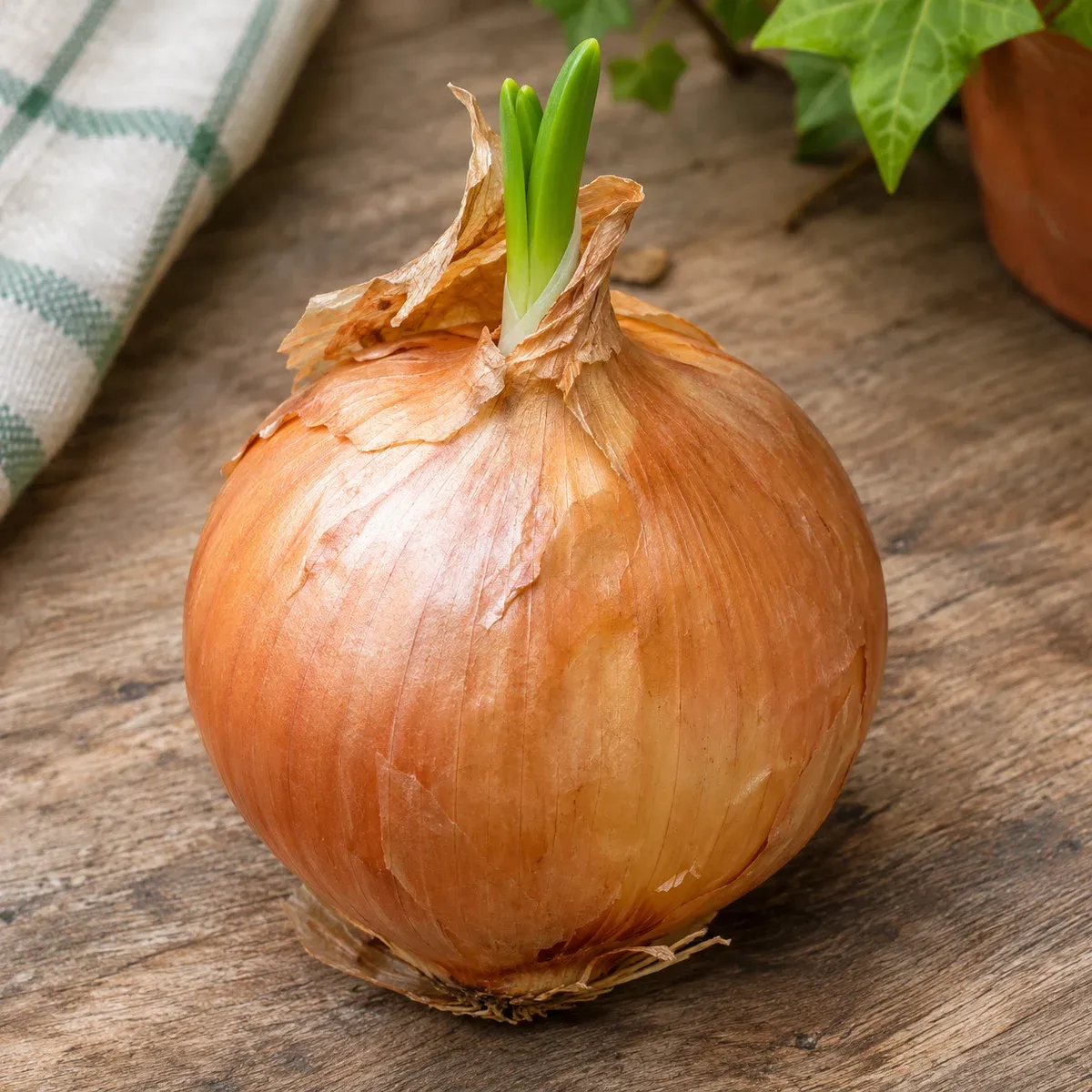
A Sprouted Kitchen Onion Is Not a Set
The large onion intended for cooking has already formed its bulb. It differs from the usual starting points for cultivation:
| What You Have | What It Refers To |
|---|---|
| A seed | The starting point for sowing |
| A seedling | A young onion to transplant |
| A set | A small bulb intended for planting |
| A large sprouted onion | A mature bulb resuming growth |
Iowa State University clearly distinguishes young onions from bulbs harvested at maturity, as well as the three starting methods. The visible sprout on a cupboard onion is therefore not enough to make it equivalent to a set.
Why Might It Bolt to Flower?
The common onion, Allium cepa, typically follows a biennial cycle: an initial phase forms the bulb, followed by a reproductive phase that may lead to flowering. Cold plays a role in this transition; variety, developmental stage, and conditions also matter. The Virginia Tech course describes these conditions, without making flowering an immediate consequence of any sprout.
Exposure to cold does not have the same effect at all stages: seeing a sprout is therefore not enough to predict future flowering. The case of refrigerated storage mentioned earlier remains a specific example, not a forecast for all onions.
A flower stalk is a stem that bears flowers at its tip. In onions, it may rise above the foliage and bear a rounded inflorescence, as described by Virginia Tech. Its appearance signals a reproductive stage, not guaranteed bulb enlargement underground.
If You Have Already Replanted It
You can monitor its progress as a cultivation experiment. The general needs of onions remain a sunny location and well-drained soil, according to Iowa State University. For watering, observe soil moisture and weather: Virginia Tech notes that frequency and quantity depend on soil, stage, and climatic conditions.
Keep a label with the date and origin of the bulb. With each observation, distinguish what changes: new leaves, a stem bearing a flower bud, or dying foliage. A photograph taken in the same place helps compare these stages.
If a flower stalk appears, adjust your harvest expectations. Iowa State University indicates that bulb quality deteriorates after bolting and they store poorly. Letting this onion continue its cycle may serve to observe flowering.
Harvesting Leaves and Regrowing a Bulb Are Two Different Objectives
Regrowth methods do not all apply to the same material. The Iowa State University protocol on kitchen scraps starts with young spring onions with their roots, from which leaves are regrown. It does not describe a large mature bulb sprouting in the cupboard.
This protocol therefore does not guarantee repeated leaf harvests from your replanted onion. Similarly, seeing multiple shoots is not enough to predict multiple future bulbs. Keep your foliage observations separate from your harvest expectations.
To Prepare a Bulb Harvest
Choose seeds, seedlings, or sets intended for cultivation, with a variety and timing suited to your garden. Bulb formation depends notably on day length and variety, as Iowa State University reminds us. With a kitchen onion of unknown variety, you lack this key information.
If starting from seeds, the sowing guide helps distinguish sowing from transplanting. You can then follow this crop separately from the sprouted onion, whose outcome will remain that of an experiment.
Key points for this crop
Practical guidance
- Starting Material
- A bulb that has already reached maturity
- Usual Cycle
- Biennial, with a flowering phase
- Expected Outcome
- No new large bulb guaranteed
- To Observe
- Leaves and potential flower stalk
Sources and references
- Sprouting Onions and Potatoes — answer no. 894771University of New Hampshire Extension, via Ask Extension, in English Accessed on 15 October 2026.
- All About OnionsIowa State University Extension and Outreach, in English Accessed on 15 October 2026.
- Vegetable Seed Production: OnionVirginia Tech, in English Accessed on 15 October 2026.
- How to Grow Vegetables from Kitchen Scraps: Avocados, Pineapples, Green Onions and More!Iowa State University Extension and Outreach, in English Accessed on 15 October 2026.