
The vegetable garden notebook / Crops
Growing leeks: sowing, transplanting and progressive harvesting
Select your leeks based on the season in which you wish to harvest them. The sowing schedule and cold tolerance vary by variety; a winter leek is not necessarily sown in winter.
Adapt this guidance to your garden’s climate and conditions.
Choose the season before the variety
The SNHF distinguishes between summer and autumn varieties, such as ‘Jaune gros du Poitou’, and autumn and winter varieties, such as ‘Géant d’hiver’. Check the harvest period and cold tolerance on the seed packet or plant label.
To prepare your sowings in France, use these guidelines, adapting them to your variety, region, and available protection:
- Summer harvest: sow under cover in February-March, according to the SNHF.
- Autumn harvest: sow in a nursery bed from March to May, according to the same source.
- Winter leeks: Kokopelli places their sowing in April-May.
For a first attempt, choose a single harvest season. Keep the variety name and its instructions: a line reading “leeks” in a calendar is not enough to describe your crop.
Sow or buy seedlings?
Sowing requires setting aside a nursery bed or tray before final planting. Kokopelli describes covering the seeds with 0.5 to 1 cm of substrate, kept moist until seedlings emerge. For early sowings in February, this source specifies a heated frame: do not assume that a simple outdoor location is suitable everywhere.
Purchased seedlings allow you to start at the transplanting stage. They are available in plugs and bare-root; the latter must be planted quickly, the SNHF reminds us.
Wait for seedlings to be sufficiently developed: Kokopelli indicates around 15 to 20 cm tall and the thickness of a pencil. Observe this stage rather than setting transplanting a fixed number of days after sowing. The sowing guide provides additional details on preparing and monitoring this first step.
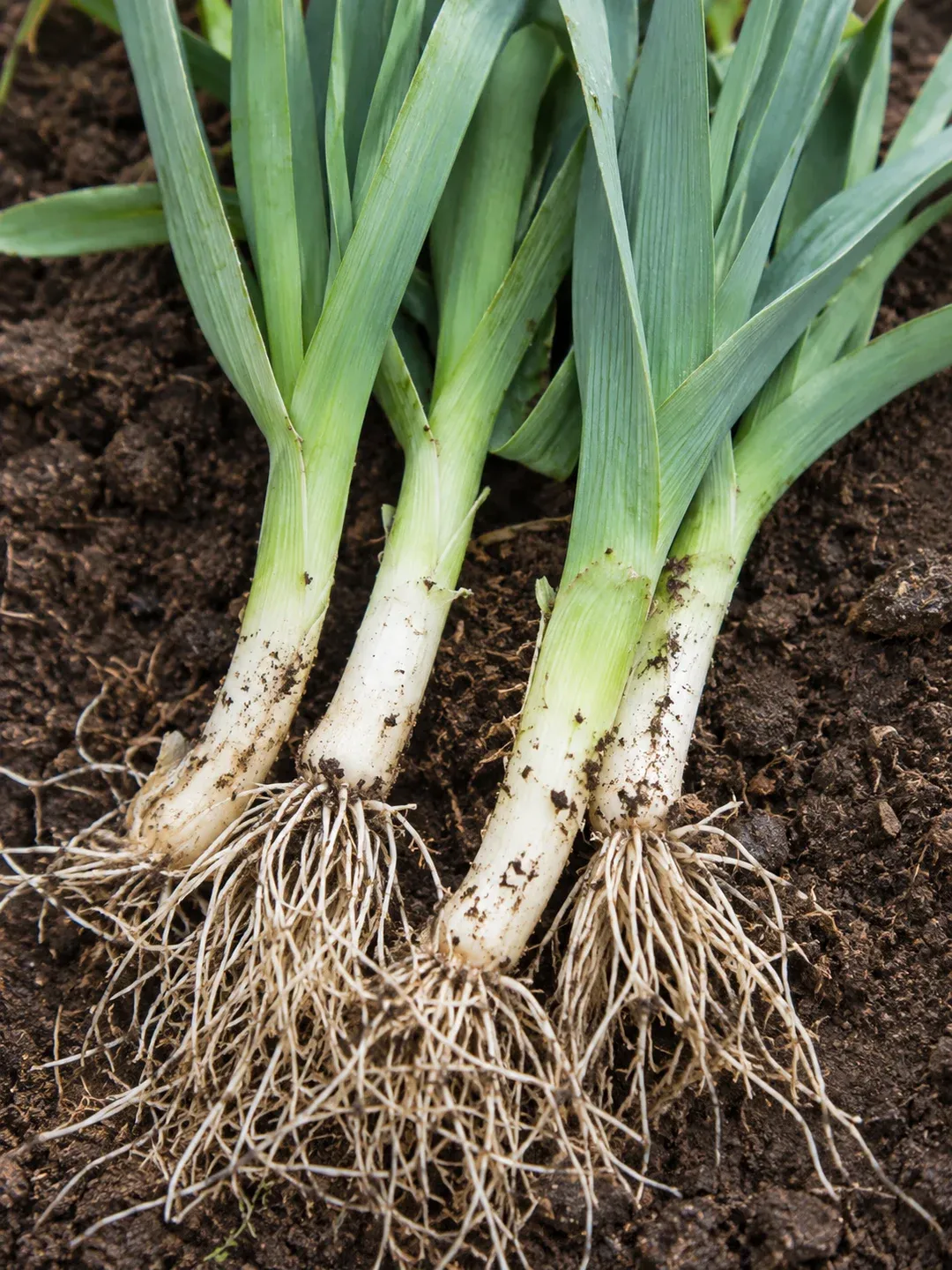
Can you grow leeks to harvest in a container?
The RHS prefers growing leeks in open ground but describes young leeks and, with sufficient care, mature plants in a large, deep container. It gives the example of four or five mature leeks in a pot about 40 cm wide. Ensure adequate depth and spacing suited to your method. RHS
Use a suitable growing medium and monitor its moisture during the season, as pots dry out faster than open ground. A nursery tray is not the final container: choose the desired harvest stage before spacing plants more closely. RHS
Prepare the ground and transplant
Choose a sunny location, as advised by the SNHF, and well-drained soil enriched with well-decomposed organic matter; the University of Minnesota advises against fresh manure. Also plan crop rotation: the SNHF recommends three to five years without garlic, onion, shallot, or leek on the same plot. Our crop rotation guide helps integrate this guideline into your plan.
Should you trim leaves and roots? Methods vary. The SNHF describes trimming both; University of Minnesota Extension suggests only shortening the roots if necessary to facilitate planting. Trimming the foliage is therefore not a universal step.
Here is the hole method described by the RHS:
- First, harden off seedlings raised indoors.
- Prepare holes about 15 cm deep and 5 cm wide, spaced 15 to 20 cm apart, with 30 cm between rows, depending on the variety.
- This method involves trimming the roots to about 2.5 cm.
- Place one seedling in each hole, then fill with water: this carries soil around the roots. It is not necessary to fill the hole by hand.
Water, weed and earth up
Shallow roots make leeks sensitive to water shortages. The University of Minnesota advises watering during dry periods, at soil level, while avoiding excess. Check moisture below the surface with a trowel and consider rainfall; a single weekly quota does not suit all soils. To decide on watering, also use our watering guide.
Weed regularly, but cultivate only shallowly near the plants to protect their roots, according to this university.
Earthing up involves gradually drawing soil around the shaft to exclude light and lengthen the white part. The RHS recommends several passes during growth, without letting soil enter between the leaves.
Harvest progressively
You can pick small leeks and let others grow larger. The RHS suggests harvesting every other leek in the row and lifting them gently with a fork. Hardy winter varieties can remain in the ground for successive harvests; this ability depends on the chosen type.
Record the sowing or purchase date, transplanting, and first observed harvests. The following year, these dates will make more sense with the variety, weather, and actual size obtained than with a fixed harvest schedule.
“Worms” in leeks: leaf miner or leek moth?
The term “worm” does not refer to a single pest. For the allium leaf miner, Jardiner Autrement describes tunnels within the leaf tissue, distorted central growth, and pupae; it distinguishes this damage from that caused by the leek moth. A single yellowed leaf or deformed plant does not allow you to choose a treatment. Leaf miner fact sheet
Examine the location of the tunnels, the condition of the upper parts of the leaves, and the presence of larvae or pupae. The fact sheet indicates that leaf miner tunnels do not rot and that the upper parts of the green leaves remain unaffected in this scenario; it also notes possible confusion with nematodes when the plant’s structure breaks down, without maggots or pupae. Compare the damage and look for larvae to identify the cause. Jardiner Autrement
To prevent leaf miner attacks, the source recommends using suitable insect-proof netting, installed without gaps and without contact with the leaves. Crop rotation matters: netting placed over soil where pupae have survived may trap future adults with the crop. Infested waste should not be added to garden compost. Jardiner Autrement
Consult the regional plant health bulletin for vegetable crops to assess observed risks, as suggested in the same fact sheet; do not turn a past flight period into a calendar valid everywhere. Netting blocks new pest entry but does not repair a leek whose tissues are already tunnelled. Combine observations and history before seeking advice if the pest remains uncertain.
Should a leek that bolts be left?
The SNHF describes a biennial plant that flowers in its second year. Spring cold can also encourage premature bolting, according to the RHS. The latter recommends removing the flower stem as soon as it appears to limit fibrous hardening of the centre; this trimming does not indefinitely rejuvenate an old leek. SNHF · RHS
When growing leeks for their shanks, check the remaining plants and harvest those that are usable without waiting for a single date for the entire row. Keeping a plant for seed serves a different purpose from extending the harvest of shanks.
Key points for this crop
Practical guidance
- Variety
- Choose the harvest season and cold tolerance
- Transplanting
- Observe seedling size rather than a fixed timeframe
- Earthing up
- Gradually draw soil around the shaft
- Harvest
- Pick as needed
Sources and references
- Cultivated leekSociété nationale d’horticulture de France (SNHF), Jean-Daniel Arnaud Accessed on 16 October 2026.
- Growing leeks successfullyAssociation Kokopelli Accessed on 16 October 2026.
- How to grow leeksRoyal Horticultural Society (RHS), in English Accessed on 18 October 2026.
- Growing leeks in home gardensUniversity of Minnesota Extension, Marissa Schuh and Jill MacKenzie, in English Accessed on 16 October 2026.
- Leek — Allium leaf minerJardiner Autrement, SNHF Accessed on 18 October 2026.