
The vegetable garden notebook / Crops
Growing tarragon: choosing French tarragon, planting and overwintering
To enjoy the aroma of French tarragon, start with a correctly identified plant raised from a division or cutting. Sowing Russian tarragon requires a different approach and yields a distinct flavour.
Adapt this guidance to your garden’s climate and conditions.
French or Russian: check before buying
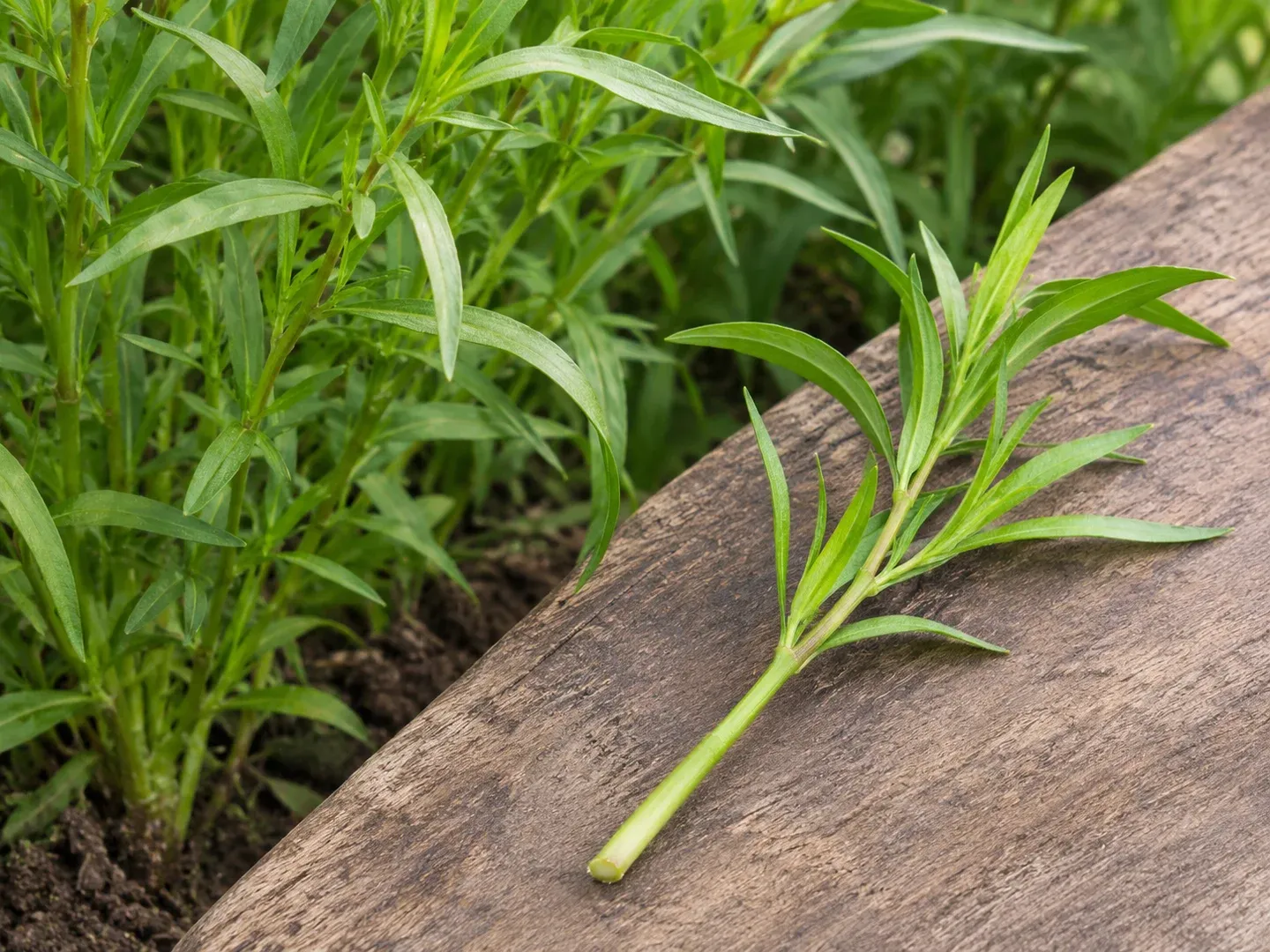
Both types are perennial tarragons, but they differ in flavour and vigour. French tarragon, often labelled Artemisia dracunculus ‘Sativa’, is chosen for its aniseed aroma. Russian tarragon is generally more vigorous and less fragrant. Do not assume a packet simply labelled “tarragon” is equivalent to a French tarragon plant. SNHF, RHS
The University of Illinois notes that French tarragon flowers are sterile: it is propagated by division or cuttings. The Russian type can be sown. If your goal is French tarragon, look for a plant with a specified origin; keep its label. Illinois
Planting in the ground or choosing a pot
Give the plant a permanent sunny, sheltered spot in well-draining soil. Light shade is tolerated. The University of Illinois emphasises drainage, particularly in winter: heavy, consistently damp soil is a real limitation for planting in open ground. Illinois
In France, prioritise spring planting when the soil has drained and conditions are milder. The SNHF guide mentions March to October, but this broad window does not mean a plant will establish equally well in extreme heat or just before a damp winter. Adjust the timing to when the plant can establish and to your ability to water it. SNHF
For French tarragon, allow a mature spread of approximately 30 cm; the Russian type may require more space. In containers, the RHS recommends a minimum of 20 cm in width and depth per plant, with drainage holes and a well-draining substrate. This initial minimum does not eliminate the need for repotting when the clump fills the entire volume. RHS
A pot also makes it easier to move the plant under cover for winter. Harden off a plant raised indoors gradually before planting it outside. Water after planting and ensure water drains freely. RHS
Adjusting watering and caring for the clump
Water new plants during dry periods in their first season. Once well-established in the ground, tarragon tolerates drought better; in pots, regularly check moisture levels and water as needed. Avoid keeping the mix waterlogged, especially in cool weather. RHS
The SNHF guide’s instruction to keep the soil moist should be understood with this caveat: water should be available for growth without stagnating around the rootstock. Pinch the tips to encourage branching and remove stems bearing flower buds if you are growing it mainly for leaves. SNHF
Do not judge the need for water solely by the number of days since the last watering. After rain, check the pot’s substrate; conversely, a dry surface does not necessarily mean the entire root ball lacks water. The watering guide helps with these observations.
Propagating to keep the right tarragon
Divide an established clump in spring: separate portions with roots and shoots, then replant them without letting the roots dry out. Division every three to four years, as noted by the University of Illinois, also helps renew a less vigorous planting. Take divisions from a healthy clump known for its aroma. Illinois
The division method described above is the simplest way to propagate French tarragon, according to the RHS. Taking softwood cuttings of young shoots in summer is another option: to prepare the stems and monitor their rooting, consult the RHS guide to softwood cuttings, in English. Division and cuttings preserve the mother plant’s characteristics; they allow you to renew French tarragon without seeking replacement seeds. RHS
Harvesting and overwintering
Cut young tips and pick leaves as needed during the growing season. The flavour is best preserved when used fresh rather than dried; the SNHF also suggests freezing any surplus. Illinois, SNHF
The foliage disappears with the cold: a leafless clump in winter is not necessarily dead. The University of Illinois advises leaving the stems over winter and cutting back the remains in spring, when growth resumes. Mark the location to avoid accidentally disturbing the rootstock. Illinois
In a cold, damp garden, shelter the French tarragon pot from rain under a porch or in a greenhouse; in open ground, success largely depends on drainage and shelter. The Russian type is hardier but still does not tolerate waterlogged soil. RHS
Declining plants or blemished leaves: what to check
If the plant declines, first examine drainage, watering, the season, and the rootstock’s condition. Autumn leaf loss needs to be assessed differently from decline during active growth. Yellowing alone does not indicate deficiency or rot.
The RHS mentions rust and powdery mildew among possible diseases. White deposits or spots require precise observation and confirmation before taking action; simply naming a disease does not justify routine treatment. Consult the vegetable garden diseases guide to prepare useful observations. RHS
Tarragon remains in place for several years: choose its neighbours based on available space, access for cutting, and their water needs, without attributing an automatic protective effect. When renewing, change a location that remains too damp; if a health issue has been identified, adapt the succession to that problem rather than inventing an annual rotation specific to tarragon.
Key points for this crop
Practical guidance
- Selection
- French tarragon: Artemisia dracunculus ‘Sativa’
- Propagation
- French: division or cuttings; Russian: sowing possible
- Soil
- Full sun, sheltered location, and careful drainage
- Winter
- Foliage dies back in winter; watch out especially for cold combined with excess moisture
Sources and references
- Herbs: a world of flavours at your fingertipsSNHF, vegetable and fruit section, April 2023 Accessed on 18 October 2026.
- How to grow tarragonRoyal Horticultural Society, in English Accessed on 18 October 2026.
- Tarragon: FrenchUniversity of Illinois Extension, in English Accessed on 18 October 2026.
- Cuttings: softwoodRoyal Horticultural Society, in English Accessed on 8 November 2026.