
The vegetable garden notebook / Techniques
Companion Planting in the Vegetable Garden: Choosing Crop Combinations
Growing several species side by side can serve different purposes. Start by ensuring they have adequate space and that you can maintain them, then examine the evidence for any potential protective effect.
Adapt this guidance to your garden’s climate and conditions.
Practical steps
- Specify
Decide why you want to grow the plants together: to use space, add a harvest or observe an effect.
- Compare
Check light, space requirements, growing period and plant needs.
- Plant
Maintain spacing and access for care and harvesting.
- Observe
Record results and limitations before repeating the trial.
Choose an Objective Before Choosing a Neighbour
Companion planting involves placing plants close together to achieve a benefit. The RHS distinguishes between space utilisation, effects on certain undesirable organisms, and physical support between plants. These objectives do not require the same level of evidence.
Before adding a species, write down what you expect from it:
- Practical organisation: Harvest a short-season crop before another takes up all the space.
- An effect to try in your garden: Observe whether an arrangement genuinely facilitates your care or harvests.
- A claimed protective effect: Seek a source that specifies the plant, pest, setup, and studied result.
A table of “good” and “bad” neighbours without these details is insufficient for decision-making. For a trial, record the varieties, arrangement, and results to compare across seasons.
Check Constraints on the Same Bed
The University of Maryland suggests comparing the growing period, development, and needs of plants. Use these criteria to review your plan:
| Criterion | What to check |
|---|---|
| Space | Draw the space taken by fully grown plants, not just young seedlings. |
| Light | Anticipate the shade from tall crops on those requiring sunlight. |
| Duration | Note when each will occupy the space and when you will harvest it. |
| Water and nutrition | Compare needs; proximity alone does not make them identical. |
| Maintenance | Maintain access for watering, observation, weeding, and harvesting. |
Considering shade and access is also part of the Maryland planning advice. If an association prevents you from reaching a plant or forces you to overcrowd rows beyond cultivation guidelines, reduce the number of plants or separate the crops.
Start by reserving space for the crop you wish to keep the longest. Then add a potential temporary crop. The RHS cites, for example, lettuces or radishes between larger, slow-growing crops: the smaller ones must be harvested before being overshadowed. This possibility depends on the actual schedule of both crops, not just their names.
A Practical Example: Marking Parsnip Rows with Radishes
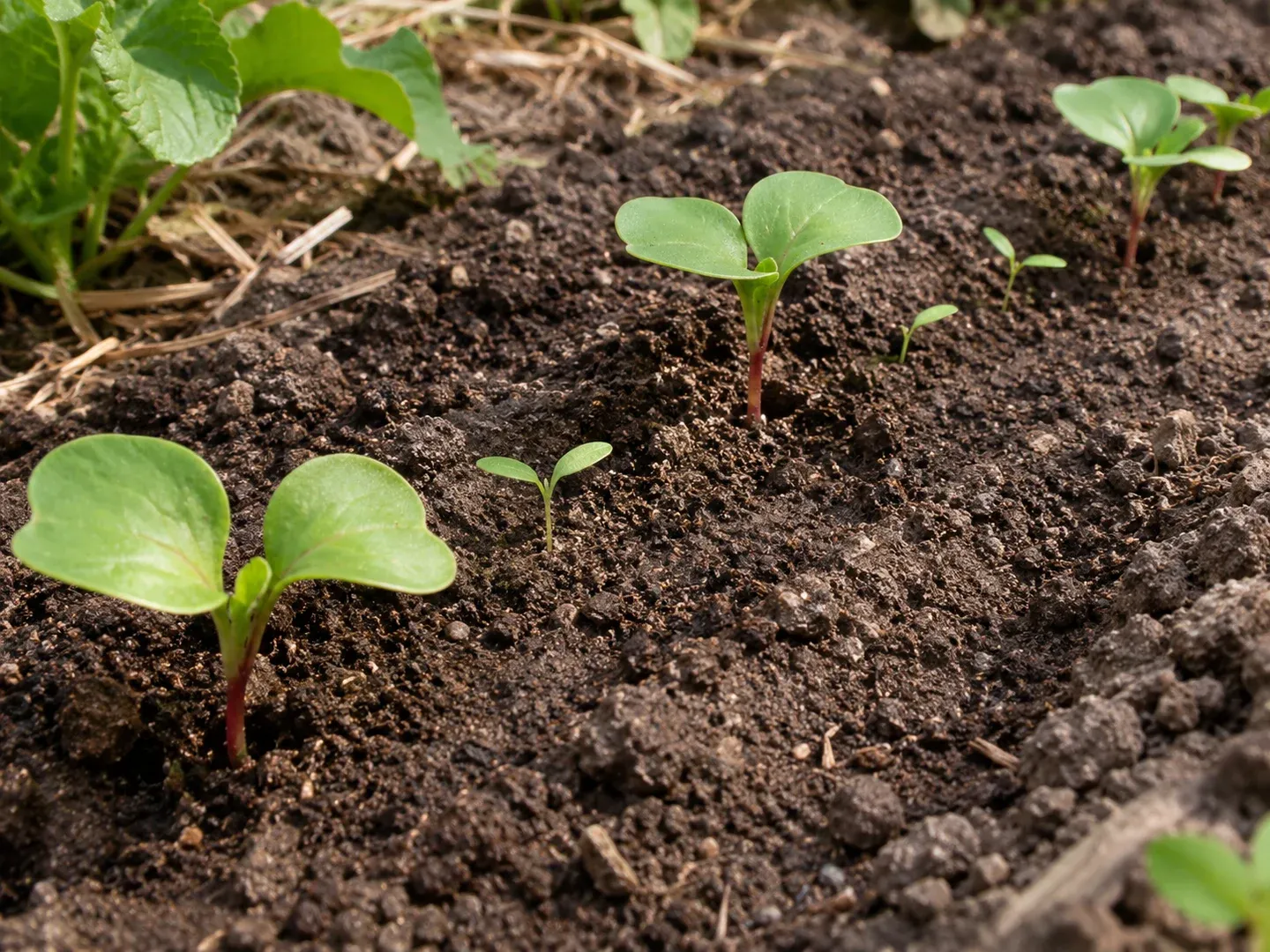
The RHS describes using fast-growing small radishes to mark rows of a slow-emerging crop like parsnip. The radishes make the row visible and are harvested before interfering with the main crop’s growth.
The stated benefit here is marking and temporarily occupying space. It is not a promise of protection against pests. This example involves short-cycle radishes: do not automatically apply it to large winter radishes, which occupy the ground longer.
Choose a period suitable for both varieties, follow their sowing guidelines, and monitor space requirements. Our sowing guide helps you plan sowing depth, spacing and labelling. If you cannot ensure timely radish harvest, simply use labels to mark your rows.
A Measured Effect Remains Linked to Its Setup
In a 2019 study, tomatoes in 5-litre pots, grown alongside French marigolds (Tagetes patula) from the start of the trial, had fewer glasshouse whiteflies (Trialeurodes vaporariorum) than the controls. The trial took place in a greenhouse at the Stockbridge Technology Centre, England. Introducing French marigolds after a heavy infestation, however, produced little effect.
This result pertains to this setup and insect. It does not demonstrate general protection against pests, nor identical effectiveness outdoors.
For practical advice on arranging a tomato bed, the tomato companion guide reviews space choices and limitations of proposed associations.
What Are the “Three Sisters” in the Vegetable Garden?
The Three Sisters is a way of growing maize, climbing French beans and squash together, originating from Indigenous communities in the Americas. The Virginia Cooperative Extension describes their functions: maize stalks support the beans, squash covers the soil, and beans fix nitrogen as legumes.
This is not a recipe to replicate in any plot. Compare varieties, maize vigour, stem development, and space required for harvests. Check space, light and growing time using the Maryland guidelines. A dwarf bean does not provide the climbing function of this setup; a compact courgette does not occupy the soil like a trailing squash.
Do not assume the presence of beans provides an immediately available quantity of fertiliser for other plants. The crop rotation guide distinguishes nitrogen fixation from what actually remains for subsequent crops. Start with a trial you can monitor for all three crops.
And Next to Potatoes?
First, reserve the soil needed for earthing up and access for harvesting. The potato companion guide considers lettuces or radishes as temporary crops, beans and growing near tomatoes. A crop planted after harvesting falls under succession: see what to plant after potatoes instead.
Observe a Trial Without Overinterpreting It
To start, choose one association and an easily observable result. Here is a suggested way to keep notes, which you can adapt to your garden:
- Describe the start. Note the species, varieties, arrangement, and planting dates.
- Define what you will monitor. For example: the date the short-season crop is removed and the space available at that time.
- Record changes. Add care, watering, observed shade, and access difficulties.
- Make a concrete assessment. Write “harvest completed before foliage closure” or “path became inaccessible”, rather than “perfect association”.
If comparing two locations, note differences in soil, exposure, and care. A better harvest on one side is insufficient to attribute the difference to proximity. The University of Maryland reminds us that results vary by location, season, and management, and recommends taking notes.
Also Keep a Record of Crop History
Two crops growing together constitute an association. Planting a crop after another’s harvest falls under succession. Rotation, as explained by the RHS, organises the movement of crop groups between years. It must be adapted to available space; very small vegetable gardens are poorly suited to complete schemes.
Record all species planted in an area, even briefly. An associated crop also counts in its history. The November vegetable garden review can be an opportunity to tidy these notes before choosing the next planting locations.
Flowers and Habitats Throughout the Season
Reserve space for flowers that provide resources at different times of year, rather than relying on a single flower to protect all vegetables. The SNHF recommends diversifying species and preferring single flowers, where pollen and nectar remain more accessible than in many double flowers. Herbs, flower strips, and green manures can contribute to this system.
Compare, for example, the conditions for borage, rosemary, or common sage, cited among resources for bumblebees. Choose those matching your soil and available space; verify their actual flowering in your garden and allow some flowers to bloom fully. SNHF
Flowers do not replace nesting sites. Also maintain quiet corners, small areas of bare soil suitable for ground-nesting bees, and dead wood in a hedge where it can remain undisturbed. Do not rework an occupied area to make it “neater”. The SNHF distinguishes these habitats by insect; a single insect hotel does not meet all their needs. Observe visits and flowering succession without automatically attributing a harvest to the new arrangement. SNHF
Sources and references
- Three ways to use companion plantingRoyal Horticultural Society (RHS), Guy Barter, in English Accessed on 15 October 2026.
- Vegetable Succession and Companion PlantingUniversity of Maryland Extension, Jon Traunfeld, in English Accessed on 15 October 2026.
- Planning a Vegetable GardenUniversity of Maryland Extension, Jon Traunfeld, in English Accessed on 15 October 2026.
- How to grow radishesRoyal Horticultural Society (RHS), in English Accessed on 15 October 2026.
- Companion planting with French marigolds protects tomato plants from glasshouse whiteflies through the emission of airborne limoneneConboy et al., PLOS ONE, 2019, in English Accessed on 15 October 2026.
- Crop rotationRoyal Horticultural Society (RHS), in English Accessed on 15 October 2026.
- Companion Planting in Gardening — IntroductionVirginia Cooperative Extension, Leonard Githinji, Virginia State University, in English Accessed on 17 October 2026.
- The ideal garden for pollinatorsJardins de France, SNHF, Vincent Albouy Accessed on 18 October 2026.