
The vegetable garden notebook / Techniques
Tomato neighbours: choose based on space and evidence
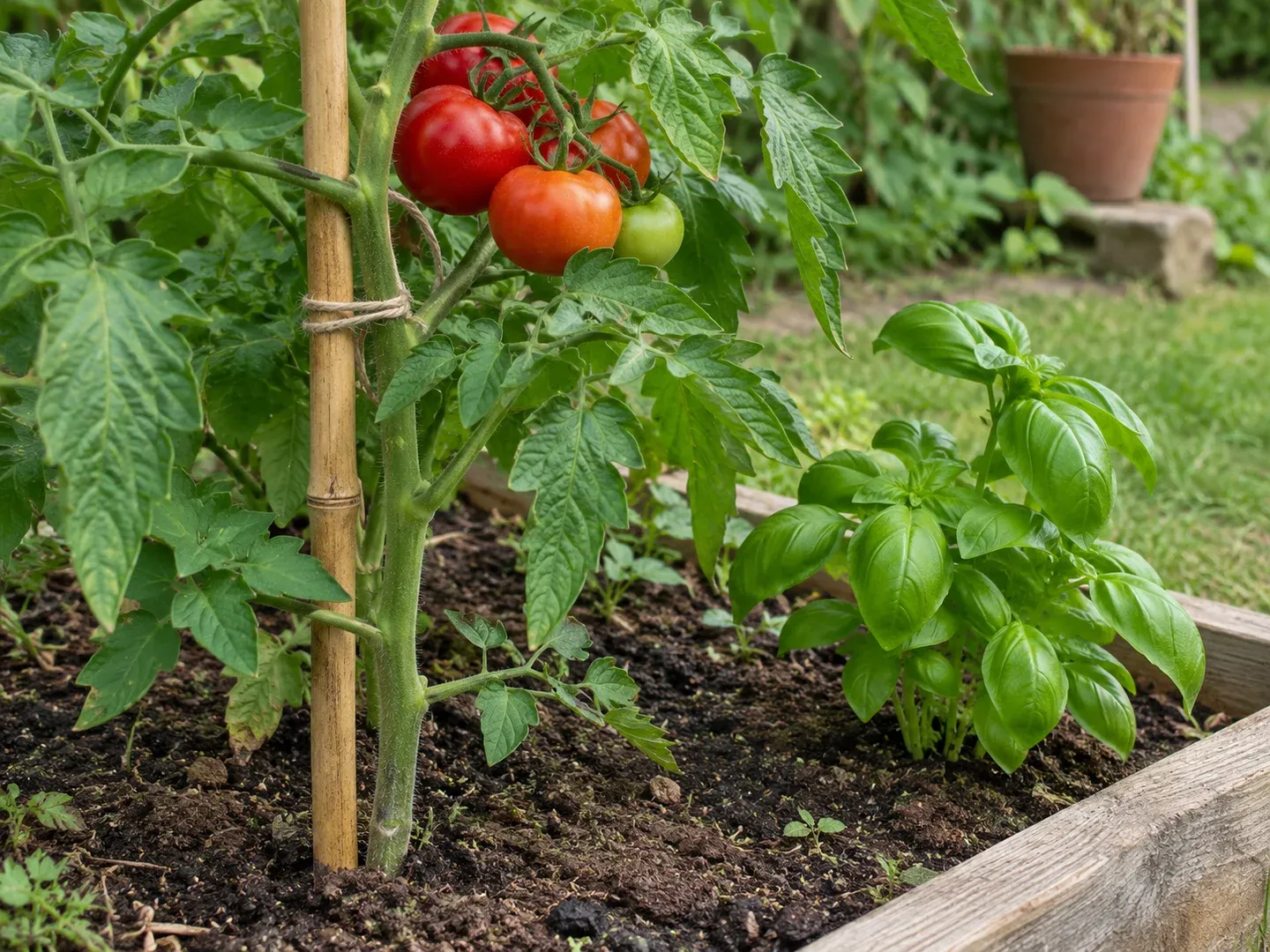
Near tomatoes, you can consider basil for harvesting or a small temporary crop, provided you preserve each plant’s space. French marigold represents a different choice: an effect on whitefly was studied in a greenhouse under specific conditions.
Adapt this guidance to your garden’s climate and conditions.
Practical steps
- Reserve
Place the tomatoes, their supports and the pathway before choosing another crop.
- Compare
Check the light, mature size and water requirements of both plants.
- Choose
Distinguish between an additional harvest and a documented protective effect.
- Adjust
Harvest the temporary crop on time and keep the plants accessible.
First, reserve space for tomatoes
A tomato trained to a single tall stem and a bush tomato do not occupy space in the same way. Check the growth habit of your variety, install the intended support and maintain the spacing indicated on its packet or label. The RHS recommends choosing a warm, sunny and sheltered location, and adjusting the spacing to the final size of the plants.
Next, sketch the mature foliage and access to each plant. You should be able to tie a stem, inspect the leaves and harvest without crossing the neighbouring crop. This space for tending the plants is part of the plan, as are pathways and shade in the University of Maryland’s recommendations.
The visible gap around a young plant is therefore not necessarily free space for the entire season. If the row is already tight, keep this space available. The tomato growing guide covers planting and care.
Basil: a neighbour chosen for its own harvest
The University of Maryland lists alternating basil and tomato plants as one possible arrangement. It also advises comparing growing duration, development, light, water and nutrition. This layout example does not prove that basil enhances the flavour of tomatoes.
To plant it, find a location that will remain warm, sunny and sheltered: these are the conditions recommended by the RHS for basil. Do not automatically place it in the centre of already dense tomato foliage. A still-sunny border or a nearby pot may be easier to manage.
The basil growing guide details container choice, planting and pruning. A separate pot is a practical option if you want to move the basil as the shade changes. However, its watering needs must be checked separately.
Lettuce or small radish: plan for temporary use of space
The RHS describes intercropping fast-growing plants, particularly lettuce and radishes, between large, slow-growing crops: the former are harvested before being overshadowed by the latter. Examples include Brussels sprouts and sweetcorn. Around tomatoes, apply this principle only if your schedule and available space allow it; this is not a result from tomato–lettuce or tomato–radish trials.
Choose a variety and sowing period suited to your garden using the lettuce sowing guide and radish sowing guide. Plan from the outset to harvest this small crop before the tomatoes occupy its space. If the tomatoes are already developed, or if the harvest cannot take place in time, plant it elsewhere.
The goal here is to harvest from a temporarily available space. You do not need to attribute disease protection to lettuce or radish to justify this use.
French marigold: what the whitefly trial allows us to say
Conboy and colleagues studied French marigold, Tagetes patula, with tomato and greenhouse whitefly, Trialeurodes vaporariorum. The trials took place in a greenhouse in Yorkshire, England, with plants in separate pots. Original publication
When marigolds were grown alongside young tomatoes from the start of the trial, the development of whitefly populations was slowed. However, adding them after a heavy infestation had already become established had little effect. The first trial did not show a significant difference in fruit production between treatments. Results of both trials
This targeted result does not guarantee protection outdoors, against other pests or against disease. The pot-based setup also does not address all questions of competition between plants grown in the same soil. If you choose marigolds, allow enough room for them: the study does not provide a universal distance to apply in every garden. The companion planting matrix allows you to find this association with its limitations.
Water and access: when to separate neighbours
Tomatoes require consistent soil moisture; the RHS highlights problems caused by significant fluctuations. Before adding a neighbour, ensure you can still reach the soil to check its moisture and provide water. Two nearby plants should not automatically receive the same amount: compare their needs and growing conditions, as suggested by the Maryland guide.
Move the proposed companion planting elsewhere if the neighbour blocks the light needed by the tomato, encroaches on the pathway or makes care difficult. This choice depends on the layout and size of the plants, not on a universal list of “enemies”. The garden planning principles remain useful, whatever the pair considered.
To prepare your planting, simply note the chosen neighbour, its location, the objective and, if temporary, the planned harvest time. During cultivation, record what actually facilitated or complicated care. These observations will help you adjust the plan; a single good harvest is not enough to prove an effect from growing the plants together.
Sources and references
- How to grow tomatoesRoyal Horticultural Society (RHS), in English Accessed on 16 October 2026.
- Vegetable Succession and Companion PlantingUniversity of Maryland Extension, in English Accessed on 16 October 2026.
- Planning a Vegetable GardenUniversity of Maryland Extension, in English Accessed on 16 October 2026.
- How to grow basilRoyal Horticultural Society (RHS), in English Accessed on 16 October 2026.
- Three ways to use companion plantingRoyal Horticultural Society (RHS), Guy Barter, in English Accessed on 16 October 2026.
- Companion planting with French marigolds protects tomato plants from glasshouse whiteflies through the emission of airborne limoneneConboy et al., PLOS ONE, 2019, in English Accessed on 16 October 2026.