
The vegetable garden notebook / Crops
Sowing lettuce: choosing the season and helping seedlings emerge
Choose a lettuce variety suited to the season and decide whether you want baby leaves or a whole plant. Then make a small sowing you can monitor until the seedlings emerge.
Adapt this guidance to your garden’s climate and conditions.
When to sow lettuce?
The type name—batavia, romaine or cut-and-come-again lettuce—is not enough: check the period indicated for the exact variety. The SNHF advises selecting it according to the sowing date. It suggests February–March in a nursery bed for spring lettuce, and September–October in a nursery bed for winter lettuce. These are benchmarks to compare with the seed packet and your climate.
For summer cultivation, choose a variety advertised as slow to bolt and provide shade during the hottest hours. For winter growing, choosing a suitable variety does not remove the need to protect the plants against severe frosts, notes the University of Maryland. The general lettuce fact sheet details the types and their management after planting.
Direct sowing or in pots?
For direct sowing, prepare a fine soil surface. Large clods hinder germination and make it harder for seedlings from these small seeds to emerge, according to the University of Minnesota. Sow thinly so you can later leave plants at the right spacing.
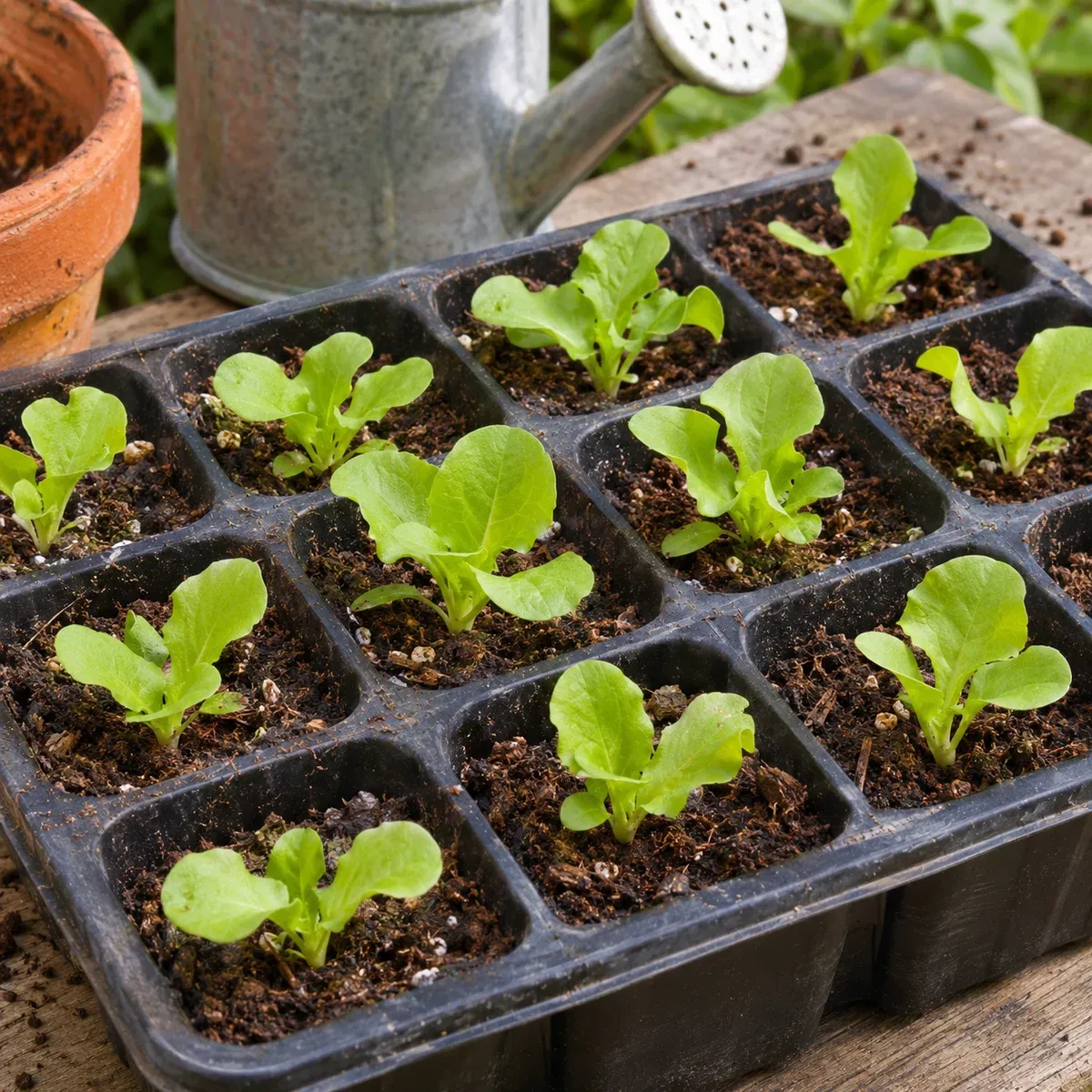
In pots, trays or cell trays, the RHS recommends moist seed compost and a bright location. In trays, carefully transfer seedlings into individual containers when they have a few leaves and are sturdy enough to handle. Before planting them outdoors, harden off the plants.
Choose direct sowing if you can monitor the moisture of the row; choose containers if you prefer to raise a few plants before spacing them out in the garden. In both cases, note the variety and date on a label.
How deep should you sow, and when will seedlings emerge?
For direct sowing in open ground, the RHS recommends approximately 1 cm depth, with rows spaced 30 cm apart. However, follow the instructions specific to the seeds: the University of Illinois notes that some varieties require light to germinate and should only be pressed into the soil without covering. Do not apply the same depth to all packets.
Keep the seedbed moist without waterlogging. Illinois cites lack of water and old seeds among the causes of failure: a failure to emerge does not necessarily mean temperature is to blame.
The SNHF gives 12 to 15 °C as a favourable temperature for germination, with seedlings emerging in 7 to 10 days depending on soil temperature.
What if seedlings fail to emerge in hot weather?
High temperatures can prevent certain varieties from germinating. The RHS then recommends sowing in the evening and providing shade to limit overheating. Also check moisture, seed coverage and the packet instructions before retrying.
This issue precedes seedling emergence. Bolting, however, concerns a lettuce that is already developed: its flowering stem elongates. Lengthening days and high temperatures can encourage this, according to the University of Maryland.
Thinning and transplanting while maintaining adequate spacing
Thin direct sowings while the plants are still small. The University of Minnesota suggests cutting excess plants with small scissors to avoid disturbing neighbours. The correct spacing depends on the variety and desired outcome: its table indicates approximately 13 cm for leaf lettuces harvested young, compared to 25 to 30 cm for fully developed plants. Plants harvested for baby leaves and full-sized lettuces do not need the same amount of room.
For plants in plugs, the SNHF recommends leaving about one-third of the plug above the soil to limit collar rot. The sowing guide provides further details on handling and planting techniques.
Preparing subsequent batches
The University of Maryland advises successive crops or varieties maturing at different times to extend the harvest period. Start with a small batch, then note how many plants you keep and how much you eat. Adjust the next batch based on these observations and the upcoming season, without planning the entire year with the same packet or promising a continuous harvest.
Key points for this crop
Practical guidance
- Sowing time
- To be chosen with the variety and local conditions
- Planting method
- Direct sowing or plants raised in containers
- Seedling emergence
- Heat, depth and moisture to be monitored
- Density
- To be adjusted according to type and harvest stage
Sources and references
- LettucesSociété nationale d’horticulture de France (SNHF), Jean-Daniel Arnaud Accessed on 16 October 2026.
- How to grow lettucesRoyal Horticultural Society (RHS), in English Accessed on 16 October 2026.
- Lettuce — Home Vegetable GardeningUniversity of Illinois Extension, in English Accessed on 16 October 2026.
- Growing lettuce, endive and radicchio in home gardensUniversity of Minnesota Extension, Marissa Schuh and Jill MacKenzie, in English Accessed on 16 October 2026.
- Growing Lettuce in a Home GardenUniversity of Maryland Extension, in English Accessed on 16 October 2026.