
The vegetable garden notebook / Crops
Growing borage: sowing, flowers and limits on culinary use
Common borage is an annual that flowers and self-seeds easily. Give it enough space, decide whether to keep seeds, and distinguish its value for pollinators from its culinary uses, which require precautions.
Adapt this guidance to your garden’s climate and conditions.
Choosing common borage and its location
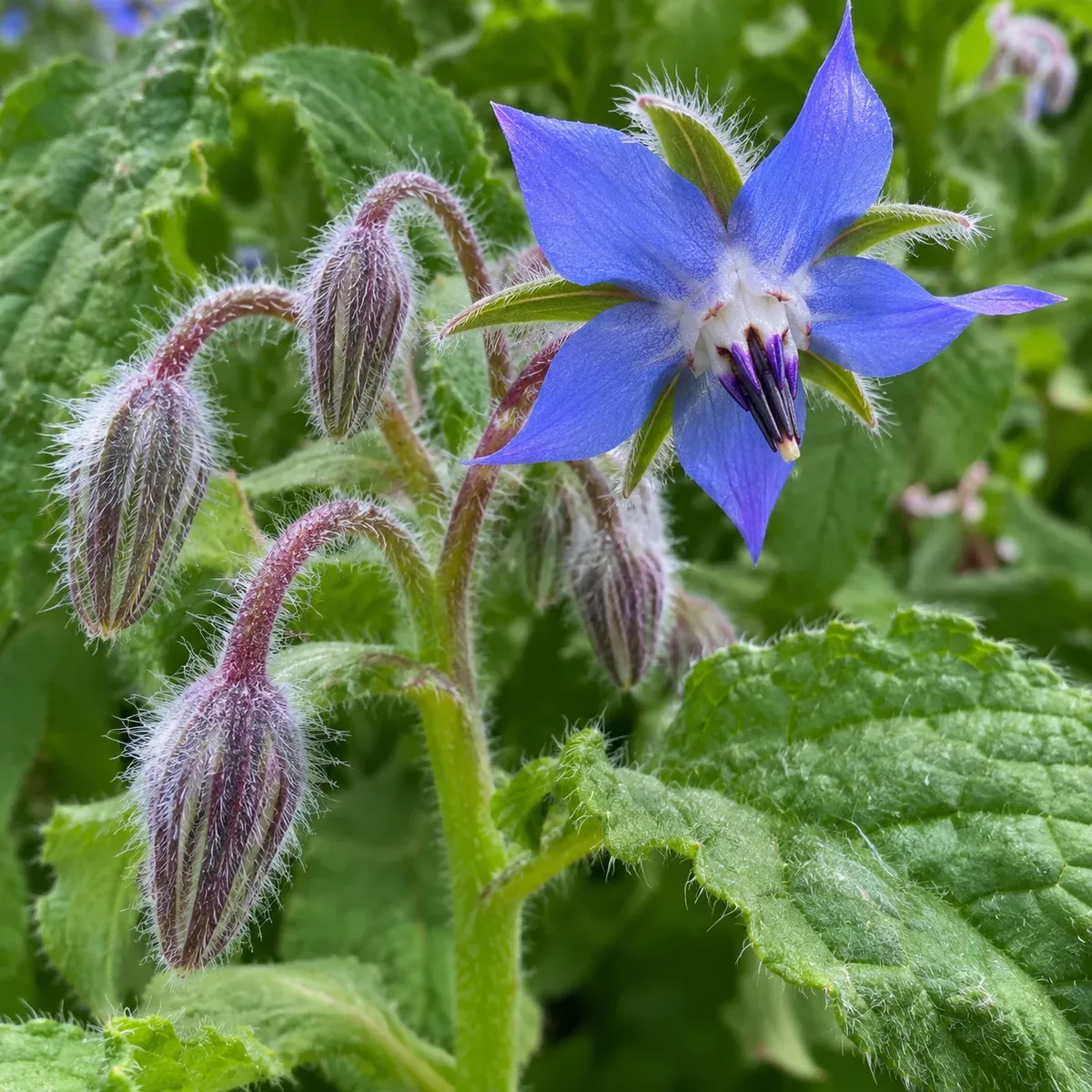
Select seeds or a plant labelled Borago officinalis. This annual borage with blue flowers is also available in white under the name ‘Alba’. B. pygmaea, low-growing and creeping, is a different perennial: its winter maintenance does not apply to the common species. The RHS indicates 50–70 cm in height for the latter. RHS, cultivation
In the vegetable garden, plan an accessible border where its stems will not smother young vegetables. The SNHF recommends light, deep, humus-rich and well-drained soil, in full sun or partial shade when the sun becomes scorching. In France, sowing is advised from March to May and planting from April to June, adjusted to soil conditions. SNHF
Sowing directly or starting with a young plant
Direct sowing avoids disturbing the roots: the RHS botanical fact sheet notes that the species does not tolerate transplantation well. Prepare a small weeded area rather than an entire bed. RHS, species
Sainte Marthe advises barely covering the seeds, then maintaining enough moisture for seedlings to emerge. Their guidelines indicate 7–10 days at around 20 °C: this benchmark depends on conditions and does not mean you should soak the seedbed if seedlings are slower to appear. Check depth, moisture and temperature before retrying. For pots, the seed supplier suggests transplanting at 5–6 leaves; keep the root ball intact and water during establishment if rain is scarce. Sainte Marthe
For developed plants, allow approximately 50 cm between plants, according to the RHS. This spacing provides more room than the close thinning suggested in some seed supplier guidelines. Successive sowings help renew ageing plants; do not expect the same plant to flower indefinitely. RHS, cultivation
Growing in pots and monitoring moisture
The RHS recommends one plant in a pot at least 30 cm wide. This diameter is not a volume in litres. Use a stable container with drainage holes, filled with suitable potting compost. Monitor the substrate during hot weather; in open ground, focus on establishment and dry periods. Borage requires little fertiliser, but keep an eye on potting compost as its nutrient reserves run down. RHS, cultivation
No formative pruning is needed. Occasional support can keep a plant from flopping onto its neighbours. RHS, cultivation
Weed initially and mulch to retain moisture without keeping the collar waterlogged. Adjust watering to the actual soil; a fixed frequency does not account for a pot exposed to wind or a moist border. Sainte Marthe, watering method
Keeping flowers for pollinators
Borage provides pollen or nectar to pollinating insects; the SNHF places it in vegetable garden borders for this reason. This does not demonstrate a repellent effect against slugs, nor protection for strawberries, nor a quantified harvest benefit. Leave flowers open for pollinators if that is your goal, and arrange neighbouring plants according to light, water and space. SNHF, RHS, species, companion planting
Culinary harvest: understanding the limits before picking
The SNHF describes harvesting fresh flowers and young leaves as needed. These are traditional uses, not a guarantee of safety. NC State recommends using leaves and flowers only sparingly and notes a risk of liver damage. SNHF, NC State
The BfR identifies borage among plants that produce 1,2-unsaturated pyrrolizidine alkaloids. It advises reducing exposure and establishes no safe threshold for their genotoxic and carcinogenic effects. No safe number of leaves, flowers or portions can therefore be determined here. Avoid eating it daily as a vegetable, drinking it regularly as a herbal tea or adding it to smoothies; this guide offers no recipe or method claimed to eliminate these substances. You may grow it for its flowers without consuming it. BfR
Observing damage and renewing the annual
Inspect young leaves for slug damage; tunnels in the leaf may indicate leaf miners. A white powdery deposit may suggest powdery mildew, documented on the species. Check several parts of the plant and how the symptoms develop before taking action: neither yellowing nor an isolated deposit is sufficient to identify a cause. RHS, species
Common borage is renewed from seed. To limit self-seeding, intervene before seed dispersal, which may begin while the plant still bears flowers. For your next sowing, collect ripe, hard seeds from the remains of the flowers, then label them and store them in a cool, dry place. There is no perennial rootstock to overwinter with this annual; new seedlings do not mean that the previous plant has survived. RHS, cultivation
Key points for this crop
Practical guidance
- Identity
- Borago officinalis: annual, distinct from the perennial B. pygmaea
- Sowing
- Direct sowing avoids transplanting, which borage tolerates poorly
- Flowering
- Flowers visited by pollinators, with no guaranteed protection for vegetables
- Culinary use
- Presence of pyrrolizidine alkaloids: this guide establishes no safe amount for home consumption
Sources and references
- Herbs: a world of flavours at your fingertipsSNHF, Vegetable and Fruit Gardens Section, April 2023 Accessed on 18 October 2026.
- How to grow borageRoyal Horticultural Society, in English Accessed on 18 October 2026.
- Borago officinalisRoyal Horticultural Society, in English Accessed on 18 October 2026.
- Successfully growing borageLa Ferme de Sainte Marthe, seed supplier Accessed on 18 October 2026.
- Borago officinalisNC State Extension, in English Accessed on 18 October 2026.
- Questions and Answers on Pyrrolizidine Alkaloids in FoodBfR, German Federal Institute for Risk Assessment, FAQ of 16 December 2022, in English Accessed on 18 October 2026.