
The vegetable garden notebook / Vegetable garden calendar
Vegetable garden in March: sowing, planting and a plan to get started
To start a vegetable garden in March, prepare a small accessible area and choose a suitable first sowing. Salad radishes can be sown from mid-March; tomatoes are started indoors in warmth. The soil must be workable and the variety suited to your conditions.
Adapt this guidance to your garden’s climate and conditions.
This guide uses French examples and seasonal references. Adjust them to your garden’s climate and local conditions.
Three priorities this month
- Check the ground before working it
Postpone preparation if the soil is frozen or very wet.
- Choose a suitable first sowing
Cross-reference the variety’s instructions with your climate and the bed’s condition.
- Plan your tomato crop
Check available heat, light and space before sowing.
An action plan to start the vegetable garden in March
Begin with a single trial you can monitor. This plan separates work in the garden from indoor preparations and the space to reserve for later; it does not require sowing everything at once.
| Where? | A first project | Before starting |
|---|---|---|
| A small area of the garden, accessible from a path | A row of salad radishes | From mid-March, with a suitable variety and light, moist, and workable soil. SNHF |
| A bright indoor location | Prepare a few tomato pots, if you can accommodate them | Ensure heat and light are available; preparing seedlings does not mean planting them outdoors. SNHF |
| A sketch of your plot | Reserve space for future plantings | Maintain access and wait, for tomatoes, until the risk of frost has passed. SNHF |
Note before the first sowing: the variety, its location and the condition that allows starting. If you are looking for a plot design rather than a work schedule, use our example vegetable garden plan and its reusable plot sheet. To expand this first choice, proceed to the March sowings.
Start with a workable bed
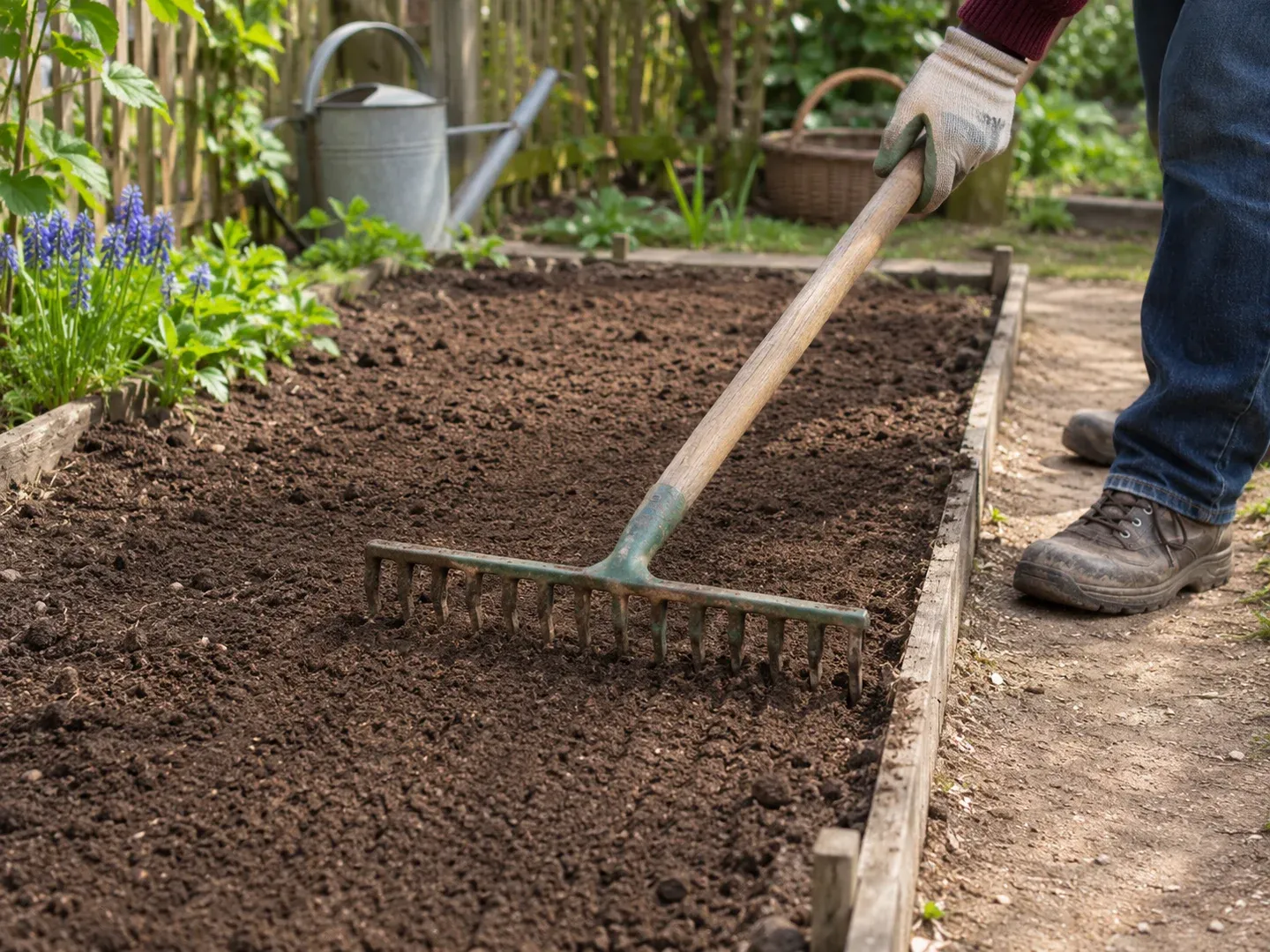
Before taking out the seeds, observe the intended location and check your local weather forecast. Is the soil still frozen? Does water remain on the surface after rain? Can you reach the bed from a path? These observations help decide the next step, without setting a uniform date for all gardens.
Do not work soil that is frozen or very wet: this precaution appears in the RHS soil preparation advice. On a waterlogged area, stay off the bed until it becomes workable again; trampling risks worsening compaction, as noted in the waterlogging fact sheet.
Once the ground is workable, limit preparation to the area you will use. If it needs loosening, do so without turning the soil over where possible, following Jardiner Autrement’s advice. While waiting, you can choose your varieties, prepare labels and identify existing crops.
Which sowings to consider in March?
These three crops offer a starting point for planning spring sowings. The table provides conditional possibilities: also check the packet instructions for your specific variety. Jardiner Autrement reminds us that plant selection and germination conditions must match the site and species.
| Crop | Spring reference | Decision to make |
|---|---|---|
| Broad bean | The SNHF indicates February-March outside the warm regions of the Midi and Southwest, where autumn sowing is recommended. | Choose a sunny location; broad beans prefer moist and deep soil. Do not extend this reference to still frozen or waterlogged ground. |
| Garden pea | Outside Mediterranean regions, the SNHF suggests starting with round-seeded varieties, then switching to wrinkled-seeded varieties. | Check the seed type and your variety’s timing. For the Mediterranean climate, the fact sheet provides a different window, from November to February: March is therefore not a national recommendation. |
| Salad radishes | The SNHF places the first outdoor sowings from mid-March. | Select a variety suited to this slot and light, moist soil without large stones or compaction. Forcing radishes and winter radishes have different uses. |
To start, choose a small row you can easily monitor. Mark its beginning and end, keep the variety name and respect its sowing depth. A single depth does not suit all seeds: even among radishes, round and long forms are sown differently. Avoid concentrating too many seeds in one spot; the radish fact sheet emphasises this point.
After sowing, observe the row’s moisture. The SNHF advises maintaining slight moisture until broad bean seedlings emerge; radishes require light watering adapted to drying conditions. Rainfall and soil condition matter more than automatic daily watering. Find the initial steps in our guide to successful sowing.
Other crops to prepare, with their complete fact sheets
To expand your first trial, separate crops to sow or plant directly in the bed from seedlings to raise before planting out. Choose one suitable option for your garden: sowing and planting dates are not interchangeable.
- Spinach: The SNHF suggests March-April for spring sowing. Select a variety intended for this slot and moist, workable soil. Source
- Jersey-type shallot: March falls within the SEMAE’s February–April reference. The soil must drain freely; do not apply this planting window to all grey shallots. Source
- Headed cabbage, particularly smooth-leaved types: The SNHF describes a March-April sowing, followed by May-June transplanting for suitable types. Check the variety’s harvest season. Source
- Brussels sprouts: Sowing in March–April allows for an autumn harvest; this is a long-season crop that needs space reserved for it. SNHF
- Prepare sunflower seedlings for planting out after frost: Choose the height, location and a bright spot for the pots. Starting under cover is possible in spring, but March is not a national outdoor sowing date. Wait until the soil has warmed, the plants have been hardened off and the risk of frost has passed before planting out. RHS
Preparing tomatoes without rushing planting out
March can be a time to plan how you will raise your tomato plants. Before sowing, check where the pots will stay during growth: do you need to free up a bright space, and can you maintain the required heat? The SNHF describes growing in pots at 20°C; Jardiner Autrement links young tomato growth to heat and abundant light.
Do not choose a planting-out date based solely on the sowing date. Tomatoes are sensitive to cold, and the SNHF advises waiting until the risk of frost has passed. If you cannot accommodate young seedlings in good conditions, prepare your variety choices instead and consider buying plants at the appropriate time. You can advance this project without immediately starting a seed tray.
A March programme to adjust weekly
On a sheet or in your journal, distribute your projects among “possible now”, “to re-examine after rain or cold” and “to prepare indoors”. For each, note the missing condition: workable ground, an identified variety, available space or a growing area with enough light.
A useful note: “Row of radishes sown today, variety noted on the label; first shoots to observe.” Then add what you actually observe. This record describes your garden, without promising seedling emergence on a fixed date.
Should all seeds bought for spring be sown?
No. Compare each packet’s instructions with your current conditions and start with what you can sow or plant and look after. Choose a few suitable crops rather than sowing everything at once.
What to do if the garden remains too wet?
Postpone soil work and sowings in the affected area. Note where water persists and re-examine after rainfall. Preparing labels, choosing locations and taking seed inventory remain possible without stepping on the beds.
The steps in pictures
Treat a month as a plan to adapt
Before sowing in open ground
While you wait, you can still prepare labels and a planting plan. This decision process does not set any nationwide sowing dates.
Before sowing in open ground, first check that the soil is workable, then that the variety and local conditions are suitable. If a requirement is not met, postpone sowing and note what needs to change. You can still prepare labels and planting positions while you wait.
Sow tomatoes in warm conditions, then wait until the risk of frost has passed before planting them outdoors after hardening off.
Based on RHS, soil condition · Jardiner Autrement, site-adapted choices · SNHF, tomato frost sensitivity.
Sources and references
- Waterlogging and floodingRoyal Horticultural Society (RHS) Accessed on 15 October 2026.
- How to make a raised bedRHS Accessed on 15 October 2026.
- Broad beanFrench National Horticultural Society (SNHF), fact sheet by Jean-Marc Muller Accessed on 15 October 2026.
- Garden peaSNHF, fact sheet by Jean-Marc Muller Accessed on 15 October 2026.
- RadishSNHF, fact sheet by Jean-Daniel Arnaud Accessed on 15 October 2026.
- Starting a garden — ProphylaxisJardiner Autrement, a programme run by the SNHF Accessed on 15 October 2026.
- TomatoSNHF, fact sheet by Jean-Marc Muller Accessed on 15 October 2026.
- SpinachFrench National Horticultural Society Accessed on 17 October 2026.
- Growing shallots in the vegetable garden is very simple!SEMAE, September 2025 edition Accessed on 17 October 2026.
- Smooth-leaved headed cabbageFrench National Horticultural Society Accessed on 17 October 2026.
- Brussels sproutsFrench National Horticultural Society Accessed on 17 October 2026.
- How to grow Helianthus, sunflowersRoyal Horticultural Society, in English Accessed on 17 October 2026.