
The vegetable garden notebook / Crops
Sowing and Growing Sunflowers in the Garden
A sunflower is not always a giant plant. Choose its height and purpose before sowing, then plan a sunny spot where its growth will not surprise you.
Adapt this guidance to your garden’s climate and conditions.
Which sunflower should you choose?
This guide covers Helianthus annuus, an annual; perennial helianthus are managed differently. The RHS describes dwarf forms for containers and very tall varieties requiring sturdy support. Check the height and purpose on the seed packet. Iowa State distinguishes between uses for cut flowers and seeds: an ornamental variety is not automatically the best choice for harvesting large seeds.
Can you keep a sunflower in a pot?
For cultivation until flowering on a balcony, opt for a dwarf variety. Plant it in a perforated, stable container suited to its expected growth; height alone does not determine a diameter valid for all varieties. Keep it in a sunny, wind-sheltered spot. Shelter is especially important when starting seedlings. In containers, check moisture more frequently than in open ground and water when the potting compost appears dry. RHS
When to sow sunflowers?
For direct sowing, wait until the soil is warm and the risk of frost has passed. Starting in pots under cover is possible in spring; acclimatise young plants before transplanting outdoors. The dates in the British guide do not apply to all French gardens. RHS
How to succeed with sowing?
- Choose a sunny spot and remove competing weeds.
- Prepare a fine, crumbly seedbed. The RHS for school gardens recommends sowing at a depth of 2 cm; also check the instructions for your variety.
- Cover, water gently, and label. Allow the spacing indicated for the variety, without applying a single distance to both giants and dwarfs.
For containers and seedling care, refer to the sowing techniques. Young sunflowers are vulnerable to slugs and snails: inspect plants during establishment. RHS
Is a stake necessary, and do they need lots of water?
Provide support suited to tall varieties at planting, and tie loosely as the stem grows. A sheltered site limits wind damage. RHS
The soil must drain well. Monitor moisture during establishment and avoid severe water shortages during flowering and seed formation if you intend to harvest the seeds, advises Iowa State. This does not justify a fixed number of litres per day.
Mulching and feeding annual sunflowers
After planting, mulching helps retain moisture; keep the base of the stem clear. To encourage flowering in annuals, the RHS suggests a potassium-rich fertiliser, such as tomato feed, following the product’s dosage and frequency instructions. Consider the substrate’s existing fertilisation before adding more. RHS
Leaves eaten, white powder, or wilting stem: what to check?
If seedlings are nibbled, look for slugs and snails at the base and on leaves, especially in the evening, before concluding it is due to insufficient watering. Protect young plants during establishment. RHS
On larger plants, powdery white patches may indicate powdery mildew. Photograph both sides of the leaves and monitor their spread. Rapid wilting with a soft, damp stem at the base warrants attention: the RHS lists sclerotinia among the risks for sunflowers. Wilting alone does not identify this fungus. Also check soil moisture and possible stem breakage before any treatment. RHS, powdery mildews · RHS, sclerotinia
Flowers and seeds: should you cut the flower heads?
If the plant has not yet flowered, compare its stage to the cycle indicated on the packet, then check sunlight, water, and vigour. RHS · Iowa
To obtain seeds, keep the flower heads after blooming. INRAE notes that fertile flowers are at the centre and produce seeds after fertilisation; insects contribute to pollination. Allow them access to the flowers. If seeds remain empty, also revisit the variety choice, maturity stage, and formation conditions: the flower head’s diameter alone does not identify the cause. INRAE · Iowa
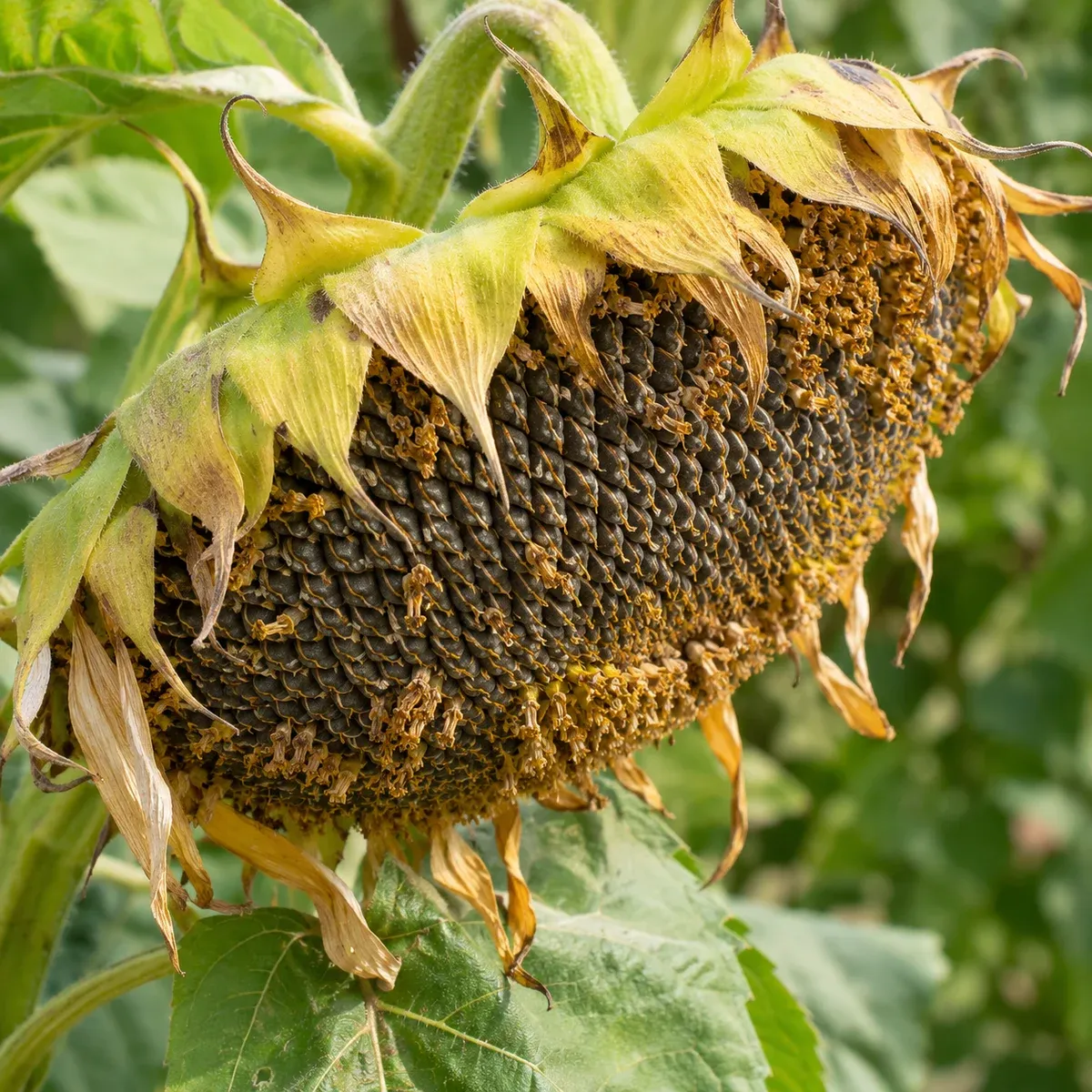
When to harvest the seeds?
Iowa State identifies several signs: the flower head tilts, petals fade, the back turns lemon yellow, and seeds are well-filled. Examine a few before cutting. Then dry the flower head in a dry, ventilated place. To collect the seeds, the RHS describes gently rubbing the dry flower head over a sheet of paper: seeds detach without needing to remove the entire centre. Remove floral debris and separate well-filled seeds from empty husks noted during maturity checks. For seeds intended for sowing, place dry seeds in an envelope or paper bag, in a cool, dry, dark place, with the plant’s name and year. RHS, Iowa
For drying precautions, labelling, and keeping seed true to type, continue with the seed harvesting and storage guide.
What happens to the plant in autumn?
The annual sunflower naturally completes its cycle in autumn: the plant will not regrow like a perennial. You may leave stable stems for birds, then remove them as they degrade. The next season begins with a new sowing. RHS
Organising neighbours and keeping records
First, note the purpose of each flower head: leave it for birds, harvest its seeds, or prepare a batch for future sowing. The first choice keeps the head on a stable plant; the other two require checking maturity and drying before storage. Label batches at cutting to avoid mixing different origins. RHS, Iowa
For the next sowing, record the actual height and space occupied in your vegetable garden plan. A harvested seed does not guarantee that the next plant will reproduce all the qualities of a hybrid variety: check the limits of saving seed true to type in the seed guide. Iowa, seeds
Key points for this crop
Practical guidance
- Plant discussed
- Annual sunflower, Helianthus annuus
- Exposure
- Full sun and location sheltered from wind
- Outdoor sowing
- In spring, once soil is warmed and risk of frost has passed
- Space
- According to the height and spread of the variety
Sources and references
- How to grow Helianthus (sunflowers)Royal Horticultural Society, in English Accessed on 17 October 2026.
- Growing sunflowers at schoolRoyal Horticultural Society, in English Accessed on 17 October 2026.
- Growing Sunflowers and Their VarietiesIowa State University Extension and Outreach, in English Accessed on 17 October 2026.
- The sunflower (Helianthus annuus)INRAE, Ephytia Accessed on 18 October 2026.
- Powdery mildewsRoyal Horticultural Society, in English Accessed on 18 October 2026.
- Sclerotinia diseaseRoyal Horticultural Society, in English Accessed on 18 October 2026.
- How to Harvest and Store SeedsIowa State University Extension and Outreach, in English Accessed on 8 November 2026.